

When viewing PRC activities through an ‘allfare’ lens, the polar regions present exposed flanks due to the tyranny of distance and extreme, unpredictable conditions.
The People’s Republic of China’s (PRC) activities in the polar regions overwhelm current monitoring bodies, providing China a “carte blanche” to set conditions for future operations in these areas. China’s pursuits create risk for allies and partners because they lack a unifying organization to monitor and mitigate the totality of PRC initiatives. This Chinese “allfare” includes exploitation of tourism; illegal, unreported, and unregulated fishing; and other illicit activities, such as human trafficking. It includes achieving positional advantage through targeted regions in Antarctica and a disregard for sovereignty (for example, balloon incursions in 2023, and other PRC incursions into Alaskan waters). Against increased Chinese (and Russian) access to the polar regions via new icebreakers, the current monitoring and response efforts of the United States, its Arctic allies, and parties to the Antarctic Treaty System (ATS) fall short. These conditions establish the need to create a Combined, Joint, Interagency Task Force Polar Regions (CJIATF-PR).
When viewing PRC activities through an “allfare” lens, the polar regions present exposed flanks due to the tyranny of distance and extreme, unpredictable conditions. Allfare is a concept which excludes no option—legal, illegal, or irregular –for those who practice it to gain advantage and weaken their adversaries. The irregularity of allfare consists of standard special operations mission sets, but also innovative mission sets born in the minds of PRC operators. In China’s case, it will do whatever it can to destabilize the West. Several examples below demonstrate the PRC’s active positioning to exploit regional resources with utter disregard for international norms. China employs dual-use entities to facilitate placement and access for its illicit activities, and it uses proxies to provide the Chinese Communist Party (CCP) with separation from illicit activities.
A CJIATF-PR would entail establishing a properly designated organization with the appropriate authorities to monitor for and respond to adversarial activity in the polar regions. Additional entities made up of allies and partners, joined with this United States task force, would create a whole-of-government, combined approach. Such a task force would need both interagency and non-governmental partners, to include actors from the commercial sector, given its need to counter the PRC’s public-private allfare strategies.
A useful comparison for the potential effectiveness of a CJIATF-PR is found in the success of the Joint Interagency Task Force – South (JIATF-S), in countering transnational criminal organizations (TCOs). In 1989, responding to the TCO threat, the United States created Joint Task Force–4, which led to the creation of JIATF-South. This Key West-based task force leverages capabilities from the Department of War (DoW) for Title 10 detection and monitoring of illicit trafficking. This involves leveraging DoW capabilities under traditional operating authorities to locate and track vessels of interest for handoff to law enforcement. It also is able to use law enforcement, allied, and partner capabilities to counter illicit traffic on the high seas or in the air. Through multi-district U.S. Coast Guard coordination that includes allies and partners, JIATF-S coordinates the transfer of tactical control to law enforcement to interdict drug traffickers.
With the growing number and scope of incursions into polar waters, airspace, and communities, the United States and like-minded states need to combine their intelligence and oversight capabilities. Since these activities occur in low visibility areas across the scope of the diplomatic, informational, military, and economic domains, an increased need exists for cooperative monitoring by an entity that has visibility of such activities and the authorities to respond to them. Enter the Combined Joint Interagency Task Force–Polar Regions. If properly designed, resourced, and authorized, a CJIATF-PR could monitor the PRC’s (or other’s) allfare activities in the polar regions and be ready to counter them.
The RAND Corporation reports that Chinese civil-military fusion law specifically provides for all civilian research activities to have military application or utility for China. During a lecture at the U.S. Army War College in July 2025, experts revealed that the PRC purposefully built an icebreaking cruise ship for Chinese “tourism.” However, this vessel conveys military-aged males who, instead of seeing wildlife, visit Chinese research stations, possibly delivering dual-use technology to them, free of oversight. Though the ATS’s terms mandate inspection processes for Antarctic research stations, no PRC station has been inspected since 2020. Although these inspections are rare and logistically challenging, increasing infrastructure and equipment at both poles warrants extra scrutiny.
The ATS exists for transparency in research, in an effort to prevent the militarization of Antarctica and to preserve it “for peaceful purposes for all mankind.” The treaty, however, provides for alterations in 2048, which could give the most prepared countries an opportunity to exploit Antarctica’s vast and increasingly accessible resources. So far, the PRC has created an exploitable situation with cheap and ready shipbuilding coupled with a booming tourism industry. Both are operating at a capacity and ability to outproduce and outcompete the United States through sheer numbers and volume.
While speculation exists as to the PRC’s intentions for its five Antarctica stations, unless inspections resume in earnest, those intentions may remain hidden.
While speculation exists as to the PRC’s intentions for its five Antarctica stations, unless inspections resume in earnest, those intentions may remain hidden. And even if revealed intentionally, it may be too late for the United States and its allies and partners to respond. While weaponizing Antarctica would be a stark violation of the ATS, the PRC continuously looks for opportunities to exploit existing legal frameworks to its advantage.
If the PRC is preparing for future resource exploitation opportunities, by prepositioning excavating equipment, it is already opening its lead and increasing its multiple points of advantage.
In the Arctic, the PRC continues to increase its access and multi-domain ambitions of access and capability to operate with impunity. While Russia also exploits the region, Russia has always been an Arctic nation and it holds its Arctic identity as vital to its national interests. The PRC, however, has no recognized geographical claim to the Arctic. It claims to be polar adjacent, and has only recently pressed to exploit its Arctic access. One of the PRC’s most insidious and frequently unchallengeable activities involves its large overseas fishing fleets. These number in the tens of thousands of vessels by some accounts, and they overfish in other nations’ fisheries. Without concern for quotas or prohibitions to protect species (such as those around the Galapagos Islands or in areas of the South Pacific), it may only be a matter of time before the PRC looks to exploit Arctic fisheries and continue similar action in the Southern Ocean. This illegal, unreported, and unregulated fishing also entails “dual-use” activity: pervasive Chinese fishing fleets report the movements of U.S. and other friendly naval and other vessels and their activities. As an extension of the People’s Liberation Army Navy, these vessels act not only in the interests of PRC businesses, but also at the bidding of the Chinese Communist Party, providing it with intelligence and possible platforms for irregular warfare.
A proposed CJIATF-PR would need to include whole-of-government, whole-of-nation support, and intergovernmental mechanisms. The PRC’s allfare campaign demands a need for the DoW, the intelligence community, law enforcement, and even the National Oceanographic and Atmospheric Administration’s involvement to counter it. Natural resource monitoring agencies, academia, non-governmental organizations, and industry should also be involved in this effort. Each member of a CJIATF-PR would need to provide access to the totality of its nation’s intelligence and law enforcement systems and agencies, while recognizing classification concerns. This is an area in which the JIATF-S model works well, based on the historical information-sharing its members do. With proper resourcing, the right authorities, robust information sharing, and effective oversight, a CJIATF-PR presents the best opportunity to properly detect, monitor, and respond to the PRC’s actions in the polar regions, when they threaten international laws and norms, or put U.S., allied, or partner interests at risk.
Michael Margolius is a commander in the U.S. Navy and a faculty instructor in the Department of Distance Education at the U.S. Army War College where he graduated in June of 2024. Previously, he served as the J3 Operations Branch Chief, Joint Personnel Recovery Agency where he oversaw JPRA support to active PR cases, the Non-Conventional Assisted Recovery Program, the DoD Blood Chit Program, engaged with the Inter-Agency as well as allies on operational support matters. He also coordinated the Post Isolation Support Activities for a Canadian Citizen held hostage in Africa, and was the Agency COVID-19 Task Force Commander. He is a graduate of the AY24 Resident Course and the Carlisle Scholars Program at the U.S. Army War College.
Travis Pantaleo is a commander in the U.S. Navy and a faculty instructor in the Department of Distance Education at the U.S. Army War College. Before joining the Army War College, he served as Deputy Director, Commander’s Action Group for Allied Joint Force Command Naples, and military aide to the Assistant Chief of Staff for Operations. His previous research includes advancing security interests by addressing illegal, unreported, and unregulated fishing in the Arctic Ocean as a national security issue.
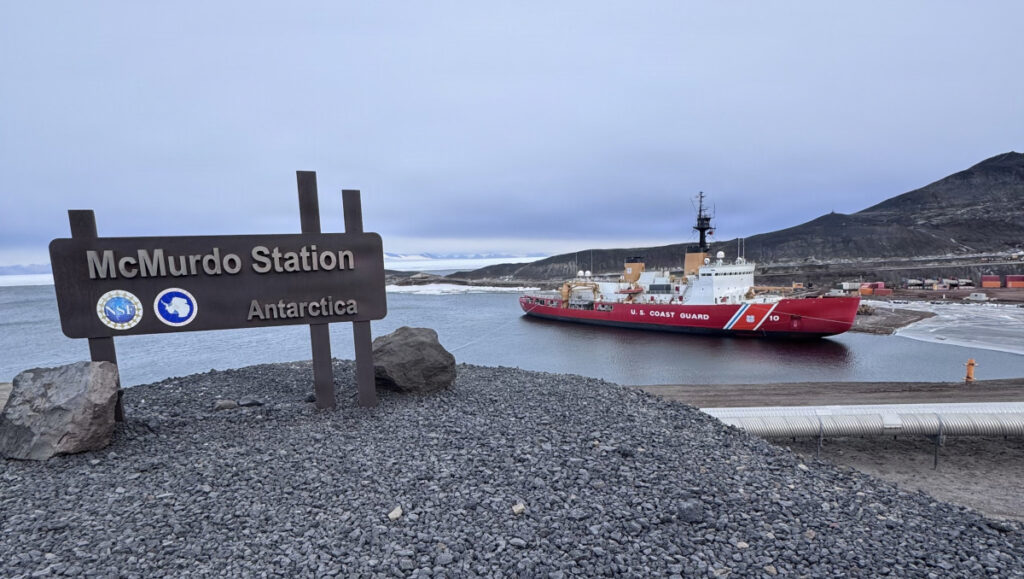
Photo Description: USCGC Polar Star (WAGB 10) sits moored at McMurdo Station Antarctica amid Operation Deep Freeze 2026, Feb. 2, 2026. Operation Deep Freeze is one of the more challenging U.S. military peacetime missions due to the harsh environment in which it is conducted, and this year also commemorates the Polar Star’s 50th year of service.
Photo Credit: U.S. Coast Guard photo by Petty Officer 2nd Class Christopher Bokum