

The War College’s mission has always been to prepare senior leaders for the world as it is: messy, ambiguous, and contested.
The U.S. Army War College (USAWC) exists to educate leaders who will serve at the intersection of policy, strategy, and military operations—an intersection defined less by clarity than by uncertainty. Our students arrive with nearly two decades of operational experience, and shaped by deployments, command experience, and broadening assignments. What they encounter in Carlisle often contrasts sharply with what they have seen before; here they face problems without clean solutions, choices defined by tradeoffs, and decisions constrained as much by politics and institutions as by force structure or doctrine.
This is by design. The War College’s mission has always been to prepare senior leaders for the world as it is: messy, ambiguous, and contested. From its founding, Elihu Root established this institution “not to promote war, but to preserve peace,” envisioning it as a place where the Army’s best officers would “study and confer upon the great problems of national defense, of military science, and of responsible command.” That vision remains especially relevant today, as strategic competition, technological change, and multi-domain conflict place a premium on judgement rather than certainty.
Yet alongside this mission sits a quiet anxiety familiar to many faculty members: the sense that we ought to be subject-matter experts on every topic we teach. Even the best and brightest among us have taught a lesson or two that brought up feelings of imposter syndrome. Given the breadth of the War College curriculum—from theories of war and national security policy to strategic competition, joint warfighting, and building defense forces—this expectation is both unrealistic and unnecessary. In fact, embracing that discomfort is part of what makes strategic education effective.
Given our mission and the challenges our graduates will face, what the War College does best is prepare leaders for uncertainty by modeling how to think, not what to think. Faculty play a central role in this process, not by providing all the answers, but by enabling learning through structured dialogue, probing questions, practical exercises, and leveraging the collective wisdom of the professionally diverse faculty and student body.
The Purpose of USAWC: Preparing Leaders for Strategic Responsibility
The operating environment facing today’s senior leaders is among the most complex and dynamic in modern history. Great-power competition has returned, as technological change accelerates, and crises increasingly unfold across operational domains and instruments of national power. Most War College students are at a point in their careers where they possess deep tactical and operational expertise but limited exposure to the political, strategic, and bureaucratic dimensions of national security decision-making. The War College exists to help leaders cross that intellectual threshold.
This transition is necessary, as our graduates will serve as strategic advisors who must integrate military power in support of broader national objectives, advise civilian leaders, orchestrate theater campaigns, and make sense of problems that lack clear solutions. To prepare them for this responsibility, the curriculum emphasizes joint, interagency, and multinational perspectives; introduces them to strategic theory; and equips them with a bevy of intellectual frameworks to advance their “mastery of strategic thinking.” Just as importantly, it cultivates intellectual humility and acceptance of ambiguity, qualities essential for future leaders whose decisions will carry national and global consequences.
The USAWC Approach: A Model Built for Complexity
Over decades, War College faculty have designed a learning model to help students navigate ambiguity, uncertainty, and the tradeoffs inherent to strategic thinking. It achieves these objectives through several reinforcing elements:
A Joint and Interagency Faculty
The War College relies on a seminar learning model facilitated by faculty teams who possess a breadth of operational, joint, interagency, and academic experience that no one individual could match. Our military faculty come from every service; nearly all have operational or command experience, and many have advanced academic degrees. Our civilian faculty are academic experts who come from leading universities around the country or practitioners from their respective government departments (e.g., the State Department or intelligence agencies). This combination of practitioner, practitioner-scholar, and pure academic allows the institution to leverage collective competence rather than individual omniscience. As lesson authors, individual subject matter experts design lessons, curate readings, and prepare the broader faculty to facilitate learning across unfamiliar topics. Professional trust and collegiality form the “secret sauce” that makes this model work.
A Curriculum Tailored to Strategic-Level Problems
Faculty instructors do not pretend that uncertainty can be eliminated. Instead, we teach students how to operate effectively despite uncertainty. Strategic theory explores how power, interests, and competition interact. National security decision-making highlights political, bureaucratic, and institutional constraints. Theater strategy and campaigning emphasize integration and prioritization. Courses on emerging technologies, civil-military relations, and the global security environment expand students’ strategic aperture. Across the curriculum, the goal is not to converge on “right answers,” but to develop mental models that help students understand strategic guidance, navigate ambiguity, balance ends, ways, and means, and communicate risk to senior decision-makers.
Seminar Learning as the Core
The seminar’s power lies in its professional diversity and collective expertise. A typical seminar includes decades of ground combat experience, maritime and air expertise, interagency and multinational perspectives, as well as operational and command experience across multiple specialties and domains. By drawing out experience, challenging assumptions, and connecting theory to real-world application, faculty transform the seminar into a laboratory for strategic thinking—one that closely mirrors the joint environments graduates will soon inhabit.
Dealing with Uncertainty: A Faculty Guide
Given the broad range of topics, no single faculty member can be an expert in everything they cover over the course of a year. As a result, faculty sometimes express discomfort about leading discussions on topics outside their personal experience. However, that discomfort is not a liability; it is a feature of strategic education.
Demonstrating how to ask better questions is often more valuable than supplying answers.
Model Intellectual Humility
Strategic leaders routinely advise on issues where information is incomplete, contradictory, or rapidly evolving. Faculty model this reality by preparing thoroughly, acknowledging gaps, and guiding inquiry rather than dictating conclusions. Demonstrating how to ask better questions is often more valuable than supplying answers.
Leverage Collective Intelligence
Seminars are intentionally professionally diverse because the War College recognizes that no single viewpoint is sufficient for understanding complex problems. Faculty can invite students to compare operational experiences and perspectives, articulate how their service or functional background and assumptions shape their thinking, and test ideas against theoretical frameworks. This approach transforms the seminar into a space for synthesis rather than assertion.
Use Socratic and Probing Questions
The Socratic Method is central to the War College’s pedagogy. Effective questioning helps students clarify the underlying logic of their arguments, challenge each other’s assumptions, and refine their understanding. Good questions include:
- “What assumptions are you making?”
- “How would this recommendation play in the interagency? With allies and partners?”
- “What risks and tradeoffs are you accepting, and why?”
Promote Perspective and Historical Mindedness
Strategic leaders must see problems through multiple lenses. Faculty cultivate this by encouraging comparisons across eras, theaters, and historical cases, introducing alternative interpretations of events, and asking how different stakeholders might view the same problem. This last area is one where the International Fellows prove particularly invaluable as they help U.S. officers better see themselves and appreciate how others see U.S. actions. Developing an appreciation for the power of perspective taking and the value of historical mindedness enables students to “ask better questions and have more informed discussions.” As Lawrence Freedman notes, “Strategy is the art of creating power,” and that art is expressed not in clarity, but in the ability to operate effectively amid ambiguity.
Practice Active Learning
Exercises, war games, case studies, and other “hands-on” experiences allow students to apply theory to practice. This application level of Bloom’s taxonomy helps future practitioners develop skills they will use in building defense forces, campaigning, and dialoguing with civilian leadership about national policies under real-world constraints. Faculty can act as a “guide on the side” to emphasize essential points that the students should consider or capture in their application of material and concepts.
Place Experts in Front of Students
While no single faculty member can be entirely adept in every area of the entire curriculum, each has subject-matter expertise worth sharing. We do this through both introductory lectures by subject matter experts that baseline student and faculty knowledge before seminar, and through “noontime lectures” that allow students to go deeper with subject matter experts in a field following a seminar discussion. This routine of placing experts in front of students in a plenary setting benefits the entire War College.
Why This Matters: Educating for the Real World, Not the Ideal One
The Army War College’s strength lies in its ability to help officers transition from tactical excellence to sound strategic judgment. The transition requires comfort with uncertainty, the ability to integrate multiple perspectives, and the discipline to ask the right questions before making consequential decisions.
Faculty play a central role in cultivating these skills, not by lecturing or delivering encyclopedic knowledge, but by guiding intellectual discovery.
In an era where emerging technologies, geopolitical shifts, and contested domains redefine the character of war, uncertainty is not a temporary condition. It is the operating environment.
What the War College ultimately teaches is not doctrine, not planning templates, not even strategy in the abstract. It teaches how to think, decide, and lead when the stakes are high and the path forward is unclear. In this way, the War College fulfills Root’s original vision—not by producing experts in everything, but by cultivating leaders who can think strategically amid uncertainty.
That is not only the essence of strategic education, but the essence of strategic leadership.
Chase Metcalf is a colonel, an Army strategist and an instructor at the U.S. Army War College. He most recently served as Deputy Director of the Russia Strategic Initiative at the United States’ European Command. He was a U.S. Army War College Fellow with Yale University in 2019-2020. He is an instructor in the USAWC Joint Warfighting Program.
Michael Posey is an active-duty U.S. Naval Flight Officer with a subspecialty in Information Systems and Operations. He currently serves as an Assistant Professor in the Department of Military Strategy, Planning, and Operations at the U.S. Army War College in Carlisle, PA.
The views expressed in this article are those of the authors and do not necessarily reflect those of the U.S. Army War College, the U.S. Army, or the Department of War.
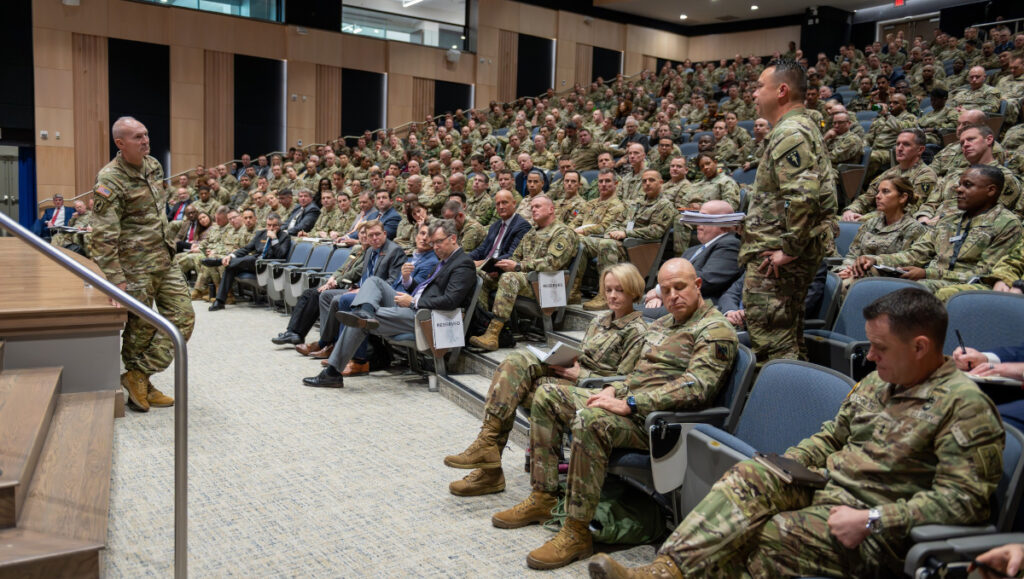
Photo Description: Former Chief of Staff of the Army, General Randy George addresses the Academic Year 2026 Resident class in Bliss Hall at the U.S. Army War College.
Photo Credit: Courtesy of the U.S. Army War College