

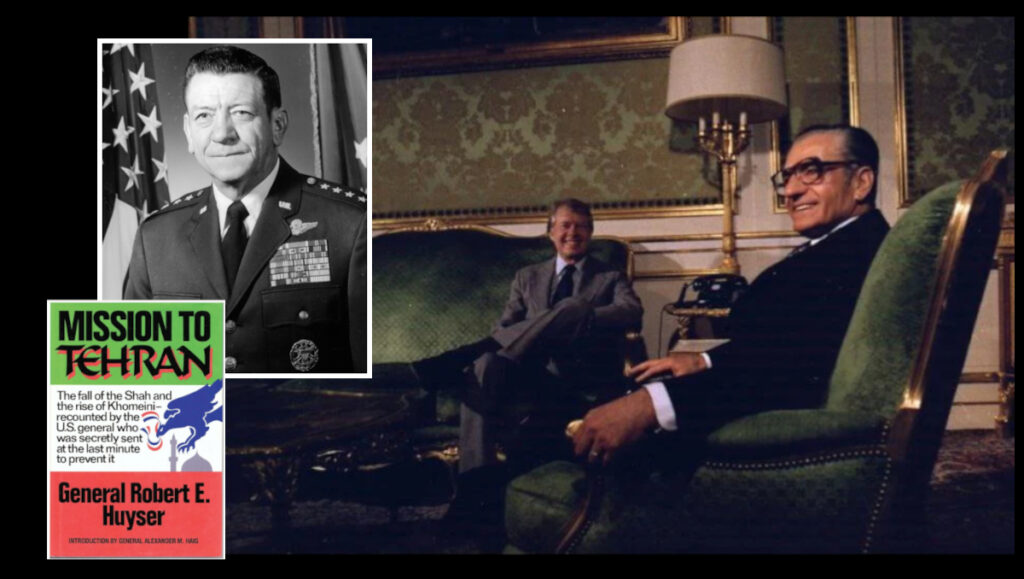
Although Huyser’s mission occurred during the Cold War, the book serves as an important case study of military diplomacy for policymakers, military leaders and diplomats—especially its limitations.
During the presidencies of Richard Nixon and Gerald Ford (1969-77), the United States relied on Iran and Saudi Arabia to bring stability to the Persian Gulf region, a strategy, known as the “Twin Pillars policy,” designed to ensure the continual flow of oil and prevent Soviet incursions into the region—vital U.S. interests. In actuality, Iran, under the leadership of the Shah of Iran, Mohammad Reza Pahlavi, was more willing to play a security role and consequently, the United States authorized billions of dollars of arms sales to meet the shah’s quest for regional primacy. In December 1977, President Jimmy Carter (1977-81), who largely continued his predecessors’ policy, stated: “Iran, because of the great leadership of the Shah, is an island of stability in one of the more troubled areas of the world.” A year later, the monarchy verged on collapse, the economy was in shambles as an opposition movement used strikes and work stoppages to control the major sectors, and the anti-shah cleric Ayatollah Ruhollah Khomeini, exiled in Paris, led a religious revival fomenting dissent with riots and anti-government demonstrations. Only the military kept the shah in power. Because of the divided counsel among Carter’s advisors as to what steps his administration should take to sustain U.S. interests, the president decided he would send a senior military officer to Iran as his emissary to convey Carter’s “concerns and reassurances,” determine if the administration could rely on Iran’s military leaders to stabilize the country by remaining at their posts and support a “responsible civilian government,” and maintain pro-U.S. relations. The preference was for appointing a four-star general the Iranian officers trusted; one who could advise these officers accordingly.
On January 3, 1979, the president directed U.S. Air Force General Robert Huyser undertake the envoy assignment. Huyser, deputy commander in chief (DCINC) of the U.S. European Command (EUCOM), the combatant command then responsible for the Middle East, oversaw foreign military sales and military assistance programs. Consequently, he had close relations with the Iranian armed forces’ leaders and a personal relationship with the shah. His task, often treated as a footnote, is an important part of the larger story of the Carter administration and the Iranian Revolution that led to the dissolution of the Pahlavi regime and the formation of the Islamic Republic in April 1979. Furthermore, Huyser’s actions were the subject of considerable controversy and frequently misreported. It is for this reason that he wrote Mission to Tehran, published in 1986, after he retired.
Although Huyser’s mission occurred during the Cold War, the book serves as an important case study of military diplomacy for policymakers, military leaders and diplomats—especially its limitations. But it is ultimately a story of failure, a fact that Huyser acknowledged publicly in June 1981 when he testified before a subcommittee of the House Foreign Affairs Committee about the assignment. His book provides substantial evidence for why.
The text, a day-by-day account, consists of an introduction by General Alexander Haig, Huyser’s superior as CINCEUCOM, a prelude that outlines events before his arrival in Tehran, three parts that cover his mission, and an epilogue. Huyser would spend 31 futile days, from January 4 to February 3, in Tehran until his personal safety was in jeopardy as anti-American sentiment reached a fever pitch after Khomeini’a return to Iran on February 1. His account details three critical factors that together contributed to mission failure: the shah’s organizational pathologies, the Carter administration’s dysfunctional national security decision-making process, and Huyser’s under preparation for his envoy role.
The shah’s organizational pathologies.
The August 1953 coup d’état of Iranian Prime Minister Mohammed Mossadegh, which the Central Intelligence Agency and the British intelligence service orchestrated after the shah had fled the country for several days because of his failure to dismiss the popular premier, taught the young monarch the value of consolidating power. He also recognized that the military was the most powerful institution for maintaining power, so he devised a centralized system that squelched individual initiative and promoted internal rivalries. He would always meet with his senior officers separately, never jointly. As a result, he ensured that his four most senior army and air force generals and an admiral (Huyser called them “the Group of Five”) could not act collectively. Their sole purpose was to follow his orders obediently. They remained loyal but so dependent on him that they could not conceive of what they would do if he ever left Iran. The U.S. Defense Department unwisely abetted this condition when in 1978 Huyser designed, at the shah’s request, a “command control system” to ensure the shah’s “absolute control.” As Huyser told the U.S. military officers assisting him with the task, previously, “the Shah had managed the armed forces singlehandedly, carrying all his doctrine in his head. He preferred to operate in this way, as insurance against a military coup.”
As a result, the senior officers lacked effective senior leader competencies, such as conceptual thinking, and behaviors like resilience, optimism, adaptability, and timely decision making. During a crisis, when teamwork mattered, these five officers were unable to act cooperatively and possessed defeatist attitudes. Ultimately, they counted on Huyser to direct their actions; he became a surrogate monarch because the shah, who left Iran on January 16, allegedly for a “holiday,” told these officers that they should trust and obey Huyser. Thus, Huyser essentially assumed command to make any progress to achieve his mission, contrary to his guidance that he was to advise only. As an example, the group was so incapable of operational planning for dealing with the massive anti-shah street demonstrations, the return of Ayatollah Khomeini’s return from exile to Iran, and how they should stage a coup, if necessary to bring stability, that Huyser had the U.S. Military Assistance Advisory Group (MAAG) staff help draw up the plans for crucial government functions such as customs, the economy, public order, and strategic communications so these officers could carry them out. Unfortunately, the Iranian military officers never executed the plans for fear of having to take responsibility.
Carter administration’s dysfunctional decision-making process.
Presidents need effective advisory systems to help them in formulating and executing policy. Carter’s advisory system has been the subject of considerable criticism for its ineptitude and internal conflicts. Huyser had to insist on written guidance for his complex mission of preserving U.S. interests in Iran—a phone call from the deputy secretary of defense was entirely inadequate as his mission consisted of two challenging parts. First, he was to convince the Group of Five to remain in Iran if the shah decided to leave, which was contrary to their expressed intention. If the shah left, their role was to assist a caretaker government under the shah-appointed Prime Minister Shapour Bakhtiar to stabilize the country. If stability was unattainable, then Huyser believed that the only alternative was to stage a coup to achieve that aim. However, when Huyser arrived in Tehran, Secretary of State Cyrus Vance informed Huyser not to meet with the officers until given authorization from Washington. Huyser thought it “was not a good omen” as it indicated a lack of “unity of effort in Washington.” Obviously, State Department had one view of the situation and the White House had another. He also learned that the U.S. ambassador, William Sullivan, disagreed with Huyser’s mission and was offering the State Department advice contrary to Huyser’s direction. Sullivan believed the military would disintegrate when Khomeini returned since the army would not shoot their fellow citizens. Instead, Sullivan pressed for support of a coalition government consisting of religious and secular moderates and the military leaders.
Huyser eventually became the preferred source in Washington because his views were consistent with those of Carter’s national security advisor Zbigniew Brzezinski, who was trying to influence Carter’s decisions urging a military coup.
Additionally, Washington established two lines of communication with Tehran, which further hampered unity of effort. Sullivan reported to Vance, and Huyser reported daily to Secretary of Defense Harold Brown or his designated representative if he was unavailable, and “received guidance almost daily.” Huyser eventually became the preferred source in Washington because his views were consistent with those of Carter’s national security advisor Zbigniew Brzezinski, who was trying to influence Carter’s decisions urging a military coup. To compound these problems, in the midst of the deteriorating situation, astonishingly the Defense Department dispatched a senior official to negotiate new terms for arms sales.
Inadequate intelligence preparation of the operational environment.
Huyser was wholly dependent on the “Group of Five” for information about Iranian military readiness and morale. Further, as he admitted, he was not an expert on Iran and its culture and did not speak Farsi, so he relied entirely on what these officers told him about events. The U.S. government did not help Huyser overcome these deficits either. The country team did not brief him on his arrival. He received no intelligence briefings before his hurried departure to Tehran because Iran was a low priority. The intelligence community paid no attention to the rise of the religious movement and leaders that would form the Islamic Republic until November 1978. Once Huyser arrived in Tehran, the CIA station provided no intelligence. The agency principally focused on surveilling Soviet Union missile testing from northern Iran. It banked on the shah’s security service, the Sâzemân-e Ettelâ’ât va Amniat-e Kešvar (SAVAK), for domestic counterintelligence. What reporting the station provided to Washington was overly positive.
The MAAG failed to furnish him other sources of information. Huyser had no contact with senior officers outside of Tehran where military discipline was fraying. The field grade officers in the MAAG had a realistic picture of an elite-led military of conscripts. Yet, their insights were unknown to him. He was uninformed about how anti-monarchial elements had influenced the university-educated junior officers to be less “reliable,” and more crucially, how the proprietary attitude of the Iranian air force technicians (homofaran, similar to warrant officers) affected their anti-U.S. posture when they believed the United States was going to remove U.S.-sold equipment from their country. Their subsequent anti-shah demonstration on February 9 at an air force base accelerated the military’s disintegration.
Ultimately, Khomeini’s sophisticated propaganda campaign against the shah and elites, his well-organized followers, the unreliability of the military, and the administration’s ineffectual late response to the crisis meant that Huyser’s chance of mission success was nearly nonexistent. Yet, the administration remained too blinkered to see the situation had been “one chance out of a million.” On February 11, 1979, as gunfire echoed throughout the city, the Bakhtiar government caved and the military fell apart when General Abbas Gharabaghi, the chief of staff of the armed forces, declared that the armed forces were “neutral” in the political contest. The U.S. chairman of the Joint Chiefs of Staff subsequently asked Huyser if he was willing to return to Tehran and lead a military coup. Recognizing its infeasibility, Huyser laid down conditions to test their earnestness: 10,000 troops and an unlimited budget. Administration officials balked. They sheathed the military instrument—neither military diplomacy nor force would change the state of affairs for now. General Alexander Haig points out in the book’s introduction that he opposed Huyser’s poorly conceived mission because it was “preeminently a political and not a military task.” This is a valid point, but in this instance, the United States had for years prioritized the military-to-military relationship over the diplomatic and intelligence instruments. Carter’s gamble was intended to correct this strategic blind spot. Its failure, however, ultimately lay with his advisors’ ignorance of a military culture that they wrongly believed that one U.S. general officer could change in a matter of days with scarce assistance. Huyser’s book is a worthwhile reminder to all Americans as to why U.S. involvement in the 1979 Iranian Revolution remains resonant, while also offering national security professionals constructive lessons in the conduct of military diplomacy.
Frank Jones is a Distinguished Fellow of the U.S. Army War College where he taught in the Department of National Security and Strategy. Previously, he had retired from the Office of the Secretary of Defense as a senior executive. He is the author or editor of four books and numerous articles on U.S. national security.
The views expressed in this article are those of the author and do not necessarily reflect those of the U.S. Army War College, the U.S. Army, or the Department of Defense.
Photo Description: Left: Portrait photograph of General Robert E. Huyser as Deputy Commander in Chief, U.S. European Command, taken between 1975 and 1979. Right: President Jimmy Carter and the Shah of Iran, 31 Dec 1977.
Photo Credit: Left: Charles L. Prichard, U.S. European Command; Right: White House Staff Photographers 1977-1981