

The Army needs to restore its preventive medicine capabilities to be prepared for possible large scale combat operations.
Preventive medicine has long been a cornerstone of military readiness, though its value tends to be overlooked during quieter stretches, such as periods of stability or low-intensity conflict where the stakes feel manageable. At its core, preventive medicine keeps forces healthy and mission-capable through disease surveillance, epidemiological investigations, hazard assessment, outbreak prevention, and managing the environmental and occupational risks that come with military life. Over the past twenty years, the army’s preventive medicine enterprise has largely been shaped by the demands of counterinsurgency operations and garrison-based health protection. Those environments intrinsically support success due to stable infrastructure, predictable troop positioning, strong logistics, contractor-managed food, sanitation and water, and dependable medical evacuation. Preventive medicine worked well under those conditions, but it also became centralized, reactive, and, over time, too dependent on a largely passive operating environment. The army needs to restore its preventive medicine capabilities to be prepared for possible large scale combat operations.
Two former directors of the U.S. Army’s School of Advanced Military Studies argue that preparation for future war dictates a conceptual and experimental approach that favors an all-inclusive perspective into combined arms that remains free of both branch and service bias. They identify that the Ukrainian war illustrates self-destructive vulnerabilities within the Russian military that disqualify them as a pacing threat, urging that the United States must turn its conceptual focus to challenges from the Chinese in the Pacific theatre of operations. Considering this prediction, the U.S. Army must also restore its preventive medicine capabilities to be prepared for large-scale combat operations during future conflicts.
In alignment with ongoing strategic planning for future war, army medicine must prioritize unbiased adaptation that is both conceptual and experimental versus strict reliance on conventional doctrine. Currently, it supports the service’s four focus areas: warfighting; delivering ready combat formations; continuous transformation; and strengthening the profession. Preventive medicine must nest itself first within the umbrella of army medicine’s strategic plan, and then within the overarching strategy of the United States military. This means transforming a strong, grounded understanding of its own historical context into a relevant and conceptual practice that addresses current and future threats. The stable conditions that define counterinsurgency, like secure bases, predictable logistics, and dependable communications, give way to something far more chaotic such as massed troop formations, long stretches in the field, degraded sanitation, contested supply lines, limited evacuation routes, and constant strain on infrastructure and communications networks. Historically, in large-scale combat operations, disease and non-battle injuries, alongside environmental exposure, do not just inconvenience a force; they wear it down, reducing combat capability as effectively as any enemy attack. Army preventive medicine must continuously adapt and innovate to address this historical challenge in the context of future war. It is prepped and ready to do so because prevention, in comparison to treatment, recovery and rehabilitation, intrinsically embraces low risk and low cost.
The Army’s preventive medicine capability is essential, but its structure, doctrine, and day‑to‑day employment were shaped by two decades of prioritizing counterinsurgency and garrison support. That alignment no longer fits. In large-scale combat operations, mismatches in preventive medicine become strategic liabilities, and if left uncorrected, threaten readiness, operational capability, and the ability to sustain operations. Focusing on counterinsurgency provided the luxury of fixed bases, functioning sanitation, accessible medical infrastructure, and established food and water sources. Large-scale combat operations strip most of that away. Units operate in harsh, contested environments, often for long stretches without resupply, evacuation support, and immediate communications to higher. The hazards pile up fast. Examples include heat, cold, scarce water, food-borne illness, vector-borne disease, industrial contamination, and unmanaged waste. High operational tempo intensifies these hazards, especially when large troop formations are crowded together, illness spreads quickly and environmental risks stack up.
Furthermore, preventive medicine can’t function as a rear-echelon afterthought. It must move with the force and be integrated into maneuver operations. If preventive medicine is positioned in forward areas of operation, it becomes a force multiplier by giving commanders capability through real-time assessments of health risk along with logical and practical options to address those identified risks. When this doesn’t happen, the consequences extend far beyond sick soldiers. Potentially, operational flexibility is reduced, combat operations wear down individuals and units, and the ability to sustain operations over time becomes compromised. Armies that enter large-scale combat operations unprepared to manage disease and nonbattle injuries don’t just absorb medical losses; they struggle to keep the force in the fight, and that ultimately influences the trajectory to success.
Historically, World War II remains one of the greatest successes of using preventive medicine in large-scale combat operations though it began poorly in this regard. Across the Pacific, from the Philippines to the final island campaigns, preventable disease took a heavier toll than enemy fire. More than 60 percent of troops contracted malaria, another five percent suffered dengue, and roughly 1.2 million soldiers were affected overall. In some formations, disease left nearly 60 percent of personnel ineffective, pushing units toward collapse before the enemy delivered a critical attack. The early campaigns showed the worst of it. At Milne Bay, malaria incidence reached 4,000 cases per 1,000 soldiers per year, costing an estimated 12,000 man‑days of labor each month.
The Army eventually adapted. In 1943, War Department directives required every company to run an anti‑malaria program, making disease control a commander’s responsibility. Preventive medicine officers and entomologists moved forward with maneuver units to manage environmental risks under field conditions. The results were immediate. Malaria rates in the Southwest Pacific dropped from 245 cases per 1,000 troops in 1943 to 41 per 1,000 by late 1944. In the China‑Burma‑India Theater, disciplined chemoprophylaxis cut rates from 320 per 1,000 to 20 per 1,000 in a single year. The strategic point is clear. The Pacific campaign showed that disease management is inseparable from sustaining combat operations. The army didn’t win by treating more casualties, it won, in part, by preventing them.
On the other hand, the Korean War underscored how environmental exposure and preventive failures can cripple forces in large-scale combat operations. Extreme cold, broken terrain, and disrupted logistics produced severe cold‑weather injuries during the winter of 1950–1951, most notably at the Chosin Reservoir. These injuries reduced unit effectiveness and imposed operational limits that had little to do with what the enemy was doing.
Preventive basics such as adequate clothing, shelter discipline, troop rotation, and command enforcement were unevenly applied and often pushed aside by tactical urgency. The result was a surge in disease and nonbattle injuries that compounded combat losses and strained evacuation systems already under pressure. Therefore, Korea showed that in large-scale combat operations, environmental exposure can become a critical factor when preventive medicine isn’t fully integrated into planning and command decisions.
Two decades of counterinsurgency created an operating environment that rewarded routine competence while hiding deeper basic weaknesses.
The post‑9/11 era reinforced the illusion that the army’s preventive medicine enterprise was stronger than actuality. For example, two decades of counterinsurgency created an operating environment that rewarded routine competence while hiding deeper basic weaknesses. Preventive medicine kept outbreaks and environmental crises rare, but not because their capability had advanced. Fixed bases, contractor‑run food, water, and sanitation, stable supply chains, reliable air evacuation, and laboratory reach‑back carried most of the load.
Preventive medicine personnel adapted to that environment. They inspected bases, managed surveillance reporting, and enforced compliance. It worked, but it demanded almost nothing outside the wire. No independent operations and no sustained exposure to threats took place. The force structure and training model that emerged was built for stability, not large-scale combat operations. That was the smoke screen. Counterinsurgency-era outcomes looked like readiness, but they weren’t. Disease stayed controlled because the conditions controlled it. Remove fixed infrastructure and contractor support and those results break down under demands of large-scale combat operations.
Currently, the Ukrainian theatre of operations continues to reveal conditions in which classic problems of disease and non-battle injuries persist during contemporary high‑intensity war. Recent qualitative assessments of Ukrainian military medical personnel describe persistent sanitation shortfalls, unreliable water access, cold‑weather injuries, infectious disease outbreaks, and musculoskeletal strain from prolonged field operations. Disease and nonbattle injuries in Ukraine originate from a predictable set of environmental and operational conditions. Trench-type systems and static positions create mud, waste buildup, and limited hygiene access leading to gastrointestinal and skin infections much like earlier 20th‑century wars. Cold‑weather injuries remain common, particularly in units without adequate shelter or rotation. Damaged infrastructure and long evacuation timelines push more care forward increasing the importance of field sanitation and preventive medicine. Moreover, Ukrainian medical personnel report respiratory infections, vector‑borne disease concerns, and outbreaks linked to overcrowding and poor sanitation.
Despite modern technology, attention paid to cutting edge technologies can potentially overshadow the continuing urgency of conventional preventive medicine, however, the Ukrainian war continues to demonstrate the relevance of this intensifying challenge. Modern sensors, drones, and digital logistics have not offset the basic realities of cold, mud, waste, water scarcity, and overcrowding. With evacuation routes contested and supply chains interrupted, prevention in forward areas becomes the main force behind operational sustainment.
The army’s current preventive medicine capability reflects decades of adjustment to garrison and counterinsurgency requirements. Preventive medicine assets are often centralized, tied to fixed facilities, and dependent on laboratory reach‑back and stable communications. Surveillance systems assume connectivity and time, while preventive medicine personnel balance combat readiness against considerable installation‑level responsibilities.
A limitation of doctrine is that it reinforces this orientation. Army Health System publications acknowledge large-scale combat operations but offer limited guidance on how preventive medicine should operate in tough conditions with limited resources and high numbers of casualties. Training opportunities for preventive medicine personnel to work forward with maneuver units remain uneven, and collective exercises rarely replicate the sustained harsh and troublesome characteristic of large-scale combat operations. This creates a risk that preventive medicine is viewed as a rear‑area or compliance function rather than a maneuver‑enabling capability. In large-scale combat operations, that misalignment can delay identification of health threats, limit commanders’ situational understanding, and allow disease and nonbattle injuries to wear down combat forces long before the effects become unavoidable.
A mismatch of appropriate preventive medicine indoctrination into large-scale combat operations creates risks at both operational and strategic levels. Operationally, undetected or unaddressed diseases and environmental hazards reduce unit strength, degrade morale, and slow the pace of operations. Rising disease and non-battle injuries increase demand for evacuation and medical resources precisely when logistics are most contested. Strategically, preventable health losses reduce force availability, strain joint medical and support functions, and threaten sustainment. History shows that large-scale combat operations are often limited not only by enemy action but by a force’s ability to sustain itself physically and environmentally over time. Preventive medicine failures can force operational pauses or conclusions unrelated to enemy operations, undermining strategic objectives. These findings are consistent with long‑standing historical patterns as discussed using examples from World War II, the Korean War, Post-9/11, and the current conflict in Ukraine. However, World War I, the Vietnam War and the ongoing crises in the Middle East also exemplify that when soldiers are anchored in fixed positions with too many people, poor infrastructure, and unreliable logistics, non-battle injuries increase.
Addressing this gap does not require growing force structure, but rather reorienting preventive medicine’s role, training, and employment to meet large-scale combat operations demands. Preventive medicine teams need the ability to independently operate forward with maneuver units under harsh conditions, relying far less on fixed infrastructure or reach‑back. Doctrine must clearly define how preventive medicine functions in active environments, emphasizing early warning, independent execution, and integration into planning processes such as the Military Decision-Making Process. However, doctrine cannot limit conceptual and experimental transformation. Training must routinely expose preventative medicine personnel to the realities of strained operations such as limited communications, disrupted logistics, and sustained field conditions, so they can function effectively when systems fail. Surveillance and reporting systems also need to remain flexible under degraded communications, providing commanders with timely, actionable information rather than delayed summaries. Above all, commanders must treat preventive medicine as a force multiplier; history, particularly in World War II, shows that prevention succeeds when it is enforced through command authority and fully integrated into operations. From World War II through Korea and into contemporary conflicts like Ukraine, history shows that disease, environmental exposure, and disease and nonbattle injuries remain critical factors in large‑scale war. While the United States Army’s preventive medicine capability performs effectively in garrison and counterinsurgency environments, it is not fully structured, conceptually aligned, or trained for large-scale combat operations. In future conflicts, this misalignment risks unnecessary readiness losses and reduced campaign sustainment. Redefining preventive medicine as a maneuver‑enabling capability that is forward, flexible, and command‑focused is essential to sustaining combat operations in the wars the Army is preparing to fight. Preventive medicine isn’t a secondary concern in large-scale combat operations; it becomes a strategic enabler of victory.
Greg Gharst is a lieutenant colonel and an Environmental Science and Engineering Officer in the U.S. Army. He earned his PhD from North Carolina State University and currently serves as a Research Fellow in the Center for Strategic Learning at the U.S. Army War College.
Rose Padmanabhan is a lieutenant colonel and an Army Nurse Corps Officer in the U.S. Army. She earned her MSN in nurse anesthesia from Villanova University, Villanova, PA and her PhD from the University of the Arts, Philadelphia, PA. She currently serves as an Operations Officer in the Reserve Component Integration Office at the U.S. Army War College.
The views expressed in this article are those of the authors and do not necessarily reflect those of the U.S. Army War College, the U.S. Army, or the Department of War.
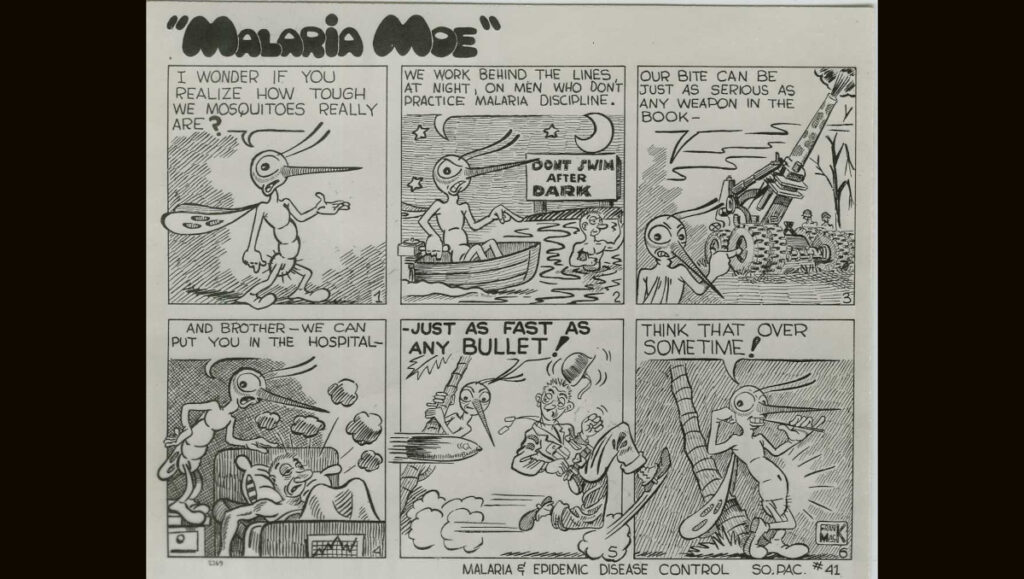
Photo Description: In an effort to counter malaria, which was decimating U.S. troops in the Pacific and southern Europe, agencies of the U.S. government, including the Army Medical Department and a precursor of the modern-day CDC, tried a variety of methods to curtail the spread. Part of that effort was an aggressive propaganda campaign. Cartoonist Frank Mack was hired for two years as part of that campaign, and he went on to create a variety of posters, calendars, and a single running comic strip called “Malaria Moe” to spread information about malaria prevention measures.
Photo Credit: OHA 80: Reeve Photograph Collection, National Museum of Health and Medicine, Otis Historical Archives