


Without space, such an operation would not have been possible.
On the early evening of June 21st, a quiet storm gathered in the skies over the Middle East. One hundred and twenty-five American aircraft, escorting seven B-2 stealth bombers, silently swept toward Iran. Their mission was clear: to neutralize fortified nuclear facilities at Fordow, Natanz, and Isfahan. As the world watched anxiously, fourteen GBU-57 Massive Ordnance Penetrators, commonly known as “bunker busters,” struck with surgical precision, destroying underground targets long thought impenetrable. “It involved misdirection and the highest level of operational security,” said Secretary of Defense Pete Hegseth. “A great deal of precision went into the strike.” The success of Operation Midnight Hammer was not achieved solely through airpower. Behind the scenes, a more invisible architecture enabled the strike: space-based intelligence. The satellites, communications links, and integrated surveillance systems of the U.S. Space Force formed the nervous system of the operation. They provided real-time intelligence, targeting data, and mission coordination from launch to impact, allowing every actor, from B-2 pilots to submarine commanders, to operate with confidence and precision. Without space, such an operation would not have been possible.
To understand the indispensable role of space assets in modern warfare, we must examine their evolution, from the relatively primitive capabilities of the Cold War to their full operational maturity in the twenty-first century. Three moments in U.S. military history, Operation Linebacker II in 1972, Operation Anaconda in 2002, and Operation Midnight Hammer in 2025, serve as critical mile markers. Each reveals the limits of space-based military assets depending on the context in which they were employed. To trace this evolution meaningfully, I begin by examining the limitations of space technology during a pivotal Cold War-era campaign.
Operation Linebacker II
In December 1972, as peace negotiations with North Vietnam faltered, President Richard Nixon launched a massive aerial bombing campaign: Operation Linebacker II. For eleven consecutive days, over 200 B-52 bombers struck targets in Hanoi and Haiphong in what became known as the “Christmas Bombings.” The damage inflicted was severe, but so too were the costs. North Vietnamese SA-2 surface-to-air missiles downed fifteen B-52s, exposing a vulnerability in what was presumed to be overwhelming American air superiority. The operation revealed a critical shortfall: the absence of real-time intelligence. While U.S. forces possessed target data, they lacked the dynamic surveillance and adaptive threat monitoring that today’s satellites provide. As a result, bombing patterns were predictable, and losses were severe. As historian Brian D. Laslie notes, “Despite great advantages, the USAF suffered heavy losses during the Vietnam conflict.” This deficiency could be attributed to the nascent state of space technology at the time. Photographic reconnaissance from satellites like CORONA or KH-4 systems had to be recovered physically, offering unprecedented but non-actionable insights days or weeks after a mission. Satellite communications were likewise in their infancy, and early missile warning systems were rudimentary.
The strategic nature of Cold War-era space assets meant that tactical forces on the ground or in the air often lacked the timely data necessary to adapt to emerging threats. Contemporary military planners expected space assets to provide crucial surveillance information. This was unprecedented because the Vietnam War saw the first use of satellite communications. A revolution in itself, as previously, real-time battlefield analysis had to be gathered by being physically present on the battlefield. Additionally, military planners used satellites to enhance communication relays; however, due to their classified nature, this was made increasingly difficult. Furthermore, the increased reliance on military surveillance technologies limited human intelligence, a vital asset during the Vietnam War because it helped combat Vietnamese guerrillas and irregular tactics. Therefore, the U.S. military defaulted to conventional solutions that required unconventional responses. This, unfortunately, resulted in strikes closer to the carpet-bombing tactics of World War II than the precision strikes of today’s Air Force. It would take decades and hard-won experience for these lessons to be internalized. By the early 2000s, the integration of space assets into real-time battlefield decision-making had begun to take shape, albeit imperfectly.
Operation Anaconda
As space-based systems matured, they began offering near-instantaneous support not only to national leaders but also to front-line units. This evolution was put to the test in Operation Anaconda in March 2002, during the invasion of Afghanistan. Conducted in the rugged Shahikot Valley, the mission aimed to encircle and destroy al-Qaeda fighters using concentric rings of coalition forces. But from the outset, Anaconda was plagued by faulty intelligence, an underestimation of enemy numbers, and a lack of synchronized support. Eight U.S. soldiers were killed, and more than fifty were wounded. Similar to the Vietnam War, at the heart of the issue was the inadequacy of space-based intelligence at the tactical level. While satellites could provide general imagery and navigation data, they failed to deliver detailed, up-to-date assessments of enemy positions. In mountainous terrain, satellite line-of-sight limitations compounded the problem, and imagery often proved outdated or misinterpreted. Although the United States had begun integrating GPS, satellite communications, and surveillance assets, the fusion of these capabilities into a cohesive operational picture remained underdeveloped. As a result, commanders on the ground often made decisions in the absence of reliable intelligence, and air support was slow to respond or imprecise in execution. Operation Anaconda exposed the growing pains of the military adjusting to modern space integration. To that effect, it acted as one of the catalysts that culminated in the creation of the Space Force. After Operation Anaconda, the U.S. military learned the value of effective space technology when operating in complex terrain. The battle underscored the need for (and the improvement of) GPS navigation, precision targeting, and the integration of air-to-ground forces. The consequences of inadequate intelligence were demonstrated during the early stages of the battle. Two decades later, however, the picture looked entirely different.
The mission’s success was not solely a product of technological superiority but of information dominance, achieved through the seamless coordination of space-enabled systems.
Operation Midnight Hammer
Operation Midnight Hammer represented the culmination of the long-standing integration between space assets and warfighting doctrine. The mission’s success was not solely a product of technological superiority but of information dominance, achieved through the seamless coordination of space-enabled systems. B-2 stealth bombers launched from the center of North America, at Whiteman Air Force Base in Missouri, and over an 18-hour flight, remained connected to mission planners, satellite feeds, and targeting updates in real time. Aerial refueling was timed with precision. U.S. Navy submarines fired over 40 Tomahawk cruise missiles to degrade enemy air defenses just before the bombers reached their targets. Escorted by F-35 fighters, the B-2s dropped bunker-busting ordnance with a margin of error measured in meters.
Though the intelligence assessments provided by the Space Force allowed for very precise and safe maneuvering inside the Iranian airspace, the operation’s effects remain to be seen. This stems primarily from the operational effectiveness of the MOP “bunker-buster” bombs, rather than surveillance and reconnaissance. According to reports by NBC, the bombs had “limited impact on deeper underground structures at Natanz and Isfahan.” Additionally, there are rumors that the Iranians moved their uranium and nuclear material from the enrichment sites before the operation. Regardless, Midnight Hammer was a deafening and dramatic example of American military might and capability and a superlative moment for the B-2.
The B-2 owes its cutting edge to its unprecedented accuracy and stealth. Previous bombers, such as the B-17s during World War II, were state-of-the-art in their day due to the Norden Bombsight, a newly developed technology that stabilized the telescopic sight at high altitudes. The bombing of ball-bearing factories at Schweinfurt in October 1943 used these bombsights; however, “only one of every 10 of their bombs landed within 500 feet of their target.” Today, that sort of accuracy would be tantamount to war crimes, as the American public has become accustomed to pinpoint accuracy fueled by space capabilities.
This modern orchestration of precision effects depends on space-based assets. Commercial and government satellites, such as those operated by Maxar and the National Reconnaissance Office, provided high-resolution imaging of Fordow, Natanz, and Isfahan. Infrared and electronic surveillance from orbital platforms enabled threat detection and targeting analysis. Secure satellite communications ensured uninterrupted connectivity from Missouri to the Persian Gulf. Perhaps most critical was the Integrated DoD/IC Operational and Intelligence Picture, which synthesized real-time data from across agencies and provided planners and commanders with a common operating picture that enabled precise strikes with minimal collateral damage. In addition, missile warning systems tracked potential threats from Iran’s air defense forces, ensuring U.S. assets could adapt and respond to any escalation. Space-based early warning and theater missile defense mechanisms—formerly strategic in nature—now function at the operational level, protecting bombers and ships alike from surprise attacks. This convergence of capabilities reflects more than just a technical achievement; it marks a doctrinal shift in how the United States wages war in the 21st century.
Conclusion
As modern warfare becomes increasingly digital and distributed, space assets have evolved into the foundation of U.S. military power. Unmanned aerial systems, precision-guided munitions, cyber operations, and electronic warfare all rely on the information dominance provided by space. The contrast between Linebacker II, Anaconda, and Midnight Hammer underscores this transformation. The former illustrates the costs of incomplete situational awareness; the latter demonstrates the power of complete information. In essence, the battlefield has moved upward. Wars are no longer won solely through superior firepower, but through superior information, and space is what makes that possible. The establishment of the Space Force in 2019 signaled the formal recognition of this shift. No longer a supporting player, space has become a focal point of military planning, execution, and deterrence. As adversaries develop their space capabilities—rom anti-satellite weapons to cyber interference—the United States must remain vigilant in defending its orbital architecture. Just as the success of Operation Midnight Hammer was rooted in years of investment and innovation, future conflicts will be shaped by the ability to secure and exploit the high ground of space. In this regard, the next battle may be won not by those who shoot first, but by those who see first, and space makes that vision possible.
Benjamin Moseman is a fourth-year student at Dickinson College, majoring in History. For the summer of 2025, he is served as an intern developing and improving national security exercise scenarios and testing wargames at the U.S. Army War College. He was working with the Department of Military Strategy, Planning, and Operations as well as the Center for Strategic Leadership.
The views expressed in this article are those of the author and do not necessarily reflect those of the U.S. Army War College, the U.S. Army, or the Department of War.
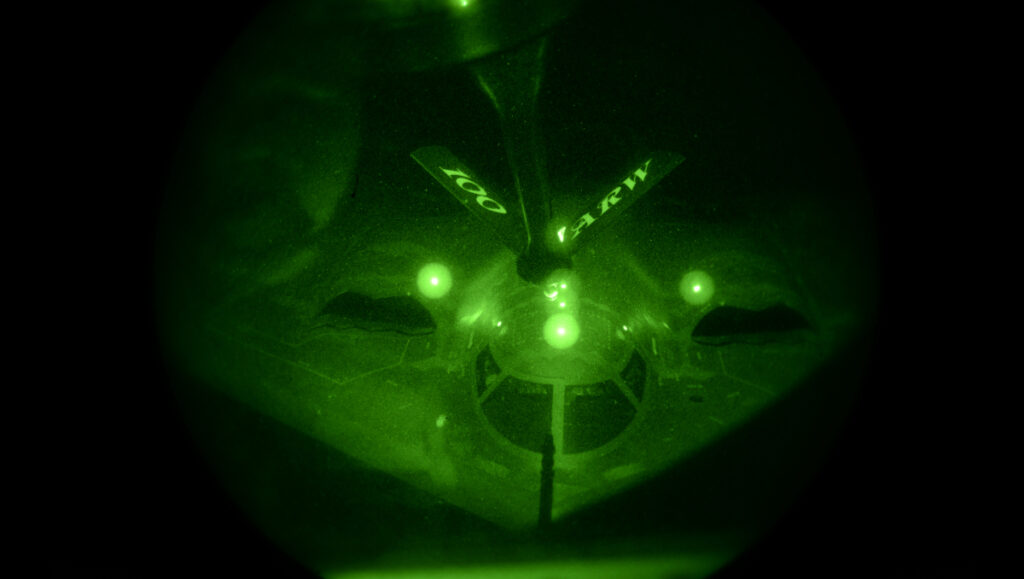
Photo Description: A KC-135 Strantotanker from the 100th Air Refueling Wing refuels a B-2 Spirit from the 509th Bomb Wing in the late hours of Jan. 18, 2017, during a mission that targeted Islamic State training camps in Libya. The B-2’s low-observability provides it greater freedom of action at high altitudes, thus increasing its range and a better field of view for the aircraft’s sensors. Its unrefueled range is approximately 6,000 nautical miles (9,600 kilometers).
Photo Credit: U.S. Air Force photo by Staff Sgt. Kate Thornton