

In the closing scene of James Michener’s novel The Bridges of Toko-Ri, an admiral thinks of the aircrew he just sent to the Korean conflict–some never to return–and asks, “Where did we get such men?” President Ronald Reagan asked the same question years later at the Medal of Honor presentation to Master Sergeant Roy P. Benavidez, speaking of both the awardee and his many comrades in Vietnam. It is often overlooked that many who served in both of those conflicts came from the activated reserve forces and selective service. During their year at the Army War College, Kent Park and Stephen Trynosky examined the challenges if we had to again rapidly expand the army for a large war. They join podcast editor Ron Granieri to discuss their research on the topic and their concerns that the U.S. is not adequately prepared for a major conflict with a near-peer threat, such as China or Russia. Park and Trynosky argue that the U.S. needs to take steps to increase its personnel readiness long before the shadow of great power conflict appears because timelines in the modern global security environment are much more compressed than in previous conflicts.
If there is a large-scale combat operation and we start sustaining casualties, in order for us to be able to continue the fight and sustain the fight based on the time available and the number of reserves that are available, we would have to almost immediately start to reauthorize the draft. And again, that just does not give us a chance to have a national dialogue and to start thinking about what does this actually mean. And there are a lot of problems with reinitiating the draft right now.
Podcast: Download
Kent Park is a 1999 graduate of the United States Military Academy and colonel in the U.S. Army. He has served in a variety of command and staff positions in Korea and also in Iraq. Colonel Park attended the Harvard Kennedy School of Government and earned a master’s degree in public policy there, before returning to the U.S. Military Academy to teach American politics in the Department of Social Sciences. He was a member of the Carlisle Scholars Program and a graduate of the AY23 Resident Course at the U.S. Army War College.
Stephen Trynosky is the John Parker Chair of Reserve Component Studies at the U.S. Army War College and earned his commission as a Medical Service Corps Officer from ROTC in 1998. He has held a diverse range of command and staff assignments in both the Regular Army and Army Reserve, to include, most recently, Senior Advisor, Professional Military Education, Office of the Secretary of War; and Commander, 993rd Medical Detachment (Veterinary Service Support). COL Trynosky holds both Juris Doctor and Master of Public Health degrees from the State University of New York at Buffalo, as well as a Master of Military Art and Science from the U.S. Army School of Advanced Military Studies and a BA in history from Saint Peter’s College. He is a graduate of the AY23 Resident Course at the U.S. Army War College.
Ron Granieri is Professor of History and the Chair of the Department of National Security and Strategy at the U.S. Army War College and the Editor of A BETTER PEACE.
The views expressed in this presentation are those of the speakers and do not necessarily reflect those of the U.S. Army War College, U.S. Army, or Department of Defense.
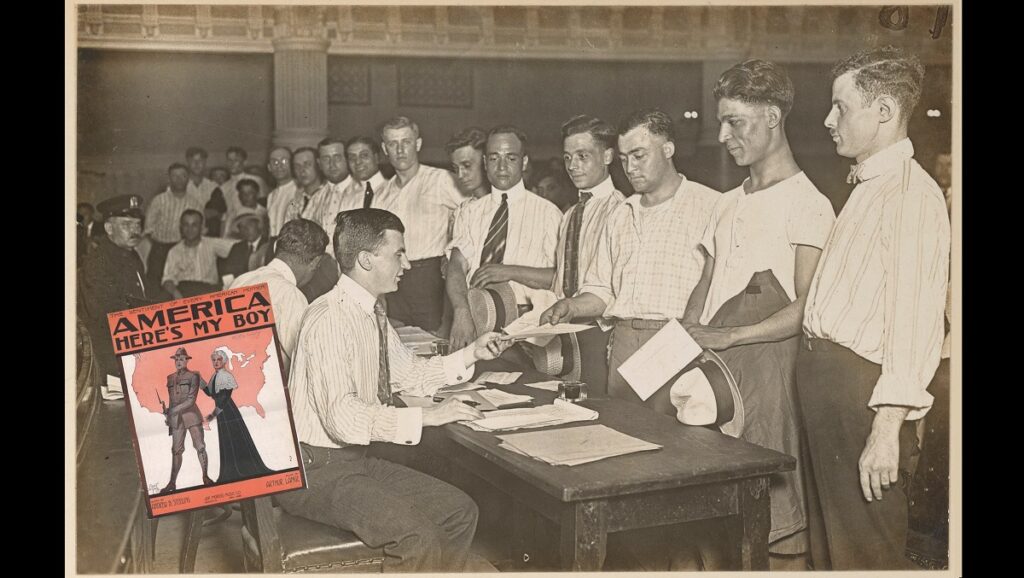
Photo Description: Men lined up at the exemption board in New York City for the World War I draft, February 1918. Inset: 1917 Cover of sheet music from the popular tune America Here’s My Boy
Photo Credit: Photographer unknown courtesy of National Archives – Identifier 45543491; Inset: Joe Morris Music Co., New York