

These myths are not harmless. They shape how army officers view themselves, how they view success, and what they believe is possible.
Every organization has its own folklore. In the U.S. Army, these stories are often reduced to short, repeatable mantras, phrases passed down by mentors, absorbed during professional development sessions, or muttered over beers after a long field problem. They’re shared as wisdom. But many are myths: narrative fallacies masquerading as truth.
The concept of the “narrative fallacy,” popularized by Nassim Nicholas Taleb in The Black Swan, refers to our tendency to construct simplified stories to explain complex realities. We crave coherence. But the stories we create often distort reality more than they reveal it and in doing so, they have the potential to blind us into a single outcome by artificially constraining people into a biased mental model. In the military, narrative fallacies are particularly powerful because they’re transmitted through hierarchy, culture, and repetition. They become “doctrine” without ever being written down.
These myths are not harmless. They shape how army officers view themselves, how they view success, and what they believe is possible. They influence retention, morale, mentorship, and even officer health. And most dangerously, they tell junior leaders what to expect before they’ve had a chance to form their own judgment, likely pre-loading them with cynicism, fatalism, and doubt. In his book Radical Inclusion, former chairman of the Joint Chiefs of Staff, General Marty Dempsey writes “A narrative battle is won by drowning out the counter message.” If we want to create a more resilient, adaptable, and optimistic army, perhaps we need to start by rewriting our own internal stories.
A Culture of Sayings
Any army officer can attest to the barrage of one-liners thrown their way before and after commissioning. These phrases, often presented as advice, are passed from one generation of officers to the next, frequently without scrutiny or context. As officers advance in rank, they receive new catchphrases tailored to their positions or perceived career trajectories. In the interest of time or mentorship efficiency, seasoned leaders recycle these phrases without reflection, and frequently without firsthand experience to support them. Military-themed social media influencers are also reinforcing these stereotypes. While seemingly innocuous and meant for laughs, they do influence perceptions.
A few notable examples that regularly circulate among Army officers include:
- “You only lead as a platoon leader and commander; the rest of the time, you’re a staff officer.”
- “Good leaders run fast and brief well.”
- “Leaders don’t get medical profiles.”
- “Your time as a Major will be a grind—mostly 20+ hour days.”
- “You need school X, Y, or Z to succeed at job X, Y, or Z.”
- “Field grade officers should be married.”
- “Officers should look a certain way and wear specific clothes off duty.”
- “You must follow a prescribed career path to be successful.”
- “The commander’s spouse must lead the Family Readiness Group.”
- “You can’t have any red boxes on a status update slide.”
- “There are such things as ‘officer’ or ‘NCO’ business.”
- “The Army doesn’t care about you after you retire or separate.”
- “Some soldiers aren’t good in garrison, but they’re the ones you want downrange.”
Branch-specific myths persist as well. For intelligence officers: “You never get to do intel after your lieutenant or junior captain time.” For aviation officers: “You never get to fly after command unless you become a warrant officer.” For combat arms officers: “You’re nothing without command.” The list goes on.
While these phrases often emerge from well-meaning attempts to pass on lessons learned, most are incomplete at best and flat-out wrong at worst. They reflect a combination of outdated beliefs, survivor bias, and personal frustration, but they get repeated until they seem universal. Over time, they become embedded in the army’s informal culture, exerting significant influence over how leaders see their careers, themselves, and their subordinates.
Typology of Army Myths
To better understand their impact, it helps to categorize these fallacies:
1. Performance Myths
These are the most superficial, yet among the most damaging. “Good leaders run fast and brief well” conflates physical fitness and charisma with effectiveness. Officers who are excellent planners, empathetic leaders, or skilled analysts but who lack high PT scores or showmanship may internalize that they’re less valuable, despite evidence to the contrary.
2. Career Path Myths
These myths claim there is only one path to success. “You must follow the prescribed timeline.” “You need intermediate level education (ILE) in-residence or broadening assignment X.” These discourage exploration, adaptability, and unconventional excellence. Officers begin to see their careers as rigid templates rather than dynamic journeys.
3. Identity Myths
These suggest that one’s personal life defines their professional trajectory. “Field grade officers should be married” is not only irrelevant, but can also be exclusionary, particularly to officers who are divorced, childless, or simply living differently. These myths marginalize officers whose lives don’t match the prescribed mold.
4. Suffering Myths
Often passed off as “just the way it is,” these sayings warn of inevitable burnout. “Majors work 20-hour days.” “Command will ruin your family life.” While workload can be heavy, these messages reinforce the idea that Army service must involve relentless sacrifice—fueling disillusionment before officers even arrive at those roles.
Why stay in a profession that tells you it will grind you down, ignore your individuality, and cast you aside when you’re no longer useful?
Real Consequences
These myths have measurable impact. Surveys and studies conducted by the Congressional Research Service and Military Health System show lifestyle problems and other psychological or physical stress have negative consequences. If these myths are believed and perpetuated, they frame expectations before officers experience reality. They lead officers to self-select out of opportunities, ignore their health, and under-invest in their personal development. Even worse, they constrain how leaders mentor others, unintentionally perpetuating the cycle.
They also hurt retention. Why stay in a profession that tells you it will grind you down, ignore your individuality, and cast you aside when you’re no longer useful? These messages are not aligned with the army’s stated goals of building cohesive teams, encouraging innovation, and promoting talent management. Yet they endure, often because no one questions them, or they’re told, it’s “just the way it is.”
Army-wide efforts like the People First strategy and the Talent Management Task Force indicate institutional awareness. But top-down reform isn’t enough if the day-to-day culture continues recycling defeatist or outdated messages.
A Better Way: Start With Another Narrative (SWAN)
The propagation of these myths through informal storytelling suggests the solution is not just to debunk them, it’s to replace them. One proposed approach, offered by Matt Offord, is the SWAN Method: Start With Another Narrative. This mindset encourages leaders to consciously choose more accurate, hopeful, and empowering stories.
Here’s how it might work:
- Instead of: “Majors are staff zombies who work 20-hour days.”
- Say: “As a Major, you’ll help shape organizations, mentor junior officers, and run the tactical Army.”
- Instead of: “Command will destroy your family life.”
- Say: “Command is demanding, but it can be deeply rewarding—and you can do it with balance and support.”
- Instead of: “Only one path leads to promotion.”
- Say: “There are multiple paths to success, and your journey can reflect your strengths and goals.”
By reframing these narratives, we preserve realism while injecting possibility. SWAN doesn’t mean sugarcoating the truth, it means questioning the cynicism. It asks officers to speak from personal experience, not hearsay; to resist defaulting to pessimism; and to guide others toward more resilient perspectives.
Institutional Recommendations
Changing army culture won’t happen through slogans alone. It requires deliberate steps:
1. Incorporate narrative literacy into leader development
Teach officers to recognize narrative fallacies and how they shape decision-making. This could be integrated into Command and General Staff College (CGSC), Pre-Command Courses, and even ROTC/USMA curricula.
2. Encourage counter-narratives in professional writing
Publications such as From the Green Notebook, Field Grade Leader, and Company Leader are perfect venues for replacing myths with truths and encouraging public discourse on the topic. The army should promote and amplify these platforms.
3. Empower senior leaders to break myths publicly
General officers and command sergeants major (CSMs) must model vulnerability and realism. By sharing their own contradictions to these myths, they give permission for others to think differently.
4. Embed narrative reflection into counseling and mentorship
Instead of defaulting to standard advice, leaders should ask: What narrative am I reinforcing? Better yet: Is it true?
Rewrite the Script
The army is in a period of transformation—conceptually, doctrinally, and culturally. But true transformation requires more than new doctrine. It demands a new mindset. And mindsets are shaped by stories.
The power of narrative is its ability to reinforce how we think. That is precisely why it is so dangerous when the narrative is a fallacy. Army officers must practice a different approach. They must challenge assumptions. They must pursue a range of opinions. They must seek to achieve a more optimal outcome rather than accept the status quo.
This doesn’t mean challenging everything. It means thinking critically before repeating institutional myths. It means acknowledging that what worked for one officer may not be universal. It means believing that there are many ways to lead, succeed, and thrive in uniform. We cannot create the future force with yesterday’s stories. It’s time to replace the myths with something better. It’s time to start with another narrative.
George J. Fust is a lieutenant colonel in the U.S. Army serving in the U.S. Indo-Pacific Command area of responsibility, where he is the G2 director of targeting and collection and advisor to senior leaders within U.S. Army Pacific. He is a graduate of Duke University and an adjunct professor. He previously taught in the Department of Social Sciences at the U.S. Military Academy and served in the 75th Ranger Regiment. He has multiple deployments and experience in Europe, Africa, and Asia.The views expressed are those of the author and do not reflect the official position of the Department of the Army or Department of Defense.
The views expressed in this article are those of the author and do not necessarily reflect those of the U.S. Army War College, the U.S. Army, or the Department of Defense.
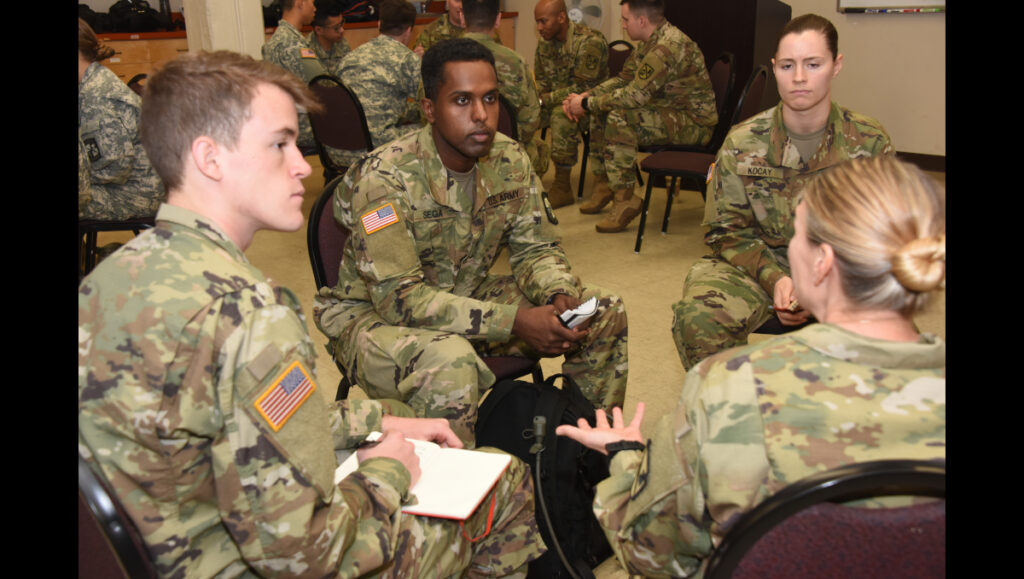
Photo Description: LTC Toni Sabo (far right), commander of the 229th Military Intelligence Battalion, the U.S. Army element at the Defense Language Institute Foreign Language Center, Presidio of Monterey, speaks with cadets from the University of California, Berkeley, Army ROTC Battalion. During two hour-long panels the cadets engaged in meaningful and purposeful conversations with Army officers and NCOs from the 229th.
Photo Credit: U.S. Army photo by Patrick Bray/Released