

Faced with potential operational failure, the USAF is redesigning both its wings (O-6 level command) and its force presentation model.
For thirty years, the U.S. Air Force (USAF) pieced together air expeditionary wings at heavily defended bases to generate airpower for joint force commanders (JFCs). While efficient at meeting the demand for low-intensity airpower, this system created a massive shortfall in the USAF’s large-scale combat capabilities. Eroding technological advantages, rising adversary anti-access/area denial capabilities, and the inability to protect generating site locations do not simply make legacy air expeditionary wings less effective, these changes render them combat ineffective.
Faced with potential operational failure, the USAF is redesigning both its wings (O-6 level command) and its force presentation model. While the USAF is still debating the final configurations of both, the joint force will face four main impacts, including: 1) a higher bar to receive forces, 2) full effectiveness upon arrival, 3) complex tradeoffs when executing each joint function, and 4) further institutional adaptation as the USAF refines its organizational design. Before exploring these impacts, however, it is important to understand the USAF’s problem and proposed solution.
The Problem
The 2023 Air Force Future Operating Concept lays out six “fights” airmen must win for JFCs to achieve their objectives in large-scale combat operations. These fights include: 1) the fight to compete with & deter; 2) the fight to get into theater; 3) the fight to get airborne; 4) the fight for air superiority; 5) the fight to deny adversary objectives; and 6) the fight to sustain ourselves.
The legacy model focused on deterring (fight #1), air superiority (#4), and denying enemy objectives (#6), while only really examining the difficulty of getting airborne (#3) in situations with chemical weapon or ballistic missile threats. U.S. force projection advantages in the late 1990s and early 2000s allowed the USAF to take for granted its ability to deploy (#2) and sustain itself (#6). The legacy model’s inability to address all six fights means the USAF must either change its model, or knowingly risk losing air superiority (and the ability to deliver all other airpower effects to JFCs) during large-scale combat.
The Proposed Solution
To field a credible combat capability, therefore, USAF senior leaders are debating variants of the proposed Deployable Combat Wing (DCW)–Air Force Force Generation (AFFORGEN) model. The figure below lays out the driving logic behind this redesign.
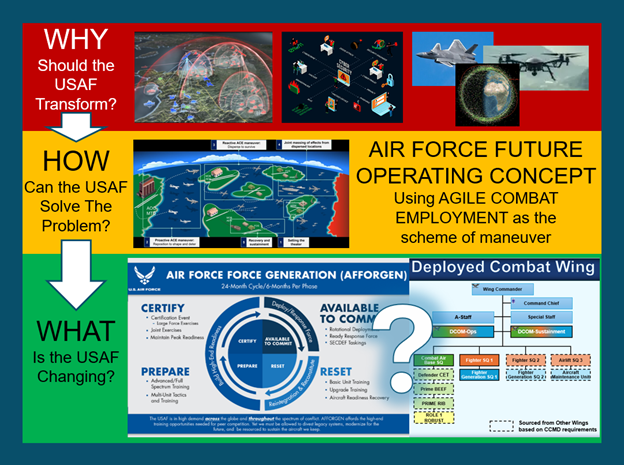
The changing future operational environment requires the USAF to transform if it wants to conduct large-scale combat operations effectively. The Air Force’s senior leaders are currently debating their options for implementing this transformation. Regardless of the service’s final decisions, the USAF’s emerging approach will combine new organizations, emerging capabilities, restructured personnel systems, and adaptable basing techniques (called Agile Combat Employment) into a cohesive set of mission-essential tasks. Agile Combat Employment (ACE) uses “operational schemes of maneuver to increase asset survivability while generating airpower in a high-threat environment.” The “proactive maneuvers involve moving forces and assets between main operating bases and potential dispersed sites to assure allies and partners and to alter adversary understanding of our intentions and capabilities.” This model depends on future USAF combat units establishing and operating multiple hub and spoke sites. These sites maximize force protection by complicating enemy targeting requirements. In turn, enhanced force protection optimizes airpower generation and employment.
Creating a force capable of implementing the Air Force Future Operating Concept requires a two-pronged transformation. Tactically, the USAF needs a deployable unit capable of executing the ACE scheme of maneuver. Variations on the DCW answer this requirement. The proposed DCW contains: a complete air staff; a combat air base squadron (new unit with security forces, force support, and engineers); a logistics detachment; and three mission generation force elements (flying squadrons with associated maintenance units) which create theater-specific airpower effects. DCWs will draw their personnel and equipment from no more than four different bases and will complete a full pre-deployment training cycle together. Further, the USAF will certify DCWs through a theater-specific exercise (like the recent Bamboo Eagle). In contrast, legacy air expeditionary wings were made up of personnel sourced from up to 93 bases, and who only met at their deployed location without any pre-deployment training as a combined unit.
The second prong of the USAF’s transformation concerns the institutional way the service builds, trains, and presents DCWs to the joint force. The proposed AFFORGEN cycle is not simply a “patch chart” for deployments. The AFFORGEN concept builds DCWs based on combatant command requirements using tailored mission generation force elements from across Air Force major commands. For example, a DCW can have fighter, airlift, and rescue units from Air Combat Command and Air Mobility Command. In addition, the AFFORGEN proposal restructures the USAF’s training, certification, personnel relocation, and equipment procurement procedures to optimize DCW formation and employment.
It is important to understand that both concepts (DCWs and AFFORGEN) are still being tested. Changes to the names and methods of both concepts are likely. Whatever final version the USAF chooses, however, the two-pronged transformation enables the USAF to reliably build, train, and present airpower units capable of winning all six fights outlined in the Air Force Future Operations Concept.
USAF Transformation’s Impacts on JFCs
From the joint perspective, the USAF transformation provides critical capabilities at the cost of significant process changes. While JFCs need airpower effects (like air superiority, global strike, and airlift) more than ever, the changing operational environment demands adjustments in how airpower is generated and employed. Joint Publication 5-0, Joint Planning, Chapter III says service capabilities impact how a JFC employs their joint functions. While these functions let JFCs “synchronize and direct” military actions, “inadequate integration and balancing of these functions can undermine the cohesion, effectiveness, and adaptability of the force.” As the USAF transforms, therefore, JFCs will need to negotiate their own changes when integrating DCWs into their operations. The next section explores the four largest impacts and opportunities from this transformation.
A Higher Bar to Receive Forces
The first major impact from the DCW-AFFORGEN transformation concerns how the JFC requests and receives airpower units. In the past, airpower elements were requested through unit type codes (UTCs). These UTCs contained the individuals or equipment necessary to complete a task, and deployed units were constructed by combining hundreds of UTCs. The DCW-AFFORGEN transformation limits force requests to the DCW level. By consolidating UTCs, the Air Force reduces a JFC’s force request flexibility to the airpower equivalent of a carrier strike group or a brigade combat team. While DCWs will be tailored to their intended theater, the wing will be a package deal. With hundreds of UTCs being consolidated into each DCW (press releases project roughly six DCWs available for each of the four six-month windows within the AFFORGEN cycle, including active duty and reserve component wings), the USAF will have fewer “units” to offer to the joint force. As a result, JFC competition for DCWs will increase. JFCs will need to clearly articulate to strategic leaders why a DCW should be allocated to their mission from the joint force’s limited pool of available forces.
Each JFC must negotiate a complex web of command relationships, authorities, objectives, rules of engagement, resources, and risk.
Full Effectiveness Upon Arrival
Secondly, the arrival of a cohesive, theater-certified DCW will provide a significant, immediate increase in the JFC’s capabilities. Each JFC must negotiate a complex web of command relationships, authorities, objectives, rules of engagement, resources, and risk. In contrast to the old wing’s need to organize, consolidate, and develop procedures which could work in the theater, DCWs will arrive prepared (by their AFFORGEN theater-specific training) to quickly recognize, adapt to, and support the JFC’s intent. The wing’s flexibility and cohesion, therefore, should provide an important, nearly instantaneous joint force multiplier.
Complex Tradeoffs When Executing Each Joint Function
The proposed DCW is meant to operate within the Agile Combat Employment concept of operations. This will improve effectiveness and enhance survivability, but achieving those goals will require changes to the way the joint force operates across all seven joint functions. As such, the JFC will have to incorporate this new hub-and-spoke system into the joint force’s maneuver plan, sustainment concept, protection priorities, fires cells, information messaging, intelligence flow, and command and control networks.
DCWs have many advantages but also some drawbacks; they will certainly require new ways of operating. In terms of movement and maneuver, DCW’s application of ACE will enable pulsed operations, create opportunities, and impose dilemmas on the adversary. However, JFCs could experience reduced intratheater airlift (since Agile Combat Employment movements consume some) unless US Transportation Command allocates additional strategic airlift.
On the information front, DCW operations enable messaging through presence. Equally important, JFCs will need to reassure allies and partners when DCWs depart.
For protection, ACE maximizes the survivability of a DCW’s combat power by complicating enemy targeting through dispersion. In turn, this dispersion will complicate the coverage, density, and allocation priorities for limited air defense assets.
Increased DCW survivability enables the JFC’s fires function to employ airpower effects longer into the JFC’s campaign. On the other hand, the rapidly shifting forces between multiple sites will complicate fires deconfliction.
From the intelligence viewpoint, multiple DCW locations will slow communication of intelligence updates. A DCW’s survivability, however, will protect a JFC’s capability to collect intelligence by preserving more airpower sensors for longer into the campaign. Also, DCWs could provide robust intel capabilities (if a remotely piloted aircraft mission force generation element is included).
Similarly, a JFC’s command and control function must expand to include new DCW command nodes and capabilities. These same nodes, however, may increase the coverage and resilience of the entire JFC’s network.
The biggest negative impact, however, will be on sustainment. A DCW will be designed to rapidly resource spoke sites, arrange medical evacuations, maintain aircraft, and ensure each site has the fuel, weapons, aircraft, personnel, and equipment required to generate airpower. What remains unclear is what sustainment support the DCW will require from the JFC. Directing critical resources from theater depots to the DCW hubs, adapting theater sustainment resource requests to DCW consumption rates, coordinating host nation assistance so the DCW can receive ship-based resupply, and protecting supply lines from enemy fires are just a few of the potential JFC sustainment challenges. When possible, JFCs should use DCW certification exercises to increase their staff’s understanding of DCWs and their dependence on joint force sustainment.
Further Institutional Adaptation as the USAF Refines Its Organizational Design
The DCW is a work in progress. The first DCW deployments in 2027 will inform both how combatant commands plan to use them, and shape service acquisition plans of how to generate them. No one knows what these iterations will reveal, but the transformation’s second- and third-order effects will definitely demand more adjustments to systems, procedures, and integration methods.
Conclusion
What then should JFCs internalize regarding the USAF’s emerging transformation? First, the USAF’s realignment into some future form of the DCW will make force requests more competitive as the joint force will have fewer deployable airpower formations to use. Second, JFCs should maximize the benefits of receiving the DCW’s cohesive, trained teams when designing their operations. Third, JFCs must comprehensively realign their joint functions to account for DCWs executing Agile Combat Employment. Finally, JFCs should expect iterative changes as the DCWs begin deploying in 2027. While the USAF’s pending transformation poses a significant challenge for JFCs, it represents the USAF’s commitment to reliably delivering airpower effects in the most complex environment a joint force will face. JFCs must actively incorporate this vital emerging Service capability as they forge an effective fighting force to persevere and succeed in large-scale combat operations against a peer adversary. Recognizing the transformation’s impacts now will allow JFCs the time, opportunity, and practice required to effectively integrate DCWs into future operations.
Patrick Lysaght is a colonel in the U.S. Air Force currently serving as a faculty instructor at the U.S. Army War College. He is a command pilot with over 2,000 hours in F-16 and T-38 aircraft. Also, he is a School of Advanced Military Studies graduate, and planned both joint operations and crisis response options for the United States Forces Korea and Defense Threat Reductions Agency staffs.
The views expressed in this article are those of the author and do not necessarily reflect those of the U.S. Army War College, the U.S. Army, U.S. Air Force, or the Department of Defense.
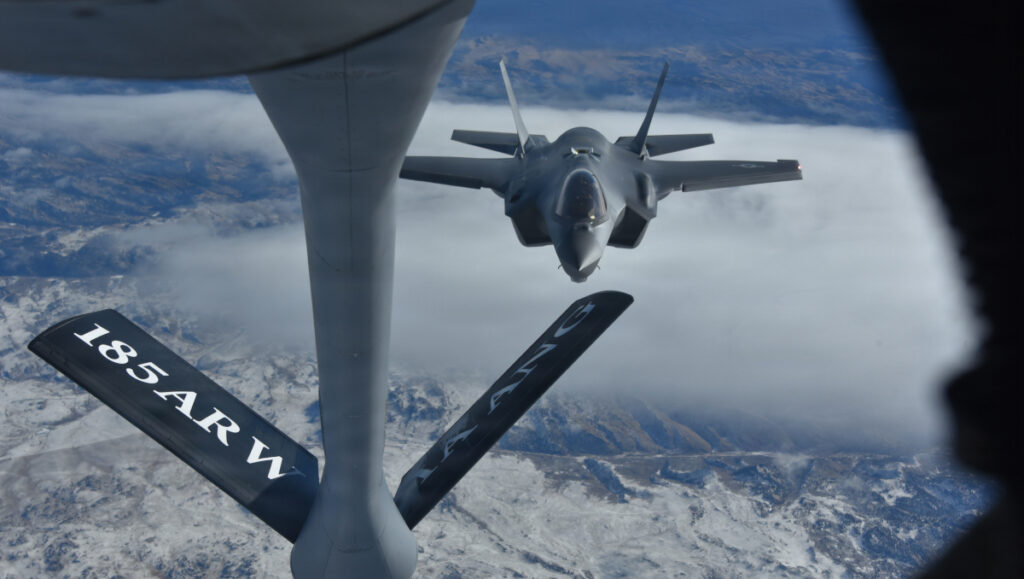
Photo Description: A KC-135 Stratotanker assigned to the 185th Air Refueling Wing refuels an F-35A Lightning II from the Wisconsin Air National Guard’s 115th Fighter Wing over the Rocky Mountains on January 10, 2026.
Photo Credit: U.S. Air National Guard photo by Staff Sgt. Olivia Monk