

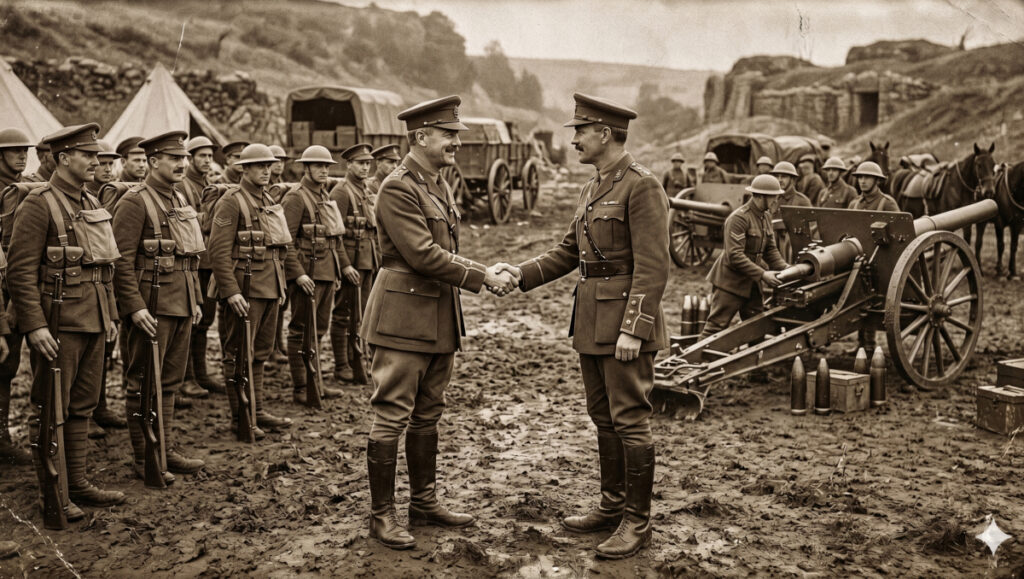
Too often there is either no true accounting for leaders who make poor strategic decisions or who produce great results at the expense of the command’s climate.
For a very long time, whenever something bad happens involving the military, there are calls for “accountability.” In other words, someone must face the consequences for the damage done to the profession of arms. Too often there is either no true accounting for leaders who make poor strategic decisions or who produce great results at the expense of the command’s climate. Over time, this has led to military cultures that treat accountability as a threat rather than an enabler of trust.
Accountability is supposed to be among the hallmarks of professionalism. At a minimum, professionals should police their own ranks and zealously deal with instances of personal misconduct and professional incompetence. That it has been weaponized to the point of being unrecognizable from its purpose should worry us. This article aims to correct the record and offer an empirically supported framework for analyzing the state of accountability in military organizations.
What is “Accountability”?
Accountability is a reciprocal relationship that reflects expectations of all members within the many important vertical and horizontal relationships that unify a joint, multicomponent force. Two or more parties—individuals, units, or other actors—should be accountable to one another. It should never be one way.
The first step is understanding the reciprocal relationship between accountable parties. Consider two people who must work together to fulfill their respective duties. Each has two responsibilities within this relationship: responsibility for the accomplishment of their own duties and being responsive to the other person. For example, when making arrangements for official travel, I am responsible for ensuring that the travel is for official purposes and the lowest possible cost. I am responsive to the G8 (Resource Management) when they have questions for me. In turn, they are responsible to the government to fully review the authorization, but also responsive to me to work quickly enough that flights are not cancelled and I don’t have to scramble at the last moment. In this sense, I and the G8 are fully accountable to each other.
Accountability should be present in all professional relationships. For simplicity, I will concentrate on three common types of military relationships where accountability is vitally important. Supporting-supported relationships see one unit providing a vital service to another unit, who in turn is accountable for providing plans, command and control, and conducive environments. A simple example is an artillery battery providing direct fire support to an infantry battalion. Clearly, if the battery fails to deliver fires on a designated target, the battalion commander holds the battery commander accountable for that failure. But there is also accountability for success—which includes recognizing the proper duty performance and learning from it to be better prepared for the next mission. Meanwhile, the battalion commander is responsible for providing resources, protection, information, and anything else needed while also responsive to the battery commander so to provide quality fire support. Trust becomes the measure of strength in their relationship and includes reliability, integrity, and competence in both directions.
In superior-subordinate relationships, the subordinate is accountable to the superior for mission accomplishment and adherence to professional norms, while the superior is accountable for the provision of direction, resources, and professional development. The accountability chain exists whether the relationship is one of direct supervision or separated by several hierarchical layers. Consider a division commander and all the subordinate company commanders. The division commander is accountable to the company commanders, and exercises that through the actions of the staff and intermediate commanders. In effect, being “responsible but not in control” consistent with the philosophy of mission command.
The most challenging are operational-institutional relationships that connect the operational force commanders with the service bureaucracy. Force commanders are accountable for the planning and execution of the mission, while the institution (composed of the service staffs, agencies, major service commands) is accountable for providing the needed resources and capabilities. What differs from other support relationships is how the institution serves as the primary interface with civilian leadership, so for some tasks like sustainment, the institution supports the operational force; while in others like programming and budgeting the operational force supports the institution. In essence, the operational and institutional militaries are accountable for the efficient and accurate flow of information in both directions necessary to drive strategic decisions.
Accountability as a Virtue
Across a service, accountability becomes a complex network of two-way relationships that may occasionally result in conflict. A deployed petroleum company will be accountable to both a theater commander and their parent sustainment command and must deal with competing requirements. Likewise, a theater commander is simultaneously accountable for fighting and winning the war while providing the institution with the needed requirements for replacements of personnel and materiel, then properly employing them upon arrival.
The accountability network must be strong, where two-way accountability is welcomed, encouraged, and maximized across all relationships. In other words, it should be a professional virtue, an idealized state in which someone is continuously responsive to the needs of others to whom they owe a response. The characteristics of an accountable command climate include the following being true for all members at all levels in an organization:
- – clarity regarding the expectations of all those who would hold the member accountable and for what
- – willingness to fulfill those expectations no matter the circumstances, including when not observed
- – transparency and honesty toward those who would hold them accountable
- – capacity and encouragement to question when the expectations are infeasible or inappropriate
- – value and respect toward those who hold them accountable
- – willingness to accept personal responsibility, even when personally costly to do so
- – seeing the fulfillment of their responsibilities as innately good
- – being willing to identify and correct one’s own errors
Accountability must therefore be practiced and cultivated, as it demands the diminishing of self-interest in favor of strengthening relational bonds. An accountable climate at unit level would have very strong supervisory relationships, for example. Subordinates would see their supervisors as benevolent and their performance feedback as constructive and helpful. Supervisors place the developmental needs of subordinates over their own, delivering feedback that helps subordinates achieve professional growth so that they can assume supervisory responsibilities in future. Competition among members would be focused more on professional competence and conduct, leading to more ethical command climates.
While any intraorganizational relationship can have problems, poor climates typically show systemic breakdowns of trust that may drive defensive behaviors.
Failures of accountability
In poor command climates, accountable relationships devolve into distrust and blaming, causing leaders and members to avoid accountability rather than embrace it. Such climates arise when upholding one’s responsibilities becomes unnecessarily burdensome, is neither recognized nor rewarded, or is viewed as complacency or blind compliance. For example, either side might view feedback as a chore rather than an opportunity. Subordinates might receive criticism poorly, discredit the supervisors’ experiences, or avoid undergoing needed change. Superiors may approach development defensively, avoid upsetting the subordinate, fail to enforce standards, or inflate ratings to make themselves look good. While any intraorganizational relationship can have problems, poor climates typically show systemic breakdowns of trust that may drive defensive behaviors. However, the complexity of the organization may make it difficult to diagnose the root causes of such problems.
Decisions without repercussions
Organizational scholars have identified four different types of organizational failures that contribute to the erosion of accountability in organizations. The first type of failure is when leaders make decisions that do not work out as hoped but the leader feels few repercussions. Instead, the effects are felt elsewhere (or put another way, “stuff” rolls downhill). This is not always a leader’s fault. In military organizations, this arises in part due to the natural rotation of leaders who rarely stay long enough to see the outcomes of their decisions. Consider the budget drawdowns of the post-Cold War 1990s, which gradually led to facilities, barracks, and equipment falling into serious disrepair. Efforts to fix the problems, such as the creation of the Installation Management Agency (IMA) in 2002 to centralize facility management, but the vulnerabilities did not emerge until long after those who designed the organization departed. This problem is endemic across the U.S. military, which rapidly rotates leaders even while many projects endure for years or decades.
Lacking empathy
The second failure is when senior leaders and junior members, particularly those separated by several levels of hierarchy, operate in separate worlds with little empathy in either direction. A sign of this is when leader messages make no sense to the rank-and-file soldiers. Another is when the organization inconsistently punishes those who err professionally or personally, producing “different spanks for different ranks.” On the other side, accountability suffers when followers weaponize complaint systems or gripe on social media rather than go through the chain of command. While power distance may be useful for unifying large complex forces toward an objective, when misused it can be corrosive to accountability.
The “Peter Principle” and selecting wrong leaders
Of course, a hierarchical organization works best when all its leaders are appropriately qualified for the positions they hold. This is not always the case. Although written as satire, Lawrence Peter’s famous treatise on leadership in hierarchies, The Peter Principle, has broad-based empirical support that people do rise to their first level of incompetence. This means that at any given time, even the best militaries will struggle with having leaders who are unsuitable for the positions they hold. Yet military incompetence is notoriously difficult to identify, even during a war. Potential solutions such as peer review programs do exist to help identify and weed out bad leaders but efforts to adopt them in military settings have been very difficult.
Lacking organizational resilience
The fourth failure in the inability of the organization to cope with stressors on relational bonds within a military force. Stress is a natural part of organizational life. Problems such as personnel attrition, constraints on resources, and excessive requirements are not uncommon in militaries, however unresolved tensions can lead to deeper conflict and breakdowns of internal relationships. Military organizations that use ineffective coping mechanisms such as conflict avoidance or glossing over problems may struggle to maintain constructive command climates anytime, but would be especially when faced with wartime stressors such as mass combat and non-combat losses.
Toward a culture of accountability
No organization can be problem free. The question is how to preserve accountability despite the problems present and prevent small-scale problems from spreading and eroding the command climate. The solution is for leaders to take a more proactive stance and build organizational cultures that institutionalize accountability as an inviolate norm. Like building a culture of warfighting, building a culture of accountability begins with re-describing the ideal relational bonds – what each unit, capability, and individual is responsible for and whom they are responsive to upward, downward, and horizontally.
This is harder than it sounds because there are different views of what the ideal looks like. For example, consider different conceptions of leadership. At the extremes are those who consider strong man or traditional leadership with centralized power versus those advocating for servant leadership where leaders subordinate themselves to members. Both paradigms have their strengths and vulnerabilities. They also result in different conceptions of accountability; one where the commander is accountable for everything that goes on in the unit versus one where accountability is far more distributed. Finding a stable synthesis of these diametrically opposed positions will be difficult.
A second barrier revolves around the differences between peacetime and wartime environments. As much as military leaders espouse train-as-you-fight mentalities, we should also encourage sustain-as-you-fight and administer-as-you-fight. These would strength operational-institutional relationships where, for example, cost consciousness and “just-in-time” logistics used in day-to-day peacetime environments may have to transition to rapid expansion of the armed forces for large-scale combat operations. Accountability enables preparedness on both sides to make this complex transition as smooth as possible.
A final barrier are the attitudes that separate the institutional army from the operational army, contributing to perceptions of unfairness. Several commentators have lamented this gap. Although a detailed examination of this gap is beyond the scope of this article, suffice to say that so long as perceptions persist that the institutional Army operates under different rules and norms from the operational army, fixing the accountability problem is going to be very difficult.
Tom Galvin is Associate Professor of Resource Management in the Department of Command Leadership and Management (DCLM) as well as the leadership and management instructor for the Carlisle Scholars Program. at the United States Army War College. He is the author of the monograph Leading Change in Military Organizations and companion Experiential Activity Book.
The views expressed in this article are those of the author and do not necessarily reflect those of the U.S. Army War College, the U.S. Army, or the Department of War.
Photo Credit: Created by Gemini