

The war in Iran began with one of the most effective decapitation strikes in history but while it may have caused temporary paralysis, it neither brought down the regime nor brought victory.
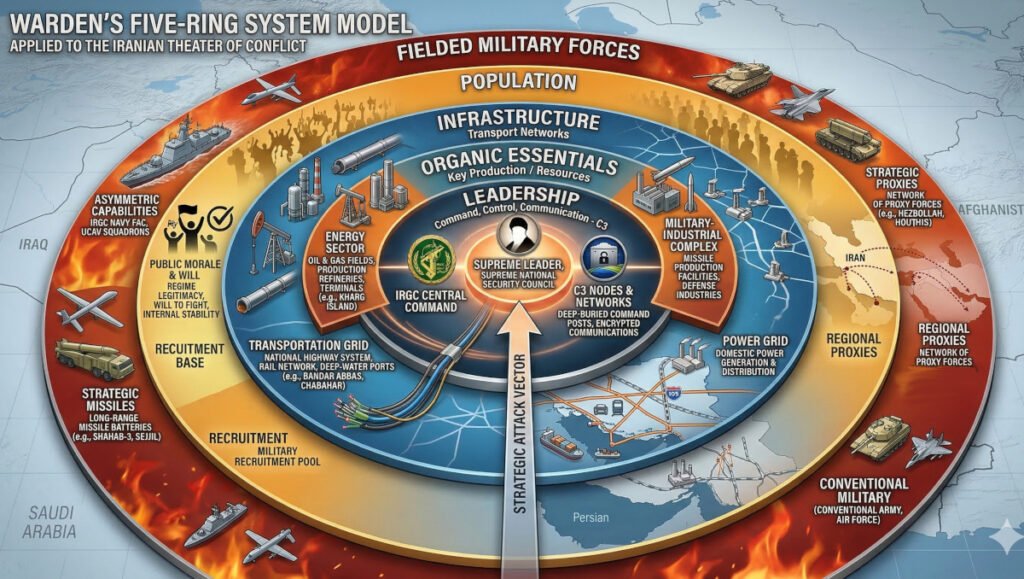
In 1995 Colonel John Warden published The Enemy as a System, in which he posited a five-ring model for understanding and targeting enemy states, with leadership at the center and fielded forces as the outermost ring. In between were rings representing the population, infrastructure, and resources like energy. His work followed the tradition of B.H. Liddel Hart’s The Strategy of Indirect Approach and Giulio Douhet’s Command of the Air in searching for a way to defeat an enemy without the costly and ultimately attritional endeavor of grinding down their military to achieve victory. The result of this model was the concept that when properly applied, the use of airpower could allow the United States to bypass the outermost rings and target the enemy leadership directly. This “decapitation” would at the very least cause complete strategic paralysis in the enemy and possibly even cause regime collapse but in either case, it would bring victory.
The war in Iran began with one of the most effective decapitation strikes in history, but while it may have caused temporary paralysis, it neither brought down the regime nor brought victory. This is because while Warden’s five ring model may apply, the importance of the rings changes radically based on the nature of the state and the system. Bringing down a robust regime like Iran is still possible but requires a radically different approach from defeating a fragile one.
Why the Inner Ring is not Enough in Iran
In a fragile state, the leadership might control a population that wishes them removed, have little inherent support from security forces (or have encouraged unhealthy competition among them), an underdeveloped bureaucracy, and little capability for organized succession. In such a state, subordinates have little to no ability to take initiative and, other than a few regime loyalists who benefit from the system, few would shed tears over its collapse. An alternative model of a fragile state might be one where the state and the population are motivated by the efforts of a charismatic leadership that any prospective alternatives would be unable to replace. Regardless of the exact nature of the fragile state, killing the leadership might have the desired effect that Warden anticipated.
Iran is not such a state. While much of the population of Iran wishes the fall of the regime or a change in the system, Iran maintains a robust and resilient system of repression to keep its population in check. This is in no small part because of loyalty to the system among many of the security services. The system of repression is present in every city and rural district and can act to suppress popular discontent at the local level. It has proven its capacity for violence and its resilience as it faced a decade’s worth of protests as well as riots and even some local insurgencies.
The psychological effect of this is that the population and security forces will believe that this repression will be able to continue unless something significant changes. This in turn deters the kind of popular uprising that might bring down the regime. As the events of the campaign have made clear, targeting the innermost of Warden’s rings might be a necessary component of defeating the Islamic Republic, but it is not by itself sufficient.
Most of the possible ways that a robust repressive regime might fall center on the very way it maintains itself – the security forces that form the contact layer of repression.
How a Robust Repressive Regime Falls
Other than an invasion, a robust repressive regime, like Iran, can fall in a number of ways. The regime can die a slower death, starved of those resources that it uses to provide benefits to the loyal elements of its population while being forced to use more and more of its resources on repression. This will eventually transition the state structure from a robust one to a fragile one ripe to fall. The cost of maintaining repression might be such that it forces the regime to lessen its grip on some areas, which then play host to an insurgency that can stress the regime beyond the point its system can tolerate.
Most of the possible ways that a robust repressive regime might fall center on the very way it maintains itself—the security forces that form the contact layer of repression. For the regime to fall, either these forces’ loyalty to the regime or their institutional or individual motivation or capability to repress their fellow citizens will have to break. This can happen locally and spread, or all at once nationally, and can take several forms. For example, a loss in the loyalty of part of a regime’s security forces can induce a coup (though at this point many repressive state structures are built with coup-proofing in mind).
Personnel in the security forces, especially those who are less ideologically committed, could also come to believe that the fall of the regime is imminent or inevitable and that further struggle is wrong, or that they do not want to be the ones left holding the bag when the regime falls. This may have a cascading effect on other members of the security forces, which may inspire and stimulate the anti-regime activity of the repressed population. Finally, if security forces at the local level are substantially degraded by external action, and as a result the population no longer sees them as a sufficient threat, the security forces will not be able to stop a popular uprising. Such an uprising might not begin as a wave but rather as a growing testing of boundaries to see whether the security forces are still capable of significant repression.
What this Means for Warden’s Rings and Iran
If the United States and Israel want to bring down the regime in Iran, they must reverse Warden’s preferred sequence through the five rings. Rather than jumping from the outside to the center ring, the United States and Israel need to target and degrade the outermost ring. They will have to fight an “air power insurgency,” acting as something like the revolutionary vanguard envisioned by Vladamir Lenin and Mao Tse Tung—both eroding the means of repression and inspiring the rising of the rest of the population. The current campaign has already gone some way to achieving this by demonstrating the powerlessness of the regime to protect itself against U.S. and Israeli strikes and embarrassing it through the destruction of symbolically important high-profile targets.
Should the United States and Israel truly desire regime change in the near term, their success so far will not be enough. Rather than targeting the heads of the regime, they will have to target the proverbial arms and fingers of repression. They can choose either to degrade Iran’s forces to the point that the Iranian can no longer effectively repress the population or try to break the morale and loyalty of the security forces by convincing them that defeat or death are inevitable. Either way, the Basij, Iranian Revolutionary Guard Corps, and Law Enforcement Command at the local level must begin to bear the brunt of U.S. and Israeli airpower.
Jacob A. Stoil, PhD, is Research Professor of Middle East Security Studies at the U.S. Army War College Strategic Studies Institute, and Chair of Applied History at the Modern War Institute, as well as Trustee of the U.S. Commission on Military History. Previously, he served as a Senior Fellow of the 40th Infantry Urban Warfare Center as well as an Associate Professor of Military History at the U.S. Army School of Advanced Military Studies (SAMS). He holds a doctorate in History from Oxford which focused on international military and SOF cooperation with indigenous forces in the Middle East and Horn of Africa, as well as an MA in History of Warfare and a BA in War Studies from King’s College London. Dr. Stoil has well over a decade of experience conducting research on the Israeli military and the broader Middle East.
The views expressed in this article are those of the author and do not necessarily reflect those of the U.S. Army War College, the U.S. Army, or the Department of War.
Photo Credit: Created by Gemini