


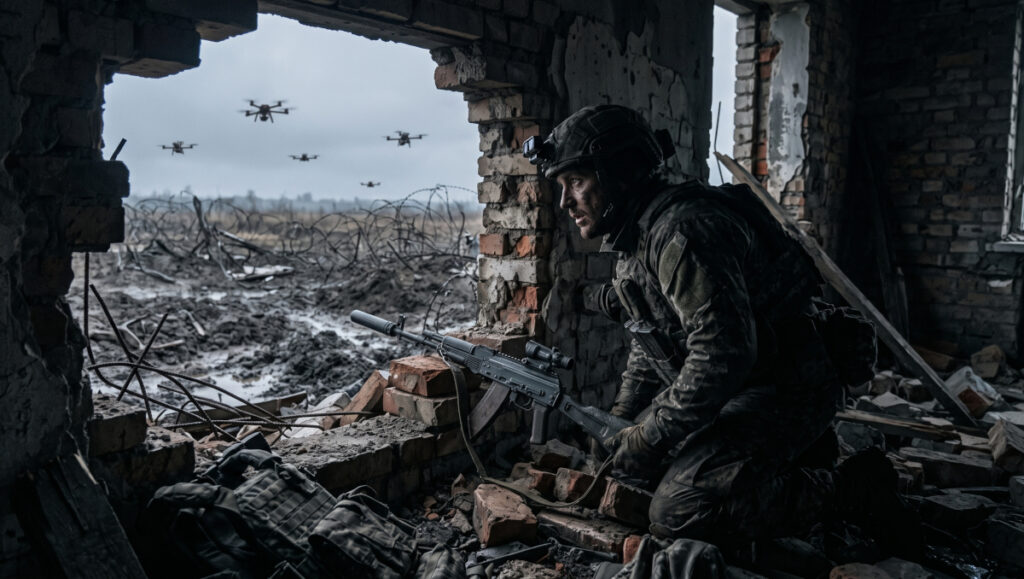
Headlines typically highlight how high-tech drones are transforming combat, but the raw reality of protracted warfare still comes down to people.
Gil Barndollar, a senior research fellow and Marine veteran who has conducted multiple research trips across Ukraine, sits down with host Steve Trynosky to discuss what the West might be missing. Barndollar argues that Western militaries risk drawing the wrong conclusions from the conflict by focusing almost exclusively on technological innovation while overlooking the grueling demands of military manpower and societal mobilization.
From frontline exhaustion and strained rotation cycles to the messy friction of conscription, the war demonstrates that technology cannot replace mass or human endurance. Trynosky and Barndollar examine why peacetime societies struggle to prepare for the shared sacrifices required in sustained, large-scale conflict—and why assuming a nation can simply switch on a draft overnight is a dangerous gamble.
It is a sobering look at the human dimension that democracies must confront before the next crisis hits.
And the underlying message was that the conflict is so vast and so intimate and so personal from a human standpoint. That is just something we have to be, we have to appreciate. We’re not going to be able to automate our way out of it.
Podcast: Download
Gil Barndollar is a senior research fellow at the Center for the Study of Statesmanship at the Catholic University of America in Washington, DC and a LTG James M. Dubik Writing Fellow at Army University Press. Gil studies military manpower, recruiting, and mobilization; he is working on a book examining the history and future of America’s all-volunteer force. A Marine veteran of the war in Afghanistan, Gil now serves in the Army National Guard. He holds a PhD in history from the University of Cambridge.
Stephen Trynosky is the John Parker Chair of Reserve Component Studies at the U.S. Army War College and earned his commission as a Medical Service Corps Officer from ROTC in 1998. He has held a diverse range of command and staff assignments in both the Regular Army and Army Reserve, to include, most recently, Senior Advisor, Professional Military Education, Office of the Secretary of War; and Commander, 993rd Medical Detachment (Veterinary Service Support). COL Trynosky holds both Juris Doctor and Master of Public Health degrees from the State University of New York at Buffalo, as well as a Master of Military Art and Science from the U.S. Army School of Advanced Military Studies and a BA in history from Saint Peter’s College. He is a graduate of the AY23 Resident Course at the U.S. Army War College.
The views expressed in this presentation are those of the speakers and do not necessarily reflect those of the U.S. Army War College, U.S. Army, or Department of War.
Photo Credit: Created by Gemini