
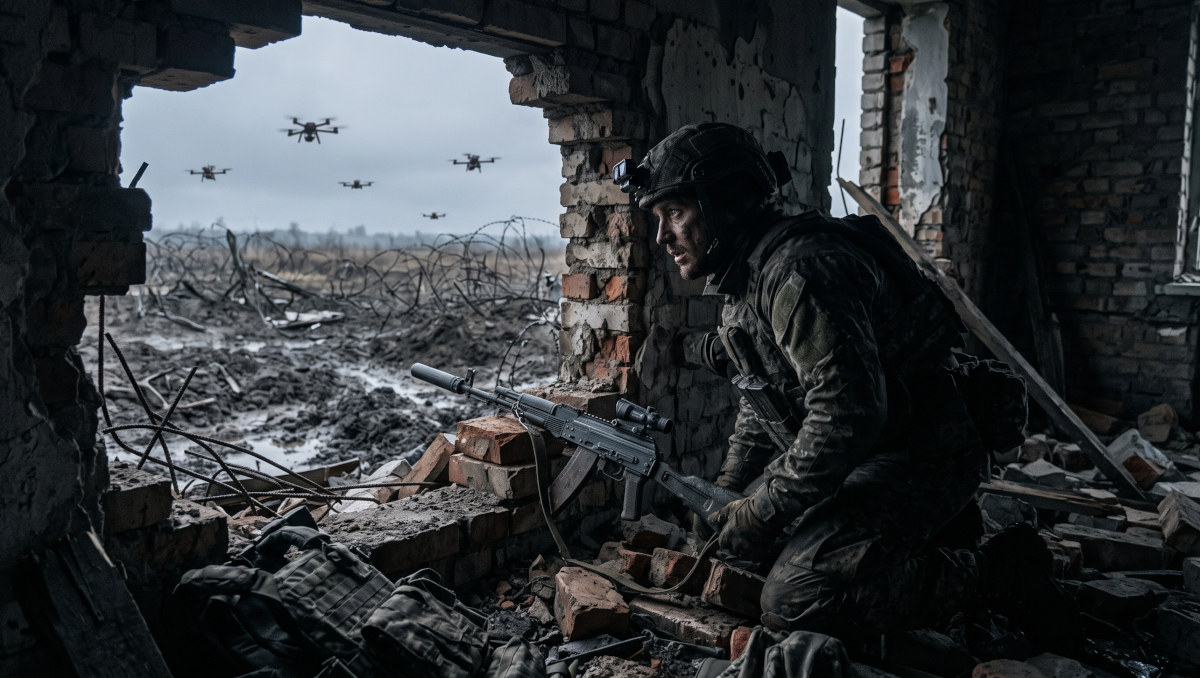
Headlines typically highlight how high-tech drones are transforming combat, but the raw reality of protracted warfare still comes down to people.
Gil Barndollar, a senior research fellow and Marine veteran who has conducted multiple research trips across Ukraine, sits down with host Steve Trynosky to discuss what the West might be missing. Barndollar argues that Western militaries risk drawing the wrong conclusions from the conflict by focusing almost exclusively on technological innovation while overlooking the grueling demands of military manpower and societal mobilization.
From frontline exhaustion and strained rotation cycles to the messy friction of conscription, the war demonstrates that technology cannot replace mass or human endurance. Trynosky and Barndollar examine why peacetime societies struggle to prepare for the shared sacrifices required in sustained, large-scale conflict—and why assuming a nation can simply switch on a draft overnight is a dangerous gamble.
It is a sobering look at the human dimension that democracies must confront before the next crisis hits.
And the underlying message was that the conflict is so vast and so intimate and so personal from a human standpoint. That is just something we have to be, we have to appreciate. We’re not going to be able to automate our way out of it.
Podcast: Download
Gil Barndollar is a senior research fellow at the Center for the Study of Statesmanship at the Catholic University of America in Washington, DC and a LTG James M. Dubik Writing Fellow at Army University Press. Gil studies military manpower, recruiting, and mobilization; he is working on a book examining the history and future of America’s all-volunteer force. A Marine veteran of the war in Afghanistan, Gil now serves in the Army National Guard. He holds a PhD in history from the University of Cambridge.
Stephen Trynosky is the John Parker Chair of Reserve Component Studies at the U.S. Army War College and earned his commission as a Medical Service Corps Officer from ROTC in 1998. He has held a diverse range of command and staff assignments in both the Regular Army and Army Reserve, to include, most recently, Senior Advisor, Professional Military Education, Office of the Secretary of War; and Commander, 993rd Medical Detachment (Veterinary Service Support). COL Trynosky holds both Juris Doctor and Master of Public Health degrees from the State University of New York at Buffalo, as well as a Master of Military Art and Science from the U.S. Army School of Advanced Military Studies and a BA in history from Saint Peter’s College. He is a graduate of the AY23 Resident Course at the U.S. Army War College.
The views expressed in this presentation are those of the speakers and do not necessarily reflect those of the U.S. Army War College, U.S. Army, or Department of War.
Photo Credit: Created by Gemini


Beginning at about the 18:00 point in this podcast, Dr. Barndollar introduces the issue of whether the American people more generally (and potential draftees and their family members more specifically?) will consider the draft as “legitimate” and, therefore, will support same.
Herein, if China and Russia, for example, attack us here at home, then, indeed, the American people, one would think, would more easily consider a draft — related to this such attack here at home — as legitimate, and, thus, would be expected to, more enthusiastically, support same?
If, however, China and Russia, for example, recognizing the above, and/or for other reasons, decided to attack one or more of our farther away allies, partners and/or friends instead, then (especially given the Trump Administration’s position on more far away allies, partners and/or friends?), would we not expect that the issue of the draft’s legitimacy, and the American people’s likelihood of supporting same, to be called into question/to be challenged by all concerned?
Thus, as relates to Dr. Barndollar’s further discussion at the end of this podcast — of the need to, early on, “set the conditions for legitimacy”/”build legitimacy” long before there is a need for a draft — as to that such essential requirement, has the U.S., of late, made the right moves/has it moved in the right direction? (If not, then is their time for reversal, and/or other improvements, re: the “build legitimacy” requirement?)
With regard to “setting the conditions for legitimacy”/”building legitimacy” for national mobilization, might it be prudent to consider China’s recent (“expansionist,” as relates to the reasons for national mobilization, how this such national mobilization can now be carried out and how this such national mobilization can now be used?) moves?
Herein, I am talking about the recent revision to China’s national mobilization law, which is said to take effect October 1st, and which is said to allow national mobilization, now, for such things as national sovereignty, national unity, territorial integrity and even “development interests.”
Is this such new revision of China’s national mobilization law an example of how a nation might try to “set the conditions for legitimacy,” and/or to “build legitimacy,” re: such things as a draft (etc., etc., etc.)?
The model that is being used in this podcast, for describing the type of large-scale combat operations that we must prepare for — and, thus, must consider the manpower requirements relating to same — this such model would seem to be (a) the current Russia-Ukraine war and, more specifically, (b) how this is such current Russia-Ukraine war is being fought.
But in a war between the U.S. and Russia and/or China, would we — and/or our opponents — mostly likely be fighting such a war; this, in the exact same manner as the current Russia-Ukraine war combatants are?
Or — based at least somewhat on the reality of the problem of achieving huge manpower capabilities over long periods of time — and/or as relates to our and/or their preferred way of fighting — would the way that such a U.S. v. Russia and/or China war would be fought, would this, indeed, look more like a high tech naval and aerospace conflict, fought over vast distances; wherein, both “we,” and “they,” rely more on unmanned systems, cyber operations, and advanced technologies. (This meaning that a mass infantry, etc., draft of millions of our, and/or their, citizens, this would not only not be required — but indeed — might actually get in the way/might be counterproductive?)
Bottom Line Question — Based on the Above:
What makes the current way that the Russia-Ukraine war is being fought today, what makes this “the only game in town” — or the most likely “game in town” — this, a relates to how major nations will decide how to fight one another?
Should my argument/question, immediately above, fail — and, thus, the way that the Russia-Ukraine war is being fought today be determined to be the only (or the most likely) “game in town” — then, going back to the need to — sooner rather than later — establish legitimacy for the draft/establish legitimacy for national mobilization (see my first two comments above),
Then might this such “legitimizing” effort best be done, today, by (a) having the nation’s political leadership, and other elites, volunteer themselves, and their families, for the very first stages of the draft and by (b) having them, formally and universally, declare themselves to be ineligible for such things as deferments? (I,E., have them “lead from the front?”)
This such undertaking and commitment, one would think, would work well; this, with other required leadership initiatives, such as, providing clear, compelling and irrefutable evidence that our nation faced an existential threat; one that, clearly, required various forms of national mobilization, to include a draft.
(If, today, requirements such as these are not met, then, likewise today, might not other efforts — to achieve “legitimacy” for national mobilization/the draft — be less likely to succeed?)
(Note that — as per my second comment above — for China to achieve national mobilization, this does seem to need that they undertake such “legitimizing” requirements as I describe above. In this regard, they only seem to need to declare what national mobilization will be used for, such as, national sovereignty, national unity, territorial integrity and, interestingly now, “development interests.” )
Correction: To the last, in parenthesis, item that I provide immediately above:
The first sentence should read: Note that — as per my second comment above — for China to achieve national mobilization, this DOES NOT seem to need that they undertake such “legitimizing” requirements as I describe above.” Apologies.
Really fascinating and informative personal observations are captured in this very well presented discussion, just wanted to thank you both for working to put this piece together!