

The debate over resuming the draft often resurfaces during global tension, yet its complexities remain misunderstood. Editor-in-Chief JP Clark sits down with experts William Taylor and Katherine Kuzminski to bridge the gap between myth and reality regarding the all-volunteer force and selective service.
Their conversation explores why the U.S. transitioned from conscription in 1973, highlighting historical challenges like high turnover and low morale. Kuzminski explains that a modern draft would require immense political capital from both the President and Congress, likely occurring only during an existential threat. The discussion also examines 21st-century mobilization hurdles, including the need for specialized technical talent and the strain on existing processing infrastructure. This episode provides essential context for anyone curious about the future of national service and military readiness.
What happens when we send 100 to 500,000 individuals who don’t necessarily want to be drafted to the front door of those MEPS stations when we were not able to process the volume that was showing up during a recruiting crisis?
Podcast: Download
Katherine Kuzminski is the Director of Studies at the Center for New American Security, or CNAS, where she is responsible for managing the center’s research agenda, publications, and research staff. She is also the lead for CNAS’s work on all things human capital and national security, a vast topic which includes military recruitment, retention, and talent management, mobilization, Department of Defense, institutional and organizational design and management, civil military relations, and veteran and military family issues. She has many publications, but the three most relevant to the all-volunteer force are Short Supply, Identifying and Addressing the Root Causes of Declining Propensity for Military Service, and Back to the Drafting Board, U.S. Draft Mobilization Capacity for Modern Operational Requirements, both from CNAS and then hot off the presses, Bend Do Not Break, Shaping the Future of the All-Volunteer Force (Oxford University Press, 2026).
William Taylor is the Lee Drain Endowed University Professor of Global Security Studies and Department Chair at Angelo State University in San Angelo, Texas. He is a graduate of the United States Naval Academy, and earned a Master’s in History from the University of Maryland, a Master’s in National Security Studies from Georgetown University, and an MPhil and PhD from George Washington University. He published Peace, War, and Partnership, Congress and the Military Since World War II (Texas A&M University Press, 2023) The All-Volunteer Force, 50 Years of Service (University Press of Kansas, 2023) and The Advent of the All-Volunteer Force, Protecting Free Society (Routledge, 2023).
JP Clark is an associate professor of military strategy teaching in the Basic Strategic Art Program. He served in the army for twenty-six years as an armor officer and strategist. He holds a Ph.D. and M.A. in history from Duke University, an M.S.S. from the Army War College, and a B.S. in Russian and German from West Point. He is the author of Preparing for War: The Emergence of the Modern U.S. Army, 1815-1917 (Harvard, 2017). He is currently working on a history of U.S. military strategy in the Pacific from 1898 to 1941 that is under contract with the University Press of Kansas. He is the 3rd Editor-in-Chief of War Room.
The views expressed in this presentation are those of the speakers and do not necessarily reflect those of the U.S. Army War College, U.S. Army, or Department of War.
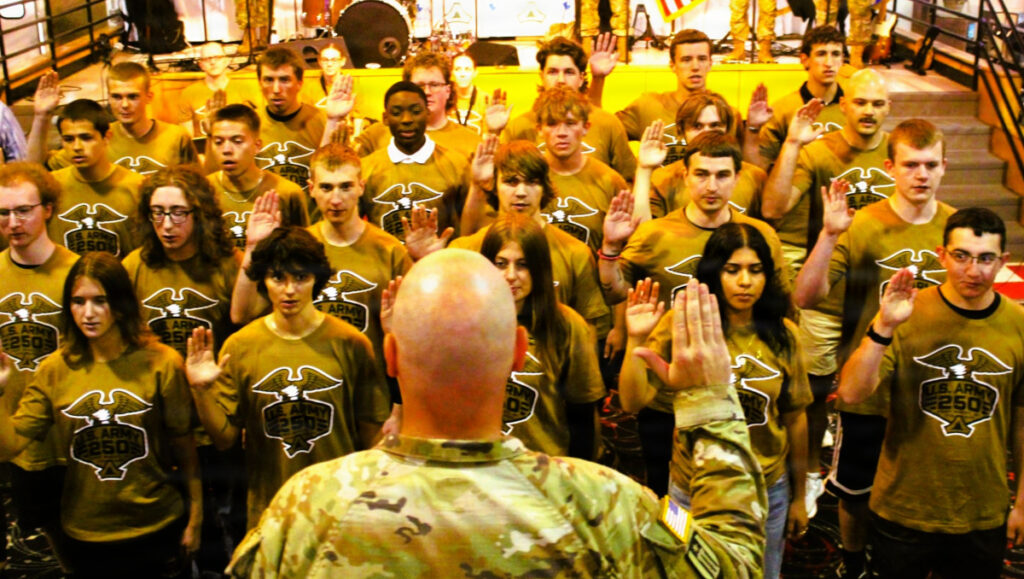
Photo Description: An Army officer gives the oath of enlistment to new Army recruits during the opening ceremony of the birthday luncheon June 13, 2025, for the Fort McCoy, Wis., observance of the Army’s 250th birthday at McCoy’s Community Center.
Photo Credit: U.S. Army Photo by Scott T. Sturkol, Public Affairs Office, Fort McCoy, WI