
The debate over resuming the draft often resurfaces during global tension, yet its complexities remain misunderstood. Editor-in-Chief JP Clark sits down with experts William Taylor and Katherine Kuzminski to bridge the gap between myth and reality regarding the all-volunteer force and selective service.
Their conversation explores why the U.S. transitioned from conscription in 1973, highlighting historical challenges like high turnover and low morale. Kuzminski explains that a modern draft would require immense political capital from both the President and Congress, likely occurring only during an existential threat. The discussion also examines 21st-century mobilization hurdles, including the need for specialized technical talent and the strain on existing processing infrastructure. This episode provides essential context for anyone curious about the future of national service and military readiness.
What happens when we send 100 to 500,000 individuals who don’t necessarily want to be drafted to the front door of those MEPS stations when we were not able to process the volume that was showing up during a recruiting crisis?
Podcast: Download
Katherine Kuzminski is the Director of Studies at the Center for New American Security, or CNAS, where she is responsible for managing the center’s research agenda, publications, and research staff. She is also the lead for CNAS’s work on all things human capital and national security, a vast topic which includes military recruitment, retention, and talent management, mobilization, Department of Defense, institutional and organizational design and management, civil military relations, and veteran and military family issues. She has many publications, but the three most relevant to the all-volunteer force are Short Supply, Identifying and Addressing the Root Causes of Declining Propensity for Military Service, and Back to the Drafting Board, U.S. Draft Mobilization Capacity for Modern Operational Requirements, both from CNAS and then hot off the presses, Bend Do Not Break, Shaping the Future of the All-Volunteer Force (Oxford University Press, 2026).
William Taylor is the Lee Drain Endowed University Professor of Global Security Studies and Department Chair at Angelo State University in San Angelo, Texas. He is a graduate of the United States Naval Academy, and earned a Master’s in History from the University of Maryland, a Master’s in National Security Studies from Georgetown University, and an MPhil and PhD from George Washington University. He published Peace, War, and Partnership, Congress and the Military Since World War II (Texas A&M University Press, 2023) The All-Volunteer Force, 50 Years of Service (University Press of Kansas, 2023) and The Advent of the All-Volunteer Force, Protecting Free Society (Routledge, 2023).
JP Clark is an associate professor of military strategy teaching in the Basic Strategic Art Program. He served in the army for twenty-six years as an armor officer and strategist. He holds a Ph.D. and M.A. in history from Duke University, an M.S.S. from the Army War College, and a B.S. in Russian and German from West Point. He is the author of Preparing for War: The Emergence of the Modern U.S. Army, 1815-1917 (Harvard, 2017). He is currently working on a history of U.S. military strategy in the Pacific from 1898 to 1941 that is under contract with the University Press of Kansas. He is the 3rd Editor-in-Chief of War Room.
The views expressed in this presentation are those of the speakers and do not necessarily reflect those of the U.S. Army War College, U.S. Army, or Department of War.
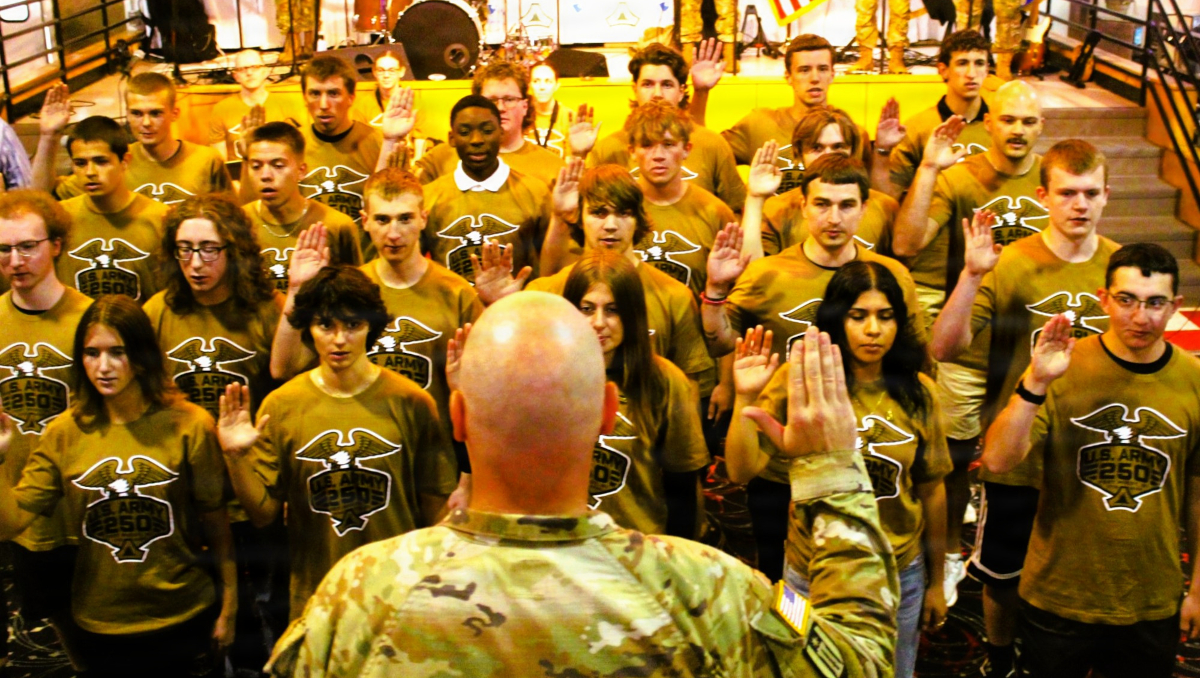
Photo Description: An Army officer gives the oath of enlistment to new Army recruits during the opening ceremony of the birthday luncheon June 13, 2025, for the Fort McCoy, Wis., observance of the Army’s 250th birthday at McCoy’s Community Center.
Photo Credit: U.S. Army Photo by Scott T. Sturkol, Public Affairs Office, Fort McCoy, WI

From the written introduction to our podcast above:
“Kuzminski explains that a modern draft would require immense political capital from both the President and Congress, likely occurring only during an existential threat.”
Q: What, then, constitutes “an existential threat?”
A: “While an existential threat is generally defined as something that is a threat to existence, this is imprecise and deserves further explanation. A more detailed definition could point to a threat being existential if it involves a group with the capability to permanently change another group’s values and the way it governs itself against the latter’s will. Two examples where a group permanently changed another group’s values and the way they govern, against their will, occurred during World War 2. In this case, the Allies destroyed the 25-year-old Nazi movement in Germany and the 76-year-old Imperialism movement in Japan. To make this happen took tremendous military force. Not counting the Allied Forces, the United States employed 16,112,566 military members and two nuclear weapons to achieve this end. Today, a truly existential threat to the United States would entail another country being able to permanently take away its freedom and change its democratic form of government, regardless of the preference of the citizenry.” (See the February 10, 2016 RealClearDefense article “What is an Existential Threat?” by Phil Walter.)
Based on the above, might the following be considered as reasonable follow-on questions?:
1. Does China, or Russia — or China and Russia combined — do these folks have an overwhelming desire to “permanently take away our freedom and change our democratic form of government, regardless of the preference of our citizenry?”
2. If China, or Russia — or China and Russia combined — if these folks do have such an overwhelming desire, do they — now or in the near term — have the necessary military abilities and capabilities needed; this, to achieve these such objectives against our will?
3. If the answer to either question 1 or 2 is in the negative, then why would we need to concern ourselves, now or in the near term, with questions relating to a “draft?”
4. Herein, if China, or Russia — or China and Russia combined — if these folks do have an overwhelming desire to “”permanently take away our freedom and change our democratic form of government, regardless of the preference of our citizenry,” then why would they not just continue along their current (seemingly successful?) path — of “changing the preference of our citizenry” via other ways and other means?
Note that, from the “other ways and other means” perspective of my question No. 4 immediately above, the existential threat that we would seem to need to be most concerned with today, this would seem to be the effort made by China, Russia, etc. — to change “the preferences of our citizenry” — this, so as to, and in this manner, “permanently take away our freedom and change our democratic form of government?”
In circumstances such as these, who do we “draft?” (In this case, I am thinking more like an NFL team football coach going to the yearly “talent” draft. I am looking for the best in specific things that we need to address specific problems, such as, in my scenario here, the “other ways and other means” threat that I describe above.)
Based on the matters that I have presented above, might we say that:
a. What China, Russia, etc., want to do, this is to peacefully — without kinetic “war” — “change the preferences of our citizenry,” and in this such manner to peacefully — without kinetic “war” — “take away our freedom and change our democratic form of government?” If so, then might we say that:
b. THIS is the existential threat that we should/must be most concerned with today?
Accordingly — and from this such specific peaceful/non-kinetic “war” perspective — (a) what U.S. and/or other nation’s citizenry, (b) with what knowledge, skills, abilities, attributes, etc., (c) and in what numbers, do we need to (via voluntary and/or non-voluntary means?) make ready, employ and deploy today; this, so as to adequately address — and so as to adequately take on and defeat — the peaceful/the non-kinetic “war” existential threat that I describe above?
(Herein, given the framing, the “naming,” the nature and/or the character of the conflict, as I describe it above, might not millions of Americans (etc.) be both more willing — and more able — to enthusiastically participate in same?)
Drafts aren’t necessary.
“A well regulated militia, being necessary for a free state, the right to keep and bear arms shall not be infringed”
This IS the Constitutional mandate for universal military service. Why? Because: what do you need for a well regulated militia, *before* the guns? What do you need?
PEOPLE !
And in that service the entire population who are physically able to serve, will be properly trained to a high standard of firearms use and safety, which then makes the entire population competent on their arms, which they have the absolute individual inalienable right AND DUTY, to keep and bear.
So if Joe Schmuckatelli leaves his firearm where his toddler gets ahold of it and shoots his little friends, or if his teenage son gets a hold of it and shoots up a school, Joe Schmucatelli will stand trial, with a jury of his peers who all know, he was trained better than that because they also were trained better than that.
Also, that means, as a matter of national security, mandatory funding for the VA directly out of the deepest pockets of DOD, as a warranty for serviceability in civilian life on every American who served, which pays for lifetime, comprehensive health care on every American. Mostly. Americans who are disabled or couldn’t serve, need to be covered too as a matter of national security.
The 2nd Amd already gives us a three-fer out of that deal. All we have to do is embrace it.
I think that there is a need for the draft in order for civilian male population to have skin in the game. I think that many young men being drafted will act out against our Armed Forces. With that in mind, you would need to have all levels of leadership ready to punish promptly each case of bad behavior and indiscipline actions.
It would look ugly and would have to be explained to the public at large. Kipling had an idea of what it would take.
https://www.kiplingsociety.co.uk/poem/poems_youngbrit.htm