


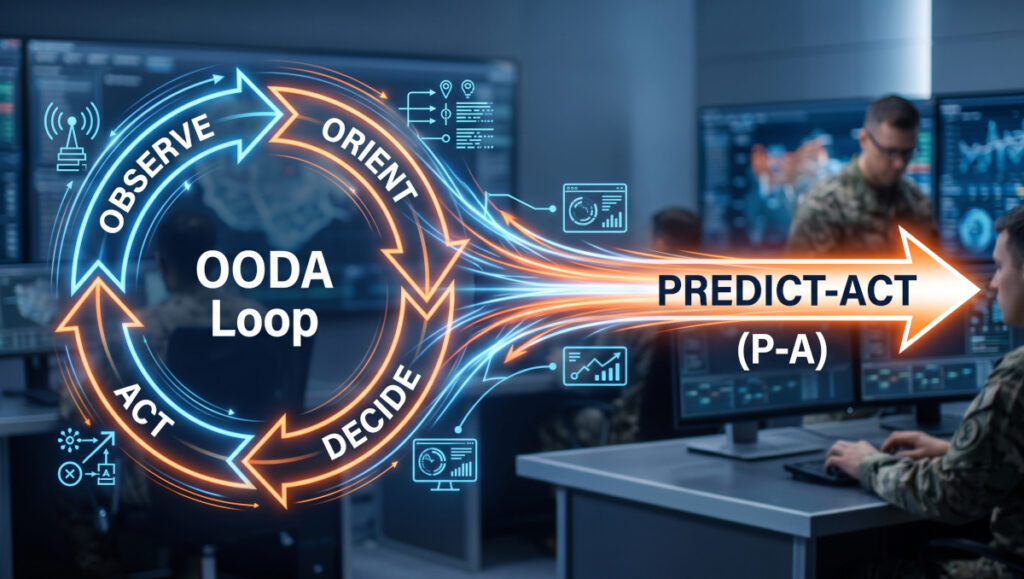
We are trading the reflection and adaptability of the circle for the velocity of the arrow.
The case for racing to dominate the cognitive domain is, by now, familiar. For years, strategists have argued that the army’s decisive, lasting advantage would be won not in the physical domain but in the cognitive one, where we know and act faster than an adversary. Finishing second in the race for artificial intelligence and intelligence amplification is unacceptable. This argument has taken hold, and the joint force is now running hard. But the urgency to finish first has produced a consequence few anticipated. In the rush to act faster than the enemy we may be dismantling the very decision model on which the original advantage was built.
For two generations, John Boyd’s OODA loop—observe, orient, decide, act—has shaped how the U.S. military thinks about decision advantage. Today, threats that move faster than human judgment are changing that loop. Driven by tactical necessity and often without awareness, the OODA loop is being transformed along a three-stage path toward a “predict-act” (P-A) vector.
This transformation represents a shift in the physics of command. A loop operates as an adaptive, circular system that self-corrects through feedback. By contrast, a vector acts as a straight, one-way arrow defined by direction and magnitude. In a P-A vector, the direction is the shortest line of action from prediction to execution, and the magnitude is the algorithm’s confidence score (see ‘Stage III,’ below). By collapsing the loop into a vector, we are trading the reflection and adaptability of the circle for the velocity of the arrow. This article traces that change across three stages and shows that it is already underway in fielded systems; further, it argues that the speed gained comes with risks we must proactively account for.
Stage I: Compressing Sensing — from Observe-Orient (O-O) to Recognition (R)
The first stage of this transformation occurs in how we “see” the battlefield. In modern conflict, the speed and volume of incoming data mean we can no longer afford the luxury of separate “observation” and “orientation” phases. To meet the demand for speed, we are merging these two steps into a single, automated state of Recognition (R), turning the decision cycle into R-D-A (recognize-decide-act). To recognize is to nearly instantly fuse inputs into a single understanding of the environment, allowing commanders to bypass manual observation and orientation. Instead of being overwhelmed with data, commanders receive a customized operational picture (the new COP) tailored to exactly how they process information.
Driven by the need to prevent cognitive overload, the transition from discrete sensing to integrated recognition is already running across multiple domains. In the air, the F-35’s fusion engine integrates feeds from its Active Electronically Scanned Array (AESA) radar, its electro-optical Distributed Aperture System (DAS), and secure tactical links, to project a single, coherent picture directly onto the pilot’s helmet visor, allowing the pilot to recognize a threat and react. On the ground, the same recognition compression reaches infantry squads through the Army’s Soldier Borne Mission Command (SBMC), which overlays terrain maps, drone feeds, and thermal target markers onto the soldier’s field of vision. At the operational level, under the Combined Joint All-Domain Command and Control (CJADC2) architecture, AI tools developed under Project Maven scan massive intelligence streams, converting raw sensor feeds into targets faster than any analyst could.
This transition aligns with Gary Klein’s Recognition-Primed Decision (RPD) model in cognitive psychology. Klein’s research shows that experienced leaders do not waste time comparing lists of options; instead, they instantly recognize a pattern and match it to an intuitive response. By fielding these technologies, the joint force has effectively automated that step. Near-instant recognition is now delivered directly to the decision-maker, compressing the observe and orient phases of the decision loop.
Stage II: The Emergence of Foresight — From Recognition (R) to Anticipation (A)
As Stage I matures, the joint force is already progressing into the second stage of the transformation: moving from R-D-A to A-D-A (anticipate-decide-act). Out of the urgent need to secure foresight before the physical battle begins, we are trading real-time reaction for active anticipation. To anticipate is to map out multiple branching future possibilities and options, allowing the force to proactively prepare for what an adversary might do next.
This shift toward automated anticipation is expanding across multiple echelons. During the Defense Advanced Research Projects Agency’s (DARPA) Air Combat Evolution (ACE) program, AI-controlled X-62A (Variable In-flight Simulation Test Aircraft) VISTA aircraft flew real-world maneuvers against human pilots, demonstrating that machine learning can preemptively position an aircraft, by anticipating aggressive human maneuvers before they occur.
In Ukraine, decentralized AI platforms coordinate swarms of drones, sharing target data and automatically reassigning roles in anticipation of jamming or other countermeasures. At the operational level, situational-awareness systems integrated with commercial AI platforms analyze historical enemy movement, supply paths, and terrain, to anticipate where an adversary is likely to establish defensive positions days in advance. In each case, the system is no longer recognizing what is happening; it is forecasting what is about to happen.
Stage III: The Hypersonic Vector—from Anticipate-Decide-Act (A-D-A) to Predict-Act (P-A)
At extreme speeds, the deliberate “decide” step becomes the bottleneck, and anticipation and decision (A-D) collapse into prediction (P) resulting in a direct predict-act (P-A) vector. In this model, predicting means calculating a single optimized outcome with an assigned confidence score and providing the immediate data trigger to execute automated action. The confidence score is not the new component that defines P-A because probabilistic forecasting systems like weather models and AI-enabled targeting tools already do that. The distinction is that once a prediction crosses a preset confidence threshold, the system triggers action automatically, with no human decision in between. In this new model, the person no longer decides whether to act. Instead, the person sets in advance the conditions under which the machine will act.
It is important to fully appreciate the P-A framework. Boyd’s logic of advantage was out cycling the adversary. That is, running your own OODA loop faster than the adversary could run theirs, presenting them with dilemmas they could not process in time (an overwhelming tempo of threats). The logic of P-A is different. It wins by out-predicting and preempting the adversary. It seeks to forecast the adversary’s move with enough confidence to act first, effectively shutting down adversary options before they are exercised. In doing so, the system predicts what will happen without necessarily understanding why. Prediction, not comprehension, becomes the basis for action. This is the implication at the heart of the P-A vector, and it is the source of the risks that follow.
The P-A vector is already deployed across several limited systems in modern combat. At the tactical defensive edge, automated air-defense systems such as the Aegis Combat System, the Phalanx Close-In Weapon System, and the Iron Dome represent the extreme of this compression: their tracking algorithms predict where a fast-moving threat will be in the future and fire interceptors automatically. The same logic now appears on the offensive end in Ukraine, where mass-produced first-person view (FPV) drones use onboard AI-guided terminal navigation to predict a target’s vector under heavy jamming and execute the final attack autonomously. At the operational level, predictive analytics increasingly generate friendly courses of action with explicit confidence levels. This dynamic is moving the commander’s role from choosing from various options in the moment to pre-authorizing the conditions under which an option is automatically executed.
Because predictive models are trained on historical data, they are blind to “Black Swan” events that a creative adversary could deliberately use to hide its actions.
The Reality of What We Are Up Against: Risks and Blind Spots
Because this transition to a predict-act framework is occurring across many different systems, we must proactively design safeguards. Deep neural networks like those in many AI models are easily fooled by adversarial spoofing, so an enemy can feed “synthetic anomalies” into our sensors, tricking our AI into executing predictable preemptive actions that play directly into their hands. And because predictive models are trained on historical data, they are blind to “Black Swan” events that a creative adversary could deliberately use to hide its actions.
Predict-Act also introduces the very real threat of cascading failure. Commercial high-frequency trading (HFT) is a good example. In HFT, AI algorithms predict very small market movements and execute millions of trades in microseconds, with no human in the decision path (the P-A vector). On May 6, 2010, those systems produced the “Flash Crash” in which competing HFT algorithms drove the market into a “crash” that erased roughly a trillion dollars in value in minutes, well faster than any human could intervene.
Now transpose that dynamic onto a crisis between nuclear-armed states. A minor sensor glitch or a deliberately injected synthetic anomaly could lead one side’s AI to a high-confidence ‘mis-prediction,’ which could auto-trigger a preemptive action, which in turn could trip the adversary’s similarly automated P-A response. In seconds, both sides could slide into an uncontrollable “algorithmic flash war” before human leaders can register that a crisis has begun. This is the danger of fielding predict-act systems that act on prediction without understanding: they will fail beyond the reach of the humans nominally in charge.
The Commander’s New Art
The transition from OODA to R-D-A, then to A-D-A, and finally to a predict-act vector is our current trajectory. We are moving there out of urgency and necessity, but perhaps without realizing how far we have already traveled. Whether P-A is the OODA loop’s evolution or its quiet replacement is, in the end, an academic question; the systems are being fielded either way, and the risks are the same. What matters is that we recognize the shift and govern it deliberately rather than stumble into it.
To mitigate these risks, our networks must integrate cognitive “circuit-breakers” and anomaly filters that alert commanders to strategic deception. Crucially, the “act” component of any P-A vector must include non-kinetic, defensive, or “silent standby” postures as automated defaults, so that the reflexive response to uncertainty is restraint rather than escalation.
Managing these systems also requires a new set of commander-driven tools designed specifically to prevent a “human-out-of-the-loop” situation, where automated speed creates a human-less vulnerability. First, commanders must actively articulate acceptable confidence levels. For example, they must raise the required confidence score to near-certainty in a murky gray-zone crisis to prevent accidental escalation, while lowering the threshold in high-tempo, defensive operations where the speed:survival ratio is high. Second, commanders must enforce algorithmic red-teaming, standing up specialized teams to aggressively probe and spoof their own AI systems to expose blind spots before the enemy can exploit them. Finally, to counter the danger of staff complacency and loss of cognitive fitness, leaders must mandate randomized cognitive audits, forcing their staffs to manually reconstruct the data-logic behind machine-generated plans to preserve active, critical human thinking.
All these safeguards are commanders’ business, and leaders must truly understand how they work. In a predict-act era, the commander’s role shifts fundamentally from executing real-time actions to managing the strategic bounds of ‘what we are allowing machines to do.’ The commander’s biggest responsibility may no longer be to fight the battle, but to engineer and program the limits of the fight and to place “humans-before the-loop (or vector).” This shift defines the future “art” of warfighting. Designing, adjusting, and enforcing these algorithmic guardrails will become the single most critical component of a commander’s intent.
Sam White is the Deputy Director of the Center for Strategic Leadership at the U.S. Army War College.
The views expressed in this article are those of the author and do not necessarily reflect those of the U.S. Army War College, the U.S. Army, or the Department of War.
Photo Credit: Created by Gemini