
A word of caution: Incorporating wargaming into a classroom requires hard work from the faculty that will push many instructors outside of their comfort zone.
In September 2020, two Army War College faculty—Christopher Hossfeld and Ken Gilliam—asked in the virtual pages of this journal, “Shall I play a game?” Their article detailed the initial implementation of the Joint Overmatch (JO) Euro-Atlantic wargame. At that time, Although Hossfeld and Gilliam’s answer was an unequivocal “Yes,” I replied, “Maybe.” After four years of experimenting with wargames, I have changed my response to an enthusiastic “Yes.”
Wargaming is a time-honored method in military education, particularly within joint professional military education (JPME) institutions. It offers an experiential learning environment that fosters strategic thinking, operational-level planning, and joint force integration.
Yet educators face the persistent challenge of prioritizing learning outcome achievement while overseeing the execution of the wargame. Overcoming this challenge requires thoughtfully designed and implemented wargames. Wargame designers must minimize game complexity while faculty and administrators must ensure that specific pedagogical conditions are met prior to wargame execution. Even when working with well‑designed games, faculty should be careful to maintain focus on the broader learning goals rather than becoming absorbed in minutiae like tactical engagement results and dice rolls.
Using the wargame Joint Overmatch (JO) as a case study, I provide recommendations for faculty instructors (FIs) to integrate wargames into a professional military education classroom. There are countless techniques from which to choose, but the essential elements for achieving learning outcomes are simple faculty proficiency and thoughtful game integration.
The Value Proposition of Wargaming
A word of caution: Incorporating wargaming into a classroom requires hard work from the faculty that will push many instructors outside of their comfort zone. Most professional military education institutions liberally blend Socratic methods with small-scale experiential learning activities, including group work and topical debates in the classroom. These are proven techniques. So why use wargames?
Simply put, with proper faculty investment, wargames provide a large bang for the buck and can appear almost magical in their power to inform and instruct. Regardless of the instructional method, JPME aims to evaluate joint warfighting-based outcomes with an emphasis on decision-making. Assessing students’ judgment in joint warfighting and other practitioner skills is very difficult via Socratic dialogue alone. Conversely, as wargaming expert Eric M. Walters emphasizes, assessing and practicing military decision-making is the primary purpose of wargames. Well-designed wargames blend experiential learning with Socratic dialogue, all while enabling the assessment of learning outcomes. Classroom wargames provide more than simulations—they allow students to apply doctrinal and service concepts in realistic scenarios, experience the consequences of decisions in a controlled environment, and apply the instruments of military power through the lens of the joint force. This methodology aligns with the Officer Professional Military Education Policy (OPMEP), which emphasizes incorporating active performance-oriented experiential learning methodologies.
Shortly after joining the U.S. Army War College (USAWC) faculty, my department chair invited me to participate in the experimental Joint Overmatch wargame. I readily accepted and partnered with three fellow faculty members from the Department of Military Strategy, Planning, and Operations, along with an expert wargamer from the Center of Strategic Leadership Wargaming Division, to evaluate the concept for integrating a board-style game into the Military Strategy and Campaigning curriculum. This marked the beginning of my four-year journey of integrating wargames into a seminar-style classroom environment, working with students to enhance strategic learning through experiential methods.
Joint Overmatch Background
Joint Overmatch is no longer used in the Army War College’s resident course. In part, this is due to unrelated changes in the larger curriculum. But it is also due to a continuous process of learning in how best to incorporate wargames; Joint Overmatch was a critical first step in that journey. As such, faculty can apply my lessons learned to the integration of any professional military education wargame.
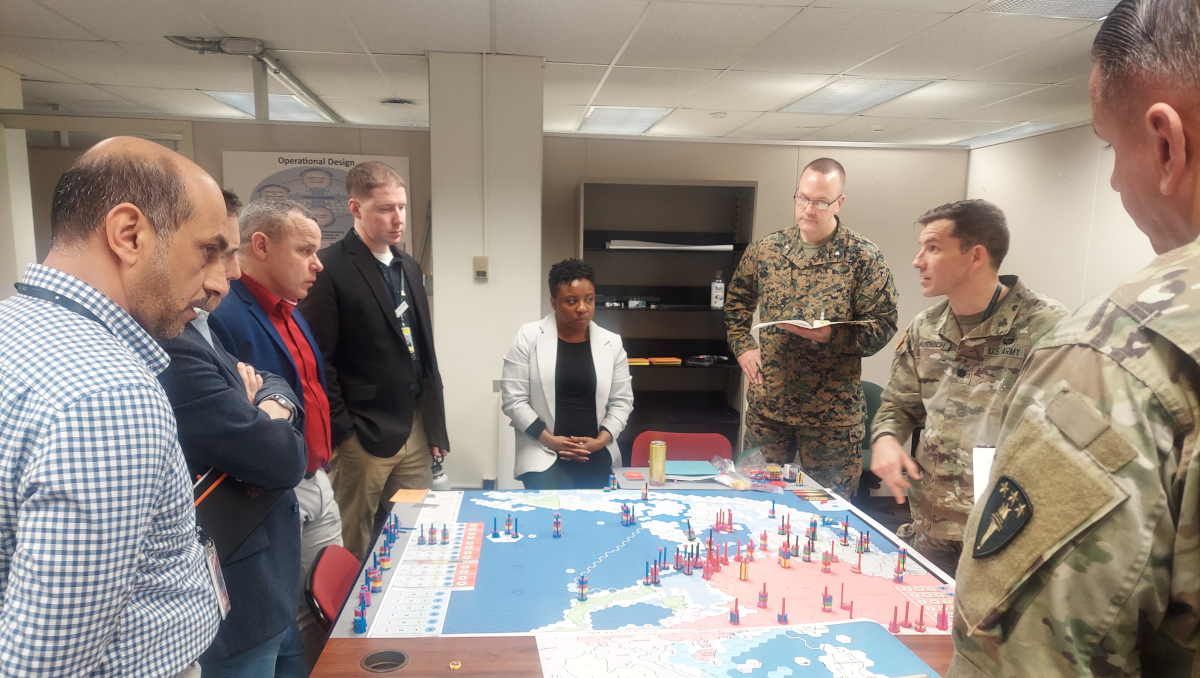
The faculty designed Joint Overmatch as a culminating experiential learning event of Military Strategy and Campaigning—one of the major blocks of instruction in the core curriculum. Additionally, I found great value in the game’s potential to support other curriculum learning outcomes. Using either a Euro-Atlantic or Indo-Pacific scenario, students spent four days fighting a campaign of several weeks of game time The game simulates warfighting across all domains with a relatively rigid rule and adjudication system using dice to introduce the unpredictability of combat. One instructor facilitates the game for a seminar of around sixteen students divided into two teams: one blue (the United States military and select partners) and one red (the adversary military and select partners). The instructor begins the exercise by issuing strategic guidance, then each team develops an overarching operational campaign. Teams use various tools from the curriculum, such as operational design and the joint planning process, to develop their campaigns. Students execute their campaigns over multiple turns and, after observing the effects of adversary actions and chance, adjust their approach. Faculty members regularly pause the game for discussion and, more importantly, to emphasize key learning outcomes, often employing the Socratic method. Faculty who taught other core courses, including those focused on strategic theory, national security policy, and defense management, also participate in the game and find opportunities to reinforce concepts from their courses. An engaged and well-prepared faculty can use joint overmatch as a capstone that reinforces many of the lessons taught in the Army War College core curriculum.
Some faculty complained that the rules were overly rigid and adjudication took too long. Yet despite imperfections in the game, many of my colleagues and I viewed the game positively. The recommendations below encapsulate best practices applicable to many academic wargames:
For a complex game such as Joint Overmatch, faculty must be well-versed in the course curriculum and gameplay, so they can focus on game integration and implementation.
Set realistic expectations for success
Too often, faculty and students misunderstand wargames and hold unrealistic expectations for what a game can and cannot achieve in professional military education. Because the Joint Staff’s Outcomes-Based Military Education (OBME) methodology encourages the use of wargames in military education, faculty can be drawn to the idea of wargaming without fully understanding the requirements and limitations. For a complex game such as Joint Overmatch, faculty must be well-versed in the course curriculum and gameplay, so they can focus on game integration and implementation. The lure of attempting too much can be particularly difficult to overcome for new faculty who are still mastering the curriculum and are inexperienced with wargames. Setting achievable expectations enables the faculty and students to define success more clearly. My definition of success includes the following: achieve course and game learning outcomes; execute game turns smoothly; integrate the entire faculty team and other curriculum concepts; and, not least, enjoy the game. The last element is not a throw-away line. Wargames are challenging for faculty and students alike; enjoying the exercise is essential to learning. It took me a year before the seminar met all these objectives. It took me another year to learn the importance of explicitly providing these expectations at the beginning of the course so that students understood what to expect from the game and what was required of them.
Complex games must be incorporated early in the curriculum.
The major problem in the first year was that I started too late. Although I was well prepared to facilitate game execution and discussion, the students faced a too-steep learning curve. For students to focus on achieving learning outcomes, they must be comfortable with game play. One solution is to introduce the game early in the course curriculum. In my second year, I introduced the game midway through the four-month course. In years three and four, I introduced the game in the first week of the course and used the game at various points of the curriculum to enhance learning and improve students’ comfort with game play. This approach proved invaluable and enabled our capstone 4-day exercise to achieve all learning outcomes because of the early integration. Early integration eliminated the requirement for a practice turn on day one, so students could immediately start planning at the start of the exercise. Additionally, we did not waste time “fighting the game.” I define “fighting the game” as students and faculty arguing over rules such as the sequence of play, engagement adjudication, and turn execution. By mostly eliminating “fighting the game,” we were able to focus on achieving learning outcomes, and we enjoyed the game!
This early introduction also enabled other members of the faculty team to plan and integrate other course learning outcomes into gameplay. Complex games can also be stressful for faculty. Faculty can reduce stress through a practical, realistic approach that includes learning the game over an extended period of time. Even with early introduction, all involved must be completely invested in the game’s success.
Invest in the game as a tool of the trade
Professional military education practitioners rely on tools of the trade. Like any good tradecraft, practitioners should master those tools. Embracing a game as an educational tool puts faculty in the proper mindset for learning the game and being creative with game implementation. In the year-one game pilot, I was invested, but I did not completely understand how to use the game as a tool. The first lesson learned was that faculty must be experts on game facilitation. While I had participated in faculty development sessions and did some individual preparation prior to game execution, I did not do enough. My inadequate investment became evident in the first two turns of the game. I required significant assistance from an experienced facilitator to successfully complete the turns. During the third and fourth turns, I felt more comfortable, so the turns were successful. This was my first board-style wargame, so some stumbling was expected, but I could have rehearsed gameplay more. I apologized to the students for the hiccups, but vowed that if given the chance, I would not begin another game unprepared. For the subsequent years, I ensured that I was well versed on adjudication and overall gameplay rules. To make sure the rules were fresh in my mind, I would prepare by executing at least two practice turns by myself the day prior to the first day of the game. During the rehearsal, I roleplayed being both a facilitator/adjudicator and a student using scripted campaign objectives, operations, and activities for both blue and red teams. I conducted year two using the Euro-Atlantic version of the game as the sole facilitator/adjudicator, and the game went well. To avoid the struggles I faced during my first year, new faculty can build confidence and improve their initial war‑game experience by partnering with and rehearsing alongside experienced faculty.
Once I became comfortable with gameplay and adjudication, I found the benefits of the game outweighed the tax on personal time. More importantly, my game preparation workload decreased each year. Years three and four were better than years one and two, and integration of the faculty team and other curriculum learning outcomes improved. Once I realized the benefits of wargaming, I found additional opportunities to incorporate games into various elective courses.
Conclusion
In summary, incorporating a wargame allowed for evaluating joint warfighting outcomes not attainable through Socratic dialogue while testing student decision-making. When appropriately employed, wargaming is a powerful tool for developing strategic and operational leaders. Effective wargaming depends on thoughtful design and adequate faculty preparation. For a complex game such as Joint Overmatch, faculty members must set realistic expectations for success, incorporate the game early in the curriculum, and invest in the game as a tool of the trade. By balancing complexity with clarity and aligning games to learning outcomes, educators can ensure that wargaming remains a vital component of JPME—preparing students to lead in an increasingly complex operational environment.
Keith Burkepile is the Professor of Military Planning at the Basic Strategic Art Program, United States Army War College (USAWC). He is a retired Marine who commanded at every level from Lieutenant through Colonel. He served in multiple planner positions following his graduation from the School of Advanced Warfighting to include a joint planning tour at United States Africa Command. Prior to his current position, he served as a faculty instructor and Senior Marine at the U.S. Army War College resident course.
The views expressed in this article are those of the author and do not necessarily reflect those of the U.S. Army War College, the U.S. Army, or the Department of War.
Photo Description: AY23 U.S. Army War College resident students conduct joint planning using Joint Overmatch Indo-Pacific Wargame.
Photo Credit: Provided by Keith Burkepile


Here is the conclusion of our article above:
“In summary, incorporating a wargame allowed for evaluating joint warfighting outcomes not attainable through Socratic dialogue while testing student decision-making. When appropriately employed, wargaming is a powerful tool for developing strategic and operational leaders. Effective wargaming depends on thoughtful design and adequate faculty preparation. For a complex game such as Joint Overmatch, faculty members must set realistic expectations for success, incorporate the game early in the curriculum, and invest in the game as a tool of the trade. By balancing complexity with clarity and aligning games to learning outcomes, educators can ensure that wargaming remains a vital component of JPME—preparing students to lead in an increasingly complex operational environment.”
Question:
If our opponents/enemies/competitors are likely to know and understand that our wargames, as presently configured, are designed to help us achieve certain learning objectives — and, thus, that our wargames are subordinate to, and thus are generally controlled and constrained by, these exact same such learning objectives —
(And, thus, are not designed to help our students understand what to do in circumstances in which these exact such learning objectives are not as relevant — and/or are massively challenged, opposed, contradicted, undermined and/or are made less useful by our such opponents, etc.?)
Then, in circumstances such as these, can we actually say that there is some great benefit; this, (a) from the (pedagogical?) use of wargames; this, (b) in the manner described by our author above?
In the alternative, might it be better to craft (more realistic?) wargames — ones in which the learning/learning objectives are not known, and/or cannot be determined — this, until the end of the wargame? And/or wargames in which our opponents, etc. — having excellent knowledge of our teachings, our learning objectives. etc. — act in such a manner as to massively challenge, oppose, contradicted, undermined, go around and/or otherwise make less useful and less relevant same?
I thoroughly enjoyed the wargame we conducted in DDE Second Resident Course 2025. It was adequately scoped and in execution it tested our strategic and tactical mindset. I will say the prompt was the key to success, while many of us would have rather conducted the wargame longer, but it was adequate based on purpose.