
In modern warfare, the front line no longer begins where supply trucks stop. It begins wherever a drone can see.
When a blue force commander says during an after-action review, “We are f—cked,” you know there’s a huge problem.
Here was the scenario. In a simulated exercise, a NATO armored force faced a small opposing-force (OPFOR) team of roughly ten Ukrainian drone operators who were all veterans rotated from front-line units. Using the Delta battlefield-management system, the OPFOR destroyed 17 armored vehicles and conducted around 30 additional strikes across less than 10 square kilometers in under half a day. NATO units never reached the drone team, not for lack of bravery or hesitation, but because logistics failed to deliver timely situational awareness, sustainment support, and responsive maneuver. The failure did not stem from insufficient courage. The exercise exposed systemic vulnerabilities in NATO’s supply chains and operational sustainment.
This was Exercise Hedgehog 2025, one of NATO’s largest drills in years. In May of that year, over 16,000 troops from twelve allied nations—including the United States, United Kingdom, France, and Finland—practiced repelling a simulated Russian incursion along the eastern flank. Among the findings from this exercise was that even well-planned operations can falter when logistics fail to keep peace with high-speed, sensor-driven warfare.
In modern warfare, the front line no longer begins where supply trucks stop. It begins wherever a drone can see. Exercise Hedgehog 2025 exposed an uncomfortable reality for NATO: the alliance’s logistics system, built for secure rear areas and deliberate decision cycles, cannot survive in a battlefield defined by constant surveillance, rapid targeting, and cheap attritable drones.
In short, NATO’s system cannot be adapted, it must be transformed. To do this, NATO must fuse logistics with decentralized (command, control, communications, computers, intelligence, surveillance, and reconnaissance (C4ISR), embed counter-drone capabilities directly into sustainment planning, reform doctrine and training for dispersion under fire, and reorient procurement toward scalable, attritable systems that can regenerate combat power at speed.
When Information Moves Slower Than Firepower
NATO’s logistics architecture has several flaws that Exercise Hedgehog exposed. Its design separates sustainment from real-time information, relies on vulnerable supply patterns, and prioritizes centralized control over distributed resilience.
Disconnection of Sustainment from Real-Time Information
NATO’s hierarchical C4ISR architecture struggled to fuse and disseminate information quickly enough to support modern logistics operations. During Exercise Hedgehog 2025, fragmented situational awareness across echelons, slow dissemination of operational data, delayed logistics decision-making, and legacy C4ISR systems all reduced the ability of sustainment networks to respond at the pace of the battlefield. When sensor-to-shooter timelines compress from minutes to seconds, abundant ammunition and fuel become irrelevant if commanders cannot rapidly translate information into action. The exercise demonstrated that modern logistics depends as much on timely information as it does on physical sustainment, requiring rapid data collection, AI-assisted fusion, and near-real-time dissemination to support maneuver and sustainment. Legacy systems designed for Cold War mass maneuvers were too slow to keep pace.
Reliance on Vulnerable Supply Patterns
Operational sustainment gaps compounded the problem. Forward logistics units frequently lacked sufficient low-cost counter-UAS systems, jammers, and dispersion aids, leaving them exposed to inexpensive, attritable drones. Doctrine and sustainment practices continued to assume relatively predictable, opaque battlefields and concentrated formations, making convoy movements, resupply routes, and logistics nodes increasingly vulnerable to persistent aerial surveillance and precision targeting. As one Estonian officer observed, “Advancing in large convoys during the day is simply no longer practicable.” The exercise further demonstrated the risks of concentrating logistics activities in fixed locations, where fuel, ammunition, maintenance, and command functions created lucrative targets for precision strikes. Together, these observations underscored that sustainment architectures designed for relatively secure rear areas are increasingly incompatible with battlefields characterized by persistent surveillance and compressed targeting cycles.
The Limits of Centralized Sustainment
The underlying challenge was doctrinal rather than technological. Although centralized sustainment remains essential for coordinating resources across a theater of operations, Hedgehog 2025 demonstrated that tactical logistics increasingly depends on decentralized execution when communications are contested and targeting cycles are compressed. Camouflage, electronic discipline, and dispersed sustainment practices were applied inconsistently, not because troops lacked skill, but because training pipelines and doctrinal templates had not fully adapted to the realities of a drone-saturated battlefield. Routine resupply missions became tactical actions subject to direct detection and targeting, while degraded communications slowed coordination between higher headquarters and forward units. As a result, sustainment planning often prioritized efficiency over dispersion and survivability, limiting the ability of subordinate units to adapt rapidly under fire. Logistics is more than cargo in transit; it is the operational capacity those resources create or withhold under fire.
Designed Friction, Real Vulnerabilities
Hedgehog 2025 was deliberately designed to expose the limits of NATO’s sustainment architecture under conditions approximating modern combat. Exercise planners introduced friction, information overload, degraded communications, and contested operating conditions to test whether existing logistics processes could adapt under sustained operational pressure. Rather than revealing isolated shortcomings, the exercise exposed recurring vulnerabilities in information flow, sustainment planning, and command relationships that reflected deeper structural assumptions about how logistics functions in war. Because these vulnerabilities stem from the architecture itself rather than isolated procedural deficiencies, they cannot be resolved through incremental improvements alone. Instead, they point to the need for a fundamental transformation of NATO’s logistics system to operate effectively in a transparent, drone-saturated battlespace. Absent such change, NATO risks maintaining logistics systems increasingly misaligned with the realities of modern warfare.
The exercise demonstrated the need for a comprehensive transformation of NATO’s sustainment architecture, integrating decentralized C4ISR, counter-UAS capabilities, and adaptive supply networks into a unified operational framework.
Breaking the Hierarchy
The findings from Hedgehog 2025 indicate that marginal adjustments to existing logistics processes are unlikely to address the challenges posed by contemporary warfare. The exercise demonstrated the need for a comprehensive transformation of NATO’s sustainment architecture, integrating decentralized C4ISR, counter-UAS capabilities, and adaptive supply networks into a unified operational framework. Doctrine, training, force design, and procurement must likewise evolve to support dispersed operations conducted under persistent surveillance and rapid targeting cycles.
To operate in high-tempo combat, NATO must standardize battlefield-management platforms and low-latency links, while AI-assisted sensor fusion must support real-time supply and maneuver decisions. Counter-UAS tools and tactics should be embedded directly into supply chains. Forward units need low-cost interceptors, jammers, electronic warfare kits, and dispersion aids, while procurement should prioritize scalable, attritable systems over exquisite technologies that are difficult to deploy quickly or in sufficient numbers. Reforming procurement alone is not enough; the operational culture that governs how forces sustain and maneuver must change as well.
Learning to Operate While Observed
Doctrine and training must reflect the realities of sustainment under fire. Massed formations and predictable maneuvers not only increase tactical risk but also create fragile supply patterns that are easy to target. Units should adopt dispersion, concealment, and decentralized execution by default to maintain resilient logistics. Training pipelines should embed multi-domain scenarios that emphasize operational improvisation while under persistent surveillance and fast sensor-to-shooter cycles. Rehearsals must simulate both cognitive overload and logistical friction, preparing officers and NCOs to manage supply, maneuver, and targeting under sustained pressure.
From Linear Supply Lines to Dynamic Networks
NATO must build dynamic, just-in-time supply chains for ammunition, fuel, and repair parts, using predictive analytics and integrating them across allied C4ISR networks to enable real-time, cross-border coordination.
Military logisticians are already grappling with many of these issues. Recent U.S. Army sustainment initiatives have emphasized predictive logistics, using data analytics and machine learning to anticipate maintenance requirements, forecast demand, and improve responsiveness in contested environments. Modular, mobile, and semi-autonomous logistical nodes would reduce reliance on long, vulnerable supply lines. Shared data architectures and automated distribution systems could extend these principles across the Alliance, enabling supply networks that adapt to operational conditions in near real time rather than relying on rigid hierarchical processes.
Use Attritability as an Advantage
Finally, NATO must reorient procurement toward resilience rather than prestige, emphasizing flexibility and attritability. Affordable, widely distributed capabilities such as drones, counter-UAS systems, and modular sensors should complement high-value platforms, helping offset the growing cost asymmetries that increasingly characterize modern warfare, while ensuring that combat power can be regenerated under sustained operational pressure. Systems that depend on centralized maintenance or long resupply cycles become liabilities in fast-moving, contested environments. Procurement should be judged not only by platform performance but by how it strengthens distributed, survivable logistics networks. The modern battlefield is transparent, lethally fast, and unforgiving of rigid, predictable systems. Logistics can no longer function as a rear-echelon activity assumed to be insulated from direct threat. It must operate as an integrated combat enabler, synchronized with sensors, fires, and real-time decision cycles. If NATO fails to fuse sustainment with live information networks, distributed maneuver, and resilient procurement, the next large-scale exercise will not be a rehearsal but a costly lesson delivered under combat conditions. The Alliance retains the industrial capacity, technological sophistication, and operational experience required to adapt. Hedgehog 2025 demonstrated that sustainment architecture must evolve with urgency if the Alliance intends to fight and endure in a sensor-driven battlespace.
Travis Veillon is a former marine infantryman and a federal employee with the U.S. Army Corps of Engineers. He has extensive education and experience in logistics, emergency management, and deployments to austere environments through disaster and recovery operations. His work focuses on operational realities, military adaptation, and strategic forecasting.
The views expressed in this article are those of the author and do not necessarily reflect those of the U.S. Army War College, the U.S. Army, or the Department of War.
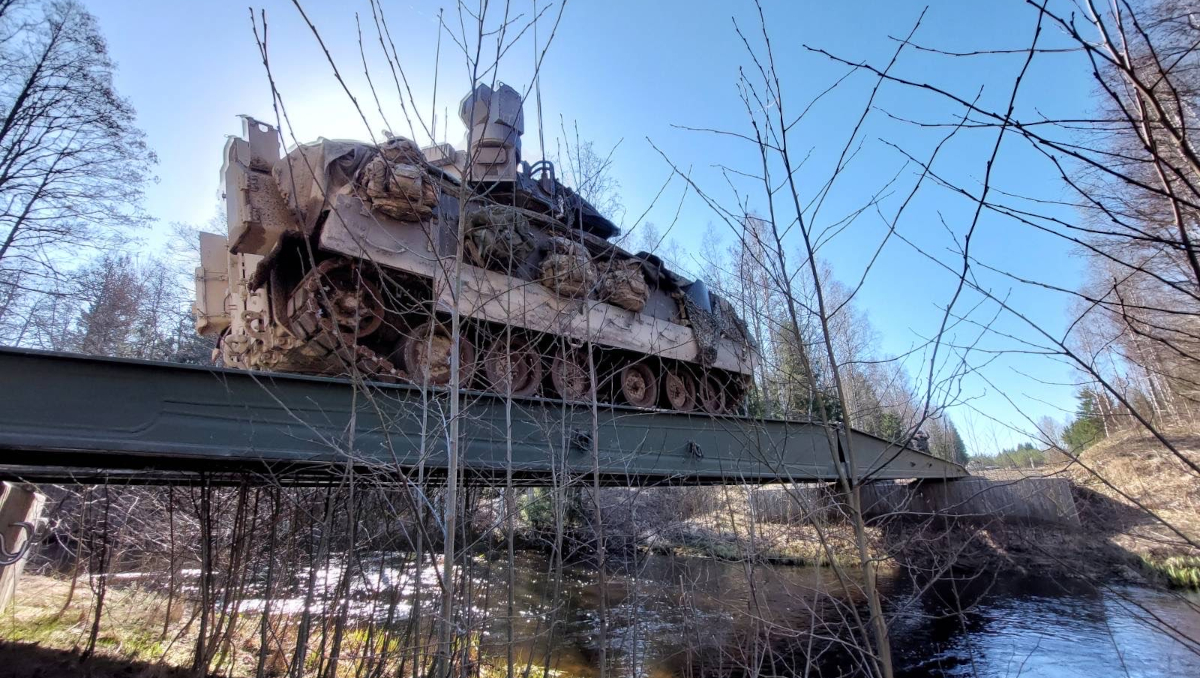
Photo Description: A U.S. Army M2A4 Bradley Fighting Vehicle, operated by a U.S. Soldier assigned to Apache Troop, 5th Squadron, 7th Cavalry Regiment, 1st Armored Brigade Combat Team, 3rd Infantry Division, crosses a bridge during Exercise YMIR at Camp Tapa, Estonia, April 10, 2025. Exercise YMIR, in preparation for Exercise Hedgehog, was a ten-day joint exercise from April 7-15 featuring complex mounted and dismounted maneuvers, combat support integration, and multinational interoperability. Country participants included Estonia, U.S., U.K., France, Latvia, and Poland.



Useful Paper