If the United States hopes to negotiate a new agreement with Russia—and possibly China—it must recognize that presidential rhetoric and ad hoc bargaining will not be enough.
A “better” U.S.-Russia nuclear arms control treaty than the recently expired New Strategic Arms Reduction Treaty (New START) is possible, if U.S. policymakers recreate the conditions that made New START succeed: strong presidential leadership, rigorous military and intelligence analysis, skilled negotiating capacity, and deliberate planning for Senate ratification. New START did not emerge from a quick deal or a momentary reset. It was the product of sustained political effort to manage alliance concerns, integrate operational realities, and build domestic support for arms control. If the United States hopes to negotiate a new agreement with Russia—and possibly China—it must recognize that presidential rhetoric and ad hoc bargaining will not be enough.
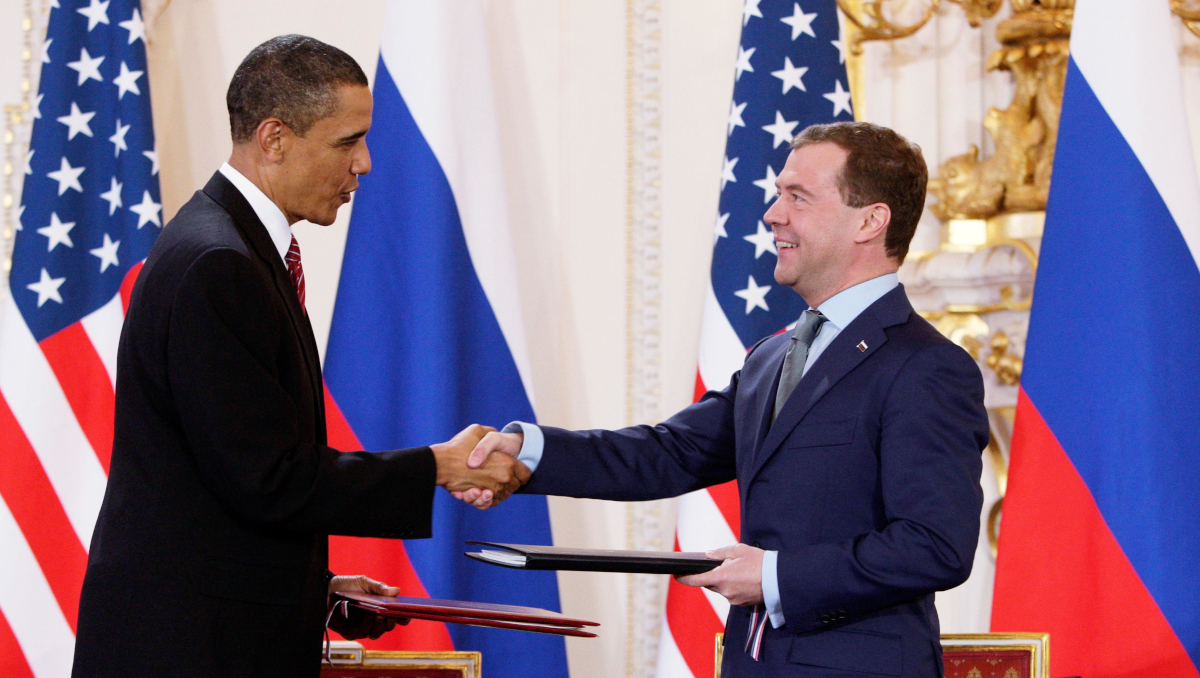
New START was integral to President Barack Obama’s Russia policy because both governments saw arms control as a way to stabilize a badly strained relationship. The treaty, the last in a sequence of US-Soviet/Russian nuclear arms control treaties that began with the 1972 Strategic Arms Limitation Treaty (SALT I), expired on February 5, 2026. Presidents Obama and Dmitry Medvedev signed the treaty in April 2010, and it went into force in February 2011. Its provision allowed a five-year extension, which Presidents Joe Biden and Vladimir Putin agreed to in 2021. Many scholars and foreign policy elites viewed New START as the centerpiece of President Obama’s effort to “reset” relations with Russia after tensions during President George W. Bush’s second term, when the United States advocated for Ukraine and Georgia to join NATO and launched the intervention in Iraq. The two countries also clashed over the US-led European ballistic missile defense system on NATO’s eastern flank, which Russia believed undermined its deterrent rather than protecting NATO members from Iranian missiles.
President Obama inherited both a diplomatic problem and a policy deadline, making arms control a strategic necessity rather than a discretionary initiative. When he took office in January 2009, he faced deteriorated relations with Russia, an expiring strategic arms control treaty—the 1991 US-Russia START treaty, due to end in December 2009—and a congressionally-mandated Nuclear Posture Review (NPR). President Obama believed a new treaty could address the first two issues, but it also had to be consistent with the NPR’s examination of the U.S. nuclear posture for the next five to ten years. In that sense, the treaty had to serve not only as a negotiating objective, but also as a part of a broader effort to define U.S. arms control policy.
Given these pressures, the Obama administration moved quickly, foregoing an extensive interagency review of Russia or arms control policy and making use of recent Bush administration nuclear analyses. In April 2009, President Obama declared his nuclear policy in a speech in Prague. Known later as the “Prague agenda,” one of its key components was reducing the role of nuclear weapons in U.S. security policy while maintaining a safe, secure, and effective arsenal for as long as nuclear weapons exist. New START formed part of this effort and was designed to uphold strategic stability between the two nations. Thus, the Prague agenda gave New START a political purpose beyond numerical reductions. It translated strategic ambition into concrete, verifiable limits that both parties judged acceptable.
After nearly a year of negotiations, the treaty limited the United States and Russia to 700 deployed intercontinental ballistic missiles, submarine-launched ballistic missiles, and nuclear-capable heavy bombers; 1,550 nuclear warheads on those deployed systems, and 800 deployed and non-deployed launchers and bombers. It also contained a robust verification and monitoring regime based on START’s provisions. Those concrete limits and verification procedures made New START more than a political symbol; they made it a functioning arms control agreement.
Russia’s response to the war in Ukraine effectively hollowed out New START before the treaty formally expired. On February 21, 2023, Russia notified the United States it would “suspend” participation in New START. In late March 2023, Russia announced it would stop sharing biannual nuclear weapons and forces data required by the treaty, and it had already halted U.S. on-site inspections. The United States offered to continue the data exchanges, but once Russia refused, the United States withheld its own data as a diplomatic countermeasure. By the time the treaty expired, Russia had gutted the agreement’s transparency and verification functions.
President Donald Trump’s comments regarding nuclear weapons early last year underscored the appeal of a “better” agreement, but they highlighted the gap between declaratory interest and actual preparation. In September 2025, Putin stated Russia was prepared to continue observing New START’s central quantitative restrictions for one year after its expiration if the United States acted “in a similar spirit.” President Trump replied this sounded “like a good idea,” yet he later said of New START, “If it expires, it expires. We’ll just do a better agreement.” On the day the treaty expired, he rejected Putin’s overture and called for experts to work on a new, improved, and modernized treaty. A day later, a senior administration official at the UN Conference on Disarmament reiterated the administration’s interest in reducing the number of nuclear weapons in the world. The problem is that a better agreement requires far more than rhetorical support.
The desire to fold additional weapons systems and parties into a future treaty may be strategically understandable, but it would make negotiations substantially harder.
A new agreement will also require more than willingness to talk; it will demand a clear U.S. theory of what strategic stability now means. While the 2025 National Security Strategy states an interest in reestablishing strategic stability with Russia, a new treaty obliges the administration to do its homework before negotiations. That means specifying U.S. national interests, clarifying policy objectives, and defining bargaining positions within a strategic framework that includes missile defense and nuclear modernization. Without such preparation, calls for a new treaty risk becoming a slogan rather than a strategy.
The desire to fold additional weapons systems and parties into a future treaty may be strategically understandable, but it would make negotiations substantially harder. The more weapons the United States seeks to incorporate—such as sub-strategic, or tactical, nuclear weapons and new Russian delivery vehicles—or the more parties it seeks to involve such as Russia and China, the more difficult the process becomes. Multiparty talks are historically difficult because of competing agendas, and sub-strategic weapons create distinct verification challenges. For that reason, it would be a mistake to assume that a new US-Russia treaty will be a quick deal. Instead, it requires attention to four lessons learned from the New START experience.
The first lesson of New START is that presidential leadership and alliance management are prerequisites for successful arms control with Russia. The direct engagement of the U.S. president was critical not only in setting the vision, but also in making clear the administration sought a reset in relations with Russia. New START was the core of President Obama’s Russia policy objective, and that required his personal involvement in decision-making and in resolving major negotiating obstacles. NATO solidarity was equally important. President Obama had to reassure allies, especially frontline states, a rapprochement with Russia would not undermine the United States’ NATO commitment or, the credibility of the U.S. nuclear umbrella, often described as extended deterrence.
The second lesson is that arms control succeeds only when military requirements, intelligence realities, and verification needs are built into the negotiating position from the start. Decisions regarding the size and scope of the U.S. nuclear arsenal were not solely political. The treaty’s protocol and annexes, and especially the verification regime, reflected the incorporation of military and technological considerations. The Department of Defense (DoD) considered not only Russian and U.S. nuclear capabilities, but also missile defense plans and the emerging prospect of conventional prompt global strike capabilities, that is, the ability to strike targets rapidly at long range with conventional weapons. The negotiating position therefore rested on a strategic appraisal of what risks the United States was willing to accept.
The third lesson is that successful arms control depends on institutional negotiating capacity, not just on high-level political endorsement. A chief negotiator with strong skills was necessary, but success depended on coordinated teamwork across senior negotiators, technical experts, regional specialists, and legal advisors. Administrative support for a large delegation was also essential. In addition, the U.S. delegation relied on an interagency backstopping committee and a high-level group of National Security Council staff and sub-cabinet officials to provide guidance. That depth of institutional support helped move the negotiations forward when obstacles prevented progress.
The fourth lesson is that a treaty’s viability in the United States depends on whether the administration can assemble a Senate coalition strong enough to ratify it. Because the Senate must give advice and consent to treaties under Article II, Section 2 of the Constitution, securing a two-thirds vote required President Obama to use political tools to build support. In this case, he committed billions of dollars to upgrade the U.S. nuclear triad –the three legs of the force: land-based missiles, submarine-launched missiles, and strategic bombers—and modernize the nuclear enterprise. That modernization commitment helped preserve a credible arsenal while also attracting modest Republican support at a time when the old bipartisan consensus on arms control had eroded.
New START’s history suggests that arms control is not obsolete, but remains effective only when treated as a long-term instrument of statecraft rather than a quick diplomatic fix. These four factors were central to New START’s negotiation and ratification, and they remain relevant because arms control is still one of the few tools available for reducing nuclear dangers and avoiding costly arms races. It would therefore be premature to declare the end of arms control simply because new negotiations appear unlikely at the moment. The more useful conclusion is that future negotiations will require patience, clarity, and preparation. Upcoming multilateral meetings may offer opportunities to explore talks on the margins, and renewed US-Russia military-to-military dialogue provides another channel for discussing security concerns. But if the United States wants an agreement with Russia—or with Russia and China—that genuinely improves on New START, it must first decide what it wants and recreate the political, analytic, and institutional conditions that made New START possible.
Frank Jones is a Distinguished Fellow of the U.S. Army War College where he taught in the Department of National Security and Strategy. Previously, he had retired from the Office of the Secretary of Defense as a senior executive. He is the author or editor of four books and numerous articles on U.S. national security.
The views expressed in this article are those of the author and do not necessarily reflect those of the U.S. Army War College, the U.S. Army, or the Department of War.
Photo Description: Barack Obama and Dmitry Medvedev after signing the “New START” treaty in Prague
Photo Credit: Courtesy of the Kremlin Public Affairs