A lot has changed since the 1940s, but the need for good intelligence has not.
Help wanted: foreign-born U.S. soldiers, sailors, and marines who are trained radio operators, speak a foreign language, and are willing to parachute behind enemy lines to conduct sabotage operations. This was the essence of “Wild Bill” Donovan’s (pg. 364-365) sales pitch to prospective recruits when establishing the Office of Strategic Services’ (OSS) Operational Group in 1942. He needed smart, daring, and loyal men and women who could blend in overseas to conduct both covert and clandestine operations. Within a few months, OSS officers were conducting intelligence operations and fighting alongside the U.S. military and friendly forces in Asia, Europe, and North Africa. For example, the OSS recruited Thai college students in the United States to rescue Allied soldiers and work with resistance fighters in Thailand.
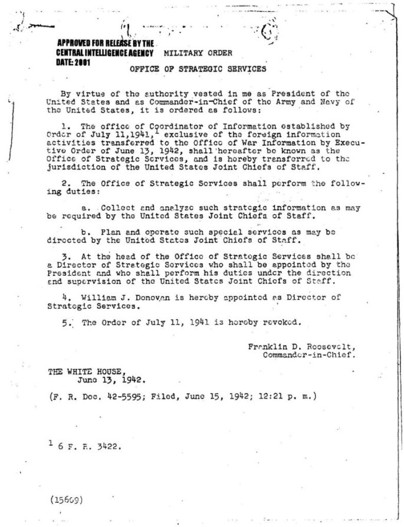
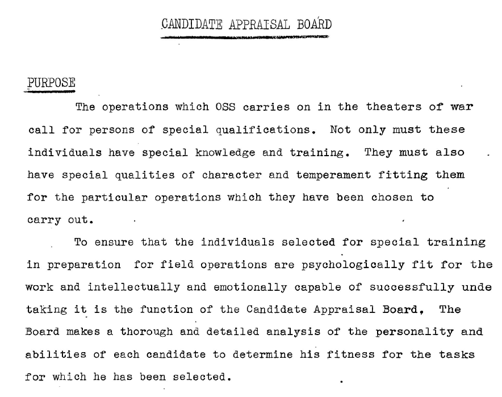
President Franklin D. Roosevelt gave his new OSS Director a broad mandate to “collect and analyze such strategic information as may be required” and “plan and operate such special services as may be directed” by the Joint Chiefs of Staff. This latitude is what Donovan wanted, and he ran with it, immediately recruiting staff and planning operations. He knew he would need different types of people, such as scholars for research and analysis and others with mental, emotional, and physical toughness for missions behind enemy lines.
What Is the Nature of Intelligence?
Carl von Clausewitz wrote that “the nature of war does not change,” and the same can be said of the nature of intelligence. A lot has changed since the 1940s, but the need for good intelligence has not. Intelligence is information with a purpose, namely decision advantage. Political and business leaders have always sought an information edge over competitors to protect and advance their power, people, and interests. The following vignettes shed light on how and why leaders use intelligence and clarify five overarching elements of its nature.
Ancient Information Advantage: According to the Bible, Joshua became the leader of the tribes of Israel about 40 years after he spied for Moses. Understanding some of the power and pitfalls of intelligence, he sent out his own spies, telling them to “Go view the land” of Jericho. While conducting reconnaissance, the spies were discovered and hid at the house of a woman named Rahab, who was reportedly a prostitute. She promised to protect them, if they agreed to spare her and her family when Israel invaded. She trusted the Israelis, tricked soldiers looking for them, and helped the spies escape. The spies reported back to Joshua, who honored their agreement with Rahab.
Millenia later, leaders still rely on intelligence collected in enemy territory, a dangerous enterprise that requires secrecy and courage. In the episode with Rahab, we see that human intelligence collectors often need help from local agents (a.k.a. sources or assets) to provide protection, access, and cover. Intelligence activities also involve deception, like when Rahab misled the soldiers seeking the spies. Agents sometimes have unsavory backgrounds but have access that makes them valuable and needs that make them willing to risk involvement. Intelligence agencies must honor promises to agents to maintain credibility.
Revolutionary Information Security: During the American Revolution in 1781, George Washington ordered his troops in New Jersey to build French ovens and bake 3,000 loaves of bread every day that would never be eaten. The plan was to trick British General Sir Henry Clinton into believing that the Colonial Army was still preparing to attack his stronghold in New York City. Clinton’s forces saw the smoke rising from the ovens, and his spies saw American soldiers guarding the ovens, suggesting Washington’s army was still in the area. The ruse worked and enabled Washington and French General Jean-Baptiste Donatien de Vimeur, comte de Rochambeau to march 400 miles south to Yorktown undetected, where they won the decisive battle of the war.
Counterintelligence protects a government’s secrets. Washington hired agents to collect information on British plans and capabilities but in this case, he needed to fool his adversary’s collection efforts. The head of British intelligence operations at the time, Major George Beckwith, is attributed with saying, “Washington did not beat us militarily. He simply outspied us.” Good counterintelligence, in this case paired with deception, can overcome military disadvantages.
For intelligence to be useful, it also requires leaders willing to act on it.
World War II Warning: In May 1942, the U.S. intercepted encrypted Japanese plans to attack a location known only as “AF.” The head of the U.S. Navy’s signals intelligence unit in Hawaii, Commander Jospeh Rochefort, believed that the Japanese intended to attack the critical outpost at Midway Island. Rochefort and his team had assembled many suggestive indications of a major Japanese offensive in the central Pacific, but many other intelligence officers, particularly in Washington, were skeptical. To get the Japanese to tip their hand, Rochefort had the Midway garrison send a false uncoded report that the island’s desalination plant was broken. Then, his team intercepted a coded Japanese message that “AF was short of fresh water.” With this confirmation of Japanese intentions that brought all of the other indicators into a clear picture of the date and location for Japan’s planned assault, Pacific Fleet Commander Admiral Chester Nimitz was able to take one of the greatest gambles of the war; he rushed three carriers to a position from which they could ambush the attackers. The result was the loss of four Japanese carriers.
Good intelligence provides warning, and actionable intelligence is specific, timely, and credible. For intelligence to be useful, it also requires leaders willing to act on it. Rochefort’s warning came nine days before the attack, affording Nimitz time to act. During World War II, the Americans and British shared decrypted messages under code names Magic and Ultra and learned that such sharing made both countries safer. This cooperation grew into what is now the Five-Eyes intelligence sharing alliance that includes Australia, Canada, and New Zealand. Intelligence is a team sport. Today, countries around the world share intelligence with trusted partners to advance mutual interests.
Five Dictums of Intelligence
These stories reveal enduring qualities of intelligence that can be distilled into five dictums.
1. Intelligence is secret. Secrecy is at the heart of intelligence work. The information that leaders want to know is kept secret, like conditions in Jericho or an enemy’s war plans. Collected intelligence is protected and only shared with those who have a “need to know.” Intelligence has four basic functions: collection, analysis, counterintelligence, and covert action. Each one requires secrecy.
2. Intelligence is information with a purpose. Intelligence is a process and a product that seeks to understand the outside world to inform a leader’s decision or provide warning, like Rochefort’s intelligence about an attack on Midway. To be useful, intelligence reporting and analysis must be accurate, objective, relevant, timely, and actionable. Intelligence seeks to leverage the power of knowledge for decision advantage, which can inform a policy, negotiation, or prevent an attack. If leaders know what their allies, competitors, or enemies plan to do, then they gain time, space, and initiative.
3. The intelligence trinity—the customer, the analyst, and the collector—must act in harmony. The cycle starts with the customer because the intelligence is for them and they set the intelligence collection priorities for what agencies should collect. Analysts proactively prepare intelligence products for decisionmakers and respond to their questions, like Rochefort’s warning to Nimitz and the spies’ report to Joshua. Analysts share customer feedback and priorities with collectors to refine operations. It is a virtuous cycle when trust and communication are high.
4. Intelligence is a human endeavor. In intelligence, human emotions and chance counterbalance planning and analysis. Emotion influences all aspects of intelligence but is probably most evident in human intelligence where sources have mixed motivations, including personal interests, ideology, fears, and ego. Rahab was probably terrified when dealing with the Israeli spies but saw a road to a better life (interest) through helping them. Chance is another factor in all human experience, and Joshua’s spies’ chance encounter with Rahab, a person willing and able to help them, changed history.
5. Intelligence is never perfect. Intelligence is characterized by uncertainty. Intelligence professionals collect data because leaders have information gaps, like the location of Japan’s attack in May 1942. Decisionmakers want clarity and hate surprises. However, policy decisions are about shaping the future, which is always uncertain. Decisionmakers and intelligence analysts can be tempted to wait for a complete picture, such as whether the British believed Washington’s deception. However, that often means the reporting is no longer intelligence, but news of things past, and the opportunity to be proactive is lost. In hindsight, everyone can connect the dots, but in the moment the fog of uncertainty makes it difficult for analysts and decision makers to distinguish signals from noise.
The Spirit of Intelligence Endures
Like early members of the OSS, intelligence professionals at national agencies and military services elsewhere are smart, daring, and loyal. Carved into the marble wall of the CIA lobby, past the stars honoring fallen officers, is a passage from the Gospel of John. “And ye shall know the truth, and the truth shall make you free.” (John 8:32) While intelligence does not profess to deliver truth, intelligence professionals seek to be the eyes and ears of policymakers and develop a clearer, objective understanding of the world. Over time, the character of intelligence changes, yet its nature remains the same: secretive, decision-driven, customer-oriented, human, and imperfect. The critical mission of intelligence is to shine light on adversary activities, make sense of them, and identify opportunities for leaders.
Michael Elieson teaches intelligence and national security strategy at the US Army War College and is the General Walter Bedell Smith Chair of National Intelligence Studies. He has more than 20 years of service in national security, a bachelor’s degree from the University of Texas, and a master’s of Applied Intelligence from Georgetown University.
The views expressed in this article are those of the author and do not necessarily reflect those of the U.S. Army War College, the U.S. Army, or the Department of War.
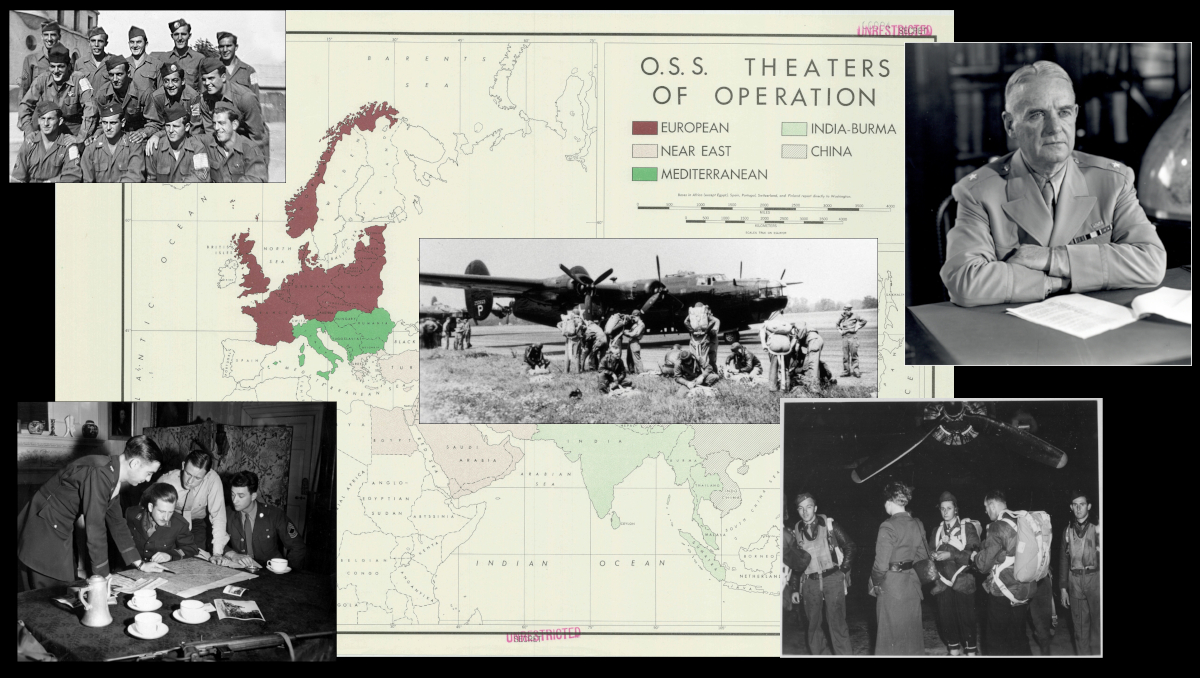
Photo Description: Clockwise from top left: Operational Group Team LAFAYETTE in August 1944; William Joseph (‘Wild Bill’) Donovan, Head of the OSS; Jedburghs in front of B-24 just before night takeoff. Area T, Harrington Airdrome, England, circa 1944; Jedburghs get instructions from Briefing Officer in London flat. Center: Jedburgh teams suit up in England prior to boarding a “Carpetbagger” B-24 Liberator drop aircraft, August 1944. Background: O.S.S. Theaters of Operation.
Photo Credit: Photos via Wikimedia Commons and ARSOF History