
Part performer and part legend, MacArthur would don aviator sunglasses, an open-collared khaki uniform, a khaki cover, and his iconic corncob pipe.
Douglas MacArthur, a renowned yet controversial American five-star general, recognized that the art of war involves shaping perceptions as much as maneuvering forces. Throughout his campaigns in the Philippines, Japan, and Korea, he combined showmanship, strategic messaging, and images that shaped morale and showcased American power. Although scholars may debate his legacy, most agree that MacArthur’s triumphs stemmed from his military prowess and his deliberate use of narrative and imagery to influence audiences. His mastery of information warfare before the rise of the digital age offers lessons for today’s warfighters.
Part performer and part legend, MacArthur would don aviator sunglasses, an open-collared khaki uniform, a khaki cover, and his iconic corncob pipe. Using symbolic props, he projected authority and audacity. Throughout his storied career, MacArthur weaponized his personal iconography as a strategic tool. He carefully constructed an image that projected power, while reinforcing his reputation as a military genius. His ability to sway others began with his own image and radiated outward, helping secure American military victories across Asia.
“I Shall Return”: Bolstering Resistance through Narrative in the Philippines
In March 1942, as the Japanese military rapidly advanced through the Philippines, President Franklin Roosevelt ordered MacArthur to leave Corregidor, the island bastion where the remnants of the American army had retreated. With his family and a handful of his staff, MacArthur rode south in torpedo boat PT-41 to Mindanao before flying to Australia. Once there, he famously promised, “I shall return” to the Filipino people and the 90,000 soldiers he left behind. MacArthur’s mantra echoed over Allied radio, and he ordered “I shall return” mementos be distributed to guerrilla forces in the form of matchbooks by aircraft and submarines. In the Philippines, his bold phrase galvanized Filipino guerrilla fighters against the Japanese invaders and provided hope that the larger-than-life MacArthur would indeed reappear. Just as importantly, MacArthur’s words inspired Americans on the home front. Roosevelt’s trusted military advisor, General Edwin “Pa” Watson, quipped that MacArthur’s declaration was “worth five corps of men,” referring to how “I shall return” quickly became a symbol of resistance in the United States. At home and abroad, his narrative reaffirmed his legitimacy as the intrepid commander of the Southwest Pacific Area.
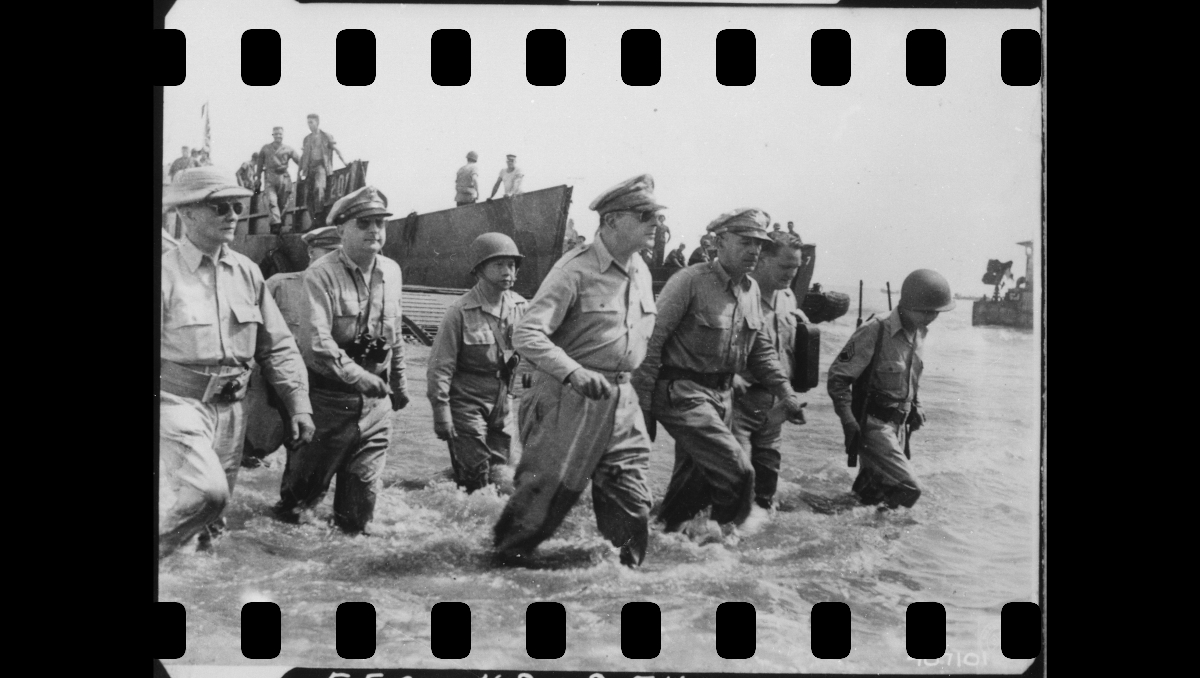
Fulfilling his pledge, MacArthur returned to Leyte Gulf in October 1944, accompanied by reporters and cameramen to broadcast images of him wading ashore for worldwide consumption. He understood that this information operation conveyed a message to friends and foes alike. No one understood a photo’s power and drama better than MacArthur. Accompanied by the President of the Philippines, Sergio Osmeña, MacArthur restored the archipelagic nation’s government as he proclaimed, “People of the Philippines, I have returned,” broadcast in both English and Tagalog. His words and deeds restored Philippine sovereignty while reinforcing the validity of the Allied cause. Long before Marine Corps doctrine highlighted the power of a prevailing narrative to create a public opinion advantage, MacArthur’s return captivated audiences worldwide. Images of the general’s return signified a man who kept his word and would defeat Japan. Meanwhile, his fulfilled promise reinforced the inevitability and righteousness of the American-led liberation of the island nation. Following his wartime success in the Philippines and elsewhere in the Pacific, MacArthur would once again demonstrate his mastery of information warfare during the occupation of postwar Japan.
Optics Enabling Occupation: Atsugi Landing and the Hirohito Photograph
On September 2, 1945, General MacArthur accepted the Japanese surrender while showcasing the U.S. military’s might during a momentous, scripted occasion on the USS Missouri. However, MacArthur’s conspicuous arrival at Atsugi Air Base days earlier proved to be a masterclass in image and symbolic power. Before he landed at Atsugi, his staff warned him of the threat of assassination by Japanese military holdouts. Nevertheless, he wanted the Japanese people’s first impression of him to be as a bold, confident leader.
As he exited the C-54 passenger aircraft, MacArthur stood confidently wearing his iconic cover and sunglasses, smoking his corncob pipe before descending the stairs. MacArthur, knowing the Japanese press would infer his authority by his mere presence, rejected the idea of a large force protection detail. MacArthur walked across the tarmac unguarded, signaling uncontested American ascendancy. Then he entered a civilian vehicle, and his motorcade transported him to Yokosuka without incident. During the drive, two divisions of Japanese soldiers lined the road, facing outward, as a sign of respect for the American general. MacArthur’s commanding arrival publicly portrayed Japan’s defeat before the official surrender on the USS Missouri.
MacArthur’s audacious arrival in Japan captured headlines, but the photograph of him standing side by side with Emperor Hirohito at the U.S. embassy in Tokyo endures as the most striking image of the American occupation of Japan. In the picture, Hirohito is impeccably dressed to the nines, while MacArthur, casually dressed in open-collar khakis, towers over him. The image captures a shift in hierarchy, with MacArthur symbolically assuming the mantle of power with the emperor’s implicit blessing. Hirohito’s recognition of MacArthur’s authority paved the way for the Japanese to rebuild as a democracy. This image, run in Japanese and American newspapers, visually signaled a shift for Japanese society, from an imperial-led regime to MacArthur-led reconstruction. MacArthur understood the emperor’s nearly mythical cultural and societal importance to many Japanese when he took this photo and throughout the American occupation.
MacArthur had to weigh justice with national stability as eleven nations determined the culpability of Japan’s leaders during World War II.
This symbolic photo laid the groundwork for MacArthur’s delicate balancing act during the Tokyo trials. MacArthur had to weigh justice with national stability as eleven nations determined the culpability of Japan’s leaders during World War II. While the trials prosecuted twenty-eight class-A war criminals, he decided to exempt Emperor Hirohito from prosecution. MacArthur understood that prosecuting the emperor could risk civil unrest and potentially hinder Japan’s recovery, while gaining his cooperation could help facilitate Japan’s democratization. By preserving the emperor’s symbolic role, he facilitated a more palatable transition for the Japanese, enabling governmental and societal reforms without triggering widespread unrest. While historians regard MacArthur’s redistribution of land , granting of universal suffrage, and constitutional reform as essential elements to Japan’s rapid post-war recovery, he set the conditions for success by first considering how to use image and narrative to gain legitimacy as the “blue-eyed Shogun.”
Surprise and Psychological Operation in Korea
Having reshaped Japan’s postwar identity through presence and nuanced diplomacy, MacArthur later led the United Nations Command (UNC) in Korea, where surprise and psychological warfare played an outsized role. After being initially overwhelmed by forces from the North, he devised a brilliant amphibious landing at Incheon. His bold use of maneuver and surprise endures as one of the most vivid examples of his military genius. Dubbed “Operation Chromite,” this maneuver broke the stalemate of the Korean War at Busan. More than an exemplar of operational art, MacArthur portrayed himself as an unorthodox, unbeatable commander. Few other generals would attempt a plan this daring, and even fewer would broadcast its success as widely. The septuagenarian five-star chose to strike at Incheon to deliver a “grievous psychological blow” to the communist forces. Media coverage of the landings reinforced the perception that MacArthur could win, even against odds of 5,000 to 1. The landing became a turning point that Incheon residents still celebrate because it strengthened the resolve of U.N. troops while achieving operational surprise against the North Korean forces.
Beyond audacious, innovative amphibious operations, MacArthur’s command of psychological warfare proved equally pivotal. The Voice of the United Nations Command broadcast counterpropaganda into North Korea. While it is challenging to gauge the full impact of the radio messages in the reclusive “hermit kingdom,” many northern defectors admitted to listening to the broadcasts as an alternative to North Korea’s state-sponsored propaganda. His efforts in this domain were foundational to the sustained, coordinated Voices of America effort during the Cold War, which demonstrated American resolve worldwide. Nevertheless, MacArthur’s use of psychological warfare and military success soon devolved into strategic overreach.
President Harry S. Truman relieved the “American Caesar” from command in April 1951 for insubordination, as his strategic ambitions clashed with the broader geopolitical concerns of civilian leadership. Instead of facing public disgrace, MacArthur artfully transformed his dismissal into a moment of martyrdom. His “Old Soldiers Never Die” address to Congress reinforced his mythic status as an American. While Truman’s decision was unpopular at the time, the event ultimately became a case study that reminds those who serve of the importance of civilian control over the military.
MacArthur’s Lessons for the Modern Warfighter
Despite MacArthur’s fall from grace during the Korean War, his image proved to be a powerful symbol of American might, perhaps to a fault. As such, modern-day leaders can still learn from him. Information doctrine reminds us that achieving information advantage must be commander-driven. Today, most leaders recognize the power of presence, which MacArthur possessed in spades. Army doctrine on leadership notes that “through their presence, leaders show what they stand for and how they expect others to carry themselves.” While most military leaders will not personally impact international headlines, they should consider developing their own distinct “leadership persona”—a form of commander’s presence that conveys their own brand of authority and competence. This persona can serve as a psychological tool, helping to unite followers under a common cause and bolstering their confidence in their leader.
There will never be another MacArthur, nor should any leader try to create an inauthentic persona. In dealing with Truman, MacArthur’s swagger proved to be his Achilles heel. Instead of boast and bluster, modern military leaders should seek to synchronize their words and deeds, showcase images that convey meaning, and leverage psychological effects to turn the tide of war. MacArthur’s use of visual symbolism and narratives prefigured modern-day information lines of effort, as we now understand that perception management is as critical as kinetic action. Today’s leaders face a more fragmented and ubiquitous information environment, making the deliberate branding of persona and message even more vital. Just as in MacArthur’s campaigns in the Philippines, Japan, or Korea, the information environment remains the most challenging yet most crucial battlespace in times of competition and armed conflict.
Michael Posey is an active-duty U.S. Naval Flight Officer with a subspecialty in Information Systems and Operations. He currently serves as an Assistant Professor in the Department of Military Strategy, Planning, and Operations at the U.S. Army War College in Carlisle, PA.
The views expressed in this article are those of the author and do not necessarily reflect those of the U.S. Army War College, the U.S. Army, or the Department of Defense.
Photo Description:General Douglas MacArthur wades ashore during initial landings at Leyte, Philippine Islands, 20 October 1944.
Photo Credit: U.S. Army Signal Corps officer Gaetano Faillace
As further evidence of the General’s capacity to shape the message through rhetoric and image projection, consider how enduring his oft-repeated misattribution to Plato the quote “Only the dead have seen the end of war”, as memorialized in his farewell address to the Cadets at West Point delivered May 12, 1962. Interestingly, making the same mistake is the Imperial War Museum, London, opened in 1936 with the quote newly craved and misattributed to Plato on its walls. The source is Harvard University philosopher Jorge Agustín Nicolás Ruiz de Santayana y Borrás (known in English as George Santayana), taken from his Soliloquies in England and Later Soliloquies (1922), “Only the dead are safe; only the dead have seen the end of war.”
I agree that senior officers need to understand, and use, the power of presence and to think of how their persona will be viewed. But at the same time, there should be a voice in the back of their head saying, don’t believe it when people tell you how wonderful you are. A little humility goes a long way. When thinking of MacArthur, I’m reminded of the famous Eisenhower quote, “I studied dramatics under him for seven years.” MacArthur was a complex, but deeply flawed, individual. He defied the President when he ordered the attack on the Bonus Army, severely damaging the administration. His failures regarding the Japanese starting in December 1941 only made things worse and contributed to the fall of the Philippines. But there is no denying the hope that “I shall return” gave those same people. His brilliance at Inchon was undone by his hubris regarding what the Chinese would do along the Yalu. George Patton also famously understood the importance of creating an image (airhorns on his jeep, famously using profanity to shock and connect with soldiers, the pistols, etc), but he was also deeply flawed and prone to egotism.
Better to use the example of a general like George Washington, who understood the critical role his image had in keeping the Revolution going. Even better, George Marshall, who worked on an image of authenticity marked by discipline, intelligence, integrity, and efficiency. He was “the Organizer of Victory” and was widely considered by both sides of the aisle in Congress to be the most trusted man in America.
Regret that General MacArthur could not convince President Truman to employ the nuclear option.
A smashing (nuclear) victory at that stage of Mao Zedong’s leadership would have shattered the CCP.
General MacArthur is a gifted military strategist. I remembered watching his war history. He survived battles after battles, came out even more brilliant in his military strategies. My favorite was his amphibious landing in Incheon.