
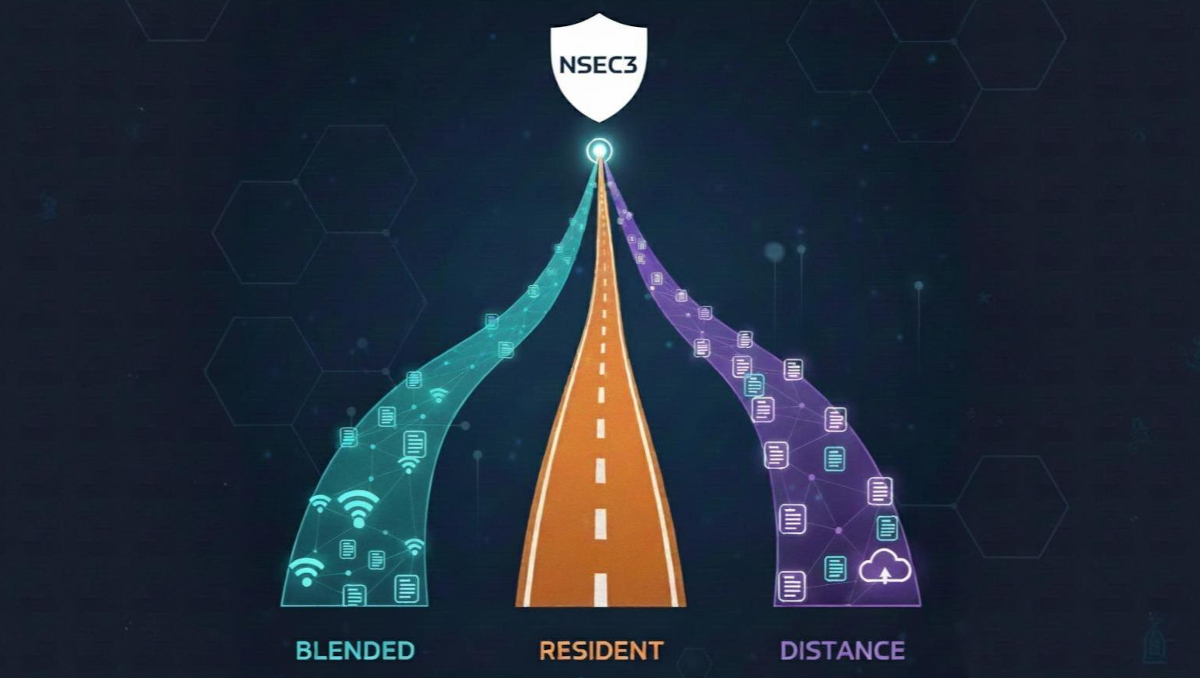
Until recently, only resident students received access to special programs.
The U.S. Army War College prepares future leaders to navigate the complexities of a constantly evolving global strategic environment. Supporting this critical mission is a rigorous curriculum delivered through three distinct modalities: the Resident Education Program (REP), a 10-month, full-time, on-campus experience structured around small, multidisciplinary seminars; the Blended Education Program (BEP), also 10 months in duration, which combines in-person and remote learning, allowing students to complete the majority of coursework from their home location; and the Distance Education Program (DEP), a two-year online program supplemented by two mandatory, two-week resident phases. Each modality is designed to accommodate diverse professional needs while maintaining the academic rigor and strategic focus essential to senior military education. All modalities provide equivalent core course content covering essential topics with special programs enhancing the “Carlisle Experience.” Until recently, only resident students received access to special programs. To bridge the gap, the National Security Simulation Exercise of Competition, Crisis, and Conflict (NSEC3) special program evolved as a groundbreaking solution, serving as proof that specialized programs can be available to students in all modalities.
Specialized programs that supplement the primary curriculum and provide opportunities for in-depth research can significantly enhance and enrich the core curriculum enabling students to tailor their own learning experiences. Programs like the Advanced Strategic Arts Program, Carlisle Scholars Program, Joint Warfighting Program, and Commandant’s Reading Program aim to push students toward achieving higher levels of Bloom’s Taxonomy and learning outcomes. These programs often facilitate direct interaction with subject matter experts and senior mentors through lectures, briefings, discussions, experiential learning exercises, or collaborative interactions. Such unique opportunities allow students to learn from the experiences of others, engage in rigorous dialogue, and question assumptions to expand their thinking.
Prior to NSEC3, only resident students accessed the full Carlisle experience, particularly special programs. This created a disparity between the modalities and prevented distance and hybrid students from receiving an enriched educational experience. The disparity presented a significant challenge for the USAWC’s goal of fostering a truly educated and balanced military education level 1 force across all components. The resident program primarily focuses on the regular component, while the distance education program predominantly serves the National Guard and reserves. Until 2020, the lack of access to specialized programs for distance students meant that a substantial majority (perhaps 85%) of National Guard and Reserve graduating students never had the opportunity to participate in these enriching experiences. The USAWC recognized this practice as detrimental to achieving a balanced force and sought to overcome the limitation.
NSEC3, formerly known as Joint Land, Air & Sea Special Program, has a long and successful history spanning over 40 years. A key feature of this robust program is the continued evolution of curriculum and modality to meet the needs of the modern warfighter. Over the last five years, faculty developed NSEC3 into a multi-modal offering for blended and distance education students. During the 2020-2021 academic year, NSEC3 became available to Distance Education Program (DEP) students for the first time. This inaugural multimodal iteration included only five students, where faculty incorporated them into an existing resident student seminar via the online communication tool Microsoft Teams. While that first year broke the barrier for distance students, the format was not ideal for their schedules or learning as they had to conform to an existing resident course schedule often conflicting with their daytime jobs. This required students to watch class recordings in the evening and asynchronously contribute to products. Essentially, the modality was still resident-focused and needed further adaptation. 2022 brought the most significant changes for distance students with two dedicated seminars representing U.S. Southern Command and the Department of Homeland Security along with the incorporation of the Chilean War College. These changes facilitated a total enrollment of 20 students and synchronous evening sessions for the distance seminars to collectively collaborate on products, learn from one another, and engage with faculty instructors. The third year saw increased DEP students enrolled and focused on internal seminar improvements, primarily a better understanding and utilization of MS Teams improving collaboration among the seminar and with other participating senior service colleges and international seminars. 2024 saw the highest enrollment totaling 36 students (31 distance and 5 blended program). This was the first year in which blended program students were able to participate; it also featured subject matter experts joining evening synchronous sessions. In 2025, NSEC3 included the Brazilian Superior War College and continued minor improvements on previous iterations. That iteration highlighted the importance of perfecting internal multimodal seminar practices and protocols as both distance and blended program seminars made dedicated efforts to focus externally and increase collaborative efforts with their partners from Chile, Brazil, and Sweden.
NSEC3 specifically leverages experiential learning to help students better understand their environment, define problems, and develop strategic options.
NSEC3 was the first USAWC special program to integrate all three educational modalities within a single syllabus, and to extend this integration to multiple senior service colleges and international partner war college equivalents. NSEC3 specifically leverages experiential learning to help students better understand their environment, define problems, and develop strategic options. The course achieves its objectives through a unique design which separates itself from other offerings at the USAWC in three distinct ways: (a) students not only assume the roles that make up a combatant command staff, but lead themselves through the process of building a strategic estimate and then providing viable options while facilitated by faculty instructors; (b learning in a distance/blended seminar is not confined to one seminar cohort but transcends the typical seminar experience, leveraging other senior service college seminars as well as integrating and collaborating with international partners expanding concepts, methods and thinking; (c) the linkage in course requirements is seamless and intentionally iterative in nature as each product naturally builds to the next. Unlike most courses—where students often struggle to make the connection between assignments, or resort to predatory reading for one requirement and then jump to the next—NSEC3 drives the students to repeat steps and tasks to refine their previous work and improve their products. The necessity of constant reframing and remaining flexible in a constantly changing environment replicates the reality of today’s strategic leaders.
The course structure consists of three major blocks of activities, from December to May, built around key tasks:
Block I: Develop the Strategic Estimate: Students collaborate to develop a strategic estimate, using plausible, notional strategic documents. This block involves lessons on the operational design framework, understanding strategic direction, analyzing the future operational environment and strategic guidance.
Block II: Develop Globally Integrated Military Options: Building on the strategic estimates, students develop recommendations and military options for their respective areas of responsibility to present (hypothetically, in an exercise) to the chairman of the Joint Chiefs of Staff.
Block III: NSEC3 Exercise: This block is the week-long collective exercise. Using the developed Strategic Estimates and options, students refine military options and direct military operations and activities while considering other elements of national power as the global situation moves from crisis towards conflict.
The implementation across modalities is key to NSEC3’s success. The course is composed of a distributed curriculum phase and a collective execution phase. The distributed learning model is an instructional approach where instructors, students, and content are in different physical or virtual locations, allowing for flexible, technology-mediated learning that can be asynchronous or synchronous. This phase runs from December to the beginning of April and consists of fifteen sessions, largely in a student-led, lab-type environment. The collective phase is a five-day exercise conducted from late April to early May. Students from various participating institutions come together for this exercise, which can take place either at Carlisle Barracks (in-person) or virtually via MS Teams. The simulation requires synchronizing activities across various entities, coordinating with interagency, intergovernmental, and multinational organizations, and planning and making decisions in a resource-constrained global environment. This blend ensures that students across all modalities can fully participate.
Collaboration is a primary requirement of the NSEC3 course. Students must collaborate within the USAWC and with students at other participating institutions. MS Teams is the platform of choice at the USAWC to facilitate this cooperative engagement. The focus on collaboration, rather than extensive reading and writing, allows students the time necessary to interact with their peers and counterparts at other colleges.
The last five years demonstrate the success of NSEC3 in integrating all three modalities and achieving the same outcomes. By offering this specialized experiential learning program to students across resident, blended, and distance education programs, the USAWC equips a larger and more balanced proportion of its graduates, including those from the National Guard and Reserve, with advanced strategic thinking and decision-making skills. These skills are essential for future enterprise leaders of the Joint Force and the Army, who must be prepared to lead teams in developing, designing, and conducting campaign plans that align diverse capabilities to address complex transregional threats across the competition continuum. The NSEC3 program, by successfully bridging the modality gap for specialized education, plays a crucial role in producing highly capable leaders ready for strategic decision-making at the highest levels of government.
Christian Cook is an Assistant Professor in the U.S. Army War College’s Department of Distance Education and the Director of the National Security Simulation Exercise of Competition, Crisis, and Conflict.
The views expressed in this article are those of the author and do not necessarily reflect those of the U.S. Army War College, the U.S. Army, or the Department of Defense.
Photo Credit: Gemini


1. As to NSEC3, with regard to Block 1, Develop the Strategic Estimate, which requires students to use plausible, notional strategic documents (such as the current NSS?) to develop a strategic estimate; as to this such requirement, would the following be considered to be worth considering, and/or, “in the ballpark?”
“The Disappearance of Major Power Competition as a US Foreign Policy Priority:
The current Trump administration’s new national security strategy departs from the explicit focus on major power competition shared by its two predecessors. The first Trump and Biden administrations both framed China and Russia’s desire to ‘shape a world antithetical to U.S. values and interests’ as a leading foreign policy concern. China was a long-term ‘pacing challenge’ in the competition for global influence, while Russia was an ‘acute threat’ actively engaged in ‘subversion and aggression.’
By contrast, the new NSS does not expressly reference major power competition once. And it adopts a notably more conciliatory tone toward competitors, framing the challenge as ‘managing European relations with Russia’ and working to ‘rebalance America’s economic relationship with China.’ Meanwhile, it frames ‘the outsized influence of larger, richer, and stronger nations’ as ‘a timeless truth of international relations,’ which in turn leads the United States to ‘reject the ill-fated concept of global domination’ in favor of ‘global and regional balances of power.’ The implication is that the United States is less intent on strategic competition and more open to spheres of influence. This may be why—aside from an odd obsession with Europe’s ‘civilizational self-confidence’—the new NSS overwhelmingly focuses on the Western Hemisphere, trade, immigration, and other issues close to home.
On key issues like Taiwan and NATO, the NSS signals more short-term continuity than not. Moreover, a simple rhetorical shift may be a welcome corrective for those who fear that overemphasizing strategic competition risks unnecessary escalation. But the worldview underlying the new NSS appears to be quite a departure from what has guided U.S. foreign policy for the past decade. That may in turn portend more substantial changes down the road.”
(From the Brooking Institute’s recent “Breaking Down Trump’s 2025 National Security Strategy.”)
2. Also as to the NSEC3 Strategic Estimate requirement, might the students be required to considered the following?
“So far however, while Trump has declared that the U.S. will ‘run Venezuela,’ he has stopped short of previous U.S. administrations of the first half of the 20th century in that he has not sought to invade and occupy Venezuela. Instead, the kidnapping of President Maduro seems intended to frighten the existing Venezuelan regime into submitting to Trump’s will, especially when it comes to U.S. control of Venezuela’s oil; not just for profit, but for leverage against Russia and China. By cutting off much of Cuba’s oil imports, it might also enable the U.S. to starve Cuba into surrender, allowing Secretary of State Marco Rubio’s relatives to return ‘home’ and regain the property that they lost in the Cuban Revolution.
The problem about trying to run client regimes in this way is: What do you do if they threaten to collapse? This is the dilemma that the U.S. faced in Vietnam, in Iran in 1979, and in Afghanistan by 2020, and the Soviet Union faced in Hungary, Czechoslovakia and Afghanistan, and Russia faced in Ukraine in 2014. Double down or quit? That is to say, allow your clients to collapse, with the resulting damage to your interests and your ‘credibility,’ or send in your own troops to try to ensure their survival? In the great majority of cases where the U.S. has chosen the latter course, the results have been disastrous.
In one critical instance, the official statements of the Trump administration go much further than the Roosevelt Corollary, which begins with ‘It is not true that the United States feels any land hunger…as regards the other nations of the Western Hemisphere’ (though this would have come as a surprise to the Spanish and Panamanians). Trump and senior Trump officials by contrast have repeatedly emphasised their desire to annex Greenland and (less seriously) Canada. And Canada and Denmark are neither enemies nor dysfunctional dictatorships, but successful democracies and the closest of U.S. allies.
Trump and his team should take note of the Danish prime minister’s warning that a seizure of Greenland would ‘end NATO.’ They should also look at how the Russian annexation of Crimea in 2014 destroyed any chance of continued Russian influence over Ukraine; and how China’s demand for the whole of the South China Sea frightened all of its neighbors, including ones previously well-disposed towards China.
China drove its neighbors into Washington’s arms. Trump risks driving America’s neighbors into the arms of China. The Trump administration also needs to remember that U.S. economic influence in Latin America is vastly reduced. Throughout the 20th century, the U.S. was by far the greatest trading partner and investor in South America. Now it is China, which has also greatly increased its role in Central America. This gives countries significant opportunities to resist U.S. economic pressure; and if the U.S. tries to destroy their increasingly vital economic ties with China, it will create a backlash that will undermine or even destroy its sphere of influence.”
(See the “Responsible Statecraft” article “Trump Sphere of Influence Gambit is Sloppy, Self-Sabatage.”)
3. Now, with the Strategic Estimate, and the corresponding potential ramifications same (see my Item 2 ) properly before them, to require the students to:
a. In Block II, develop recommendations and military options for their respective areas of responsibility — and to present same (hypothetically, in an exercise) to the chairman of the Joint Chiefs of Staff. And to require the students to:
b. In Block III, refine military options, and direct military operations and activities; this, as the global situation (again as outlined at my Item 2 above) moves from crisis towards conflict?
Question — Based on my initial comment above:
If, in the recent past, NSEC3 planning and gameplay were based upon great power competition and conflict with China; this, taking place 10 years in the future in the USINDOPACOM. If this is (or, now, actually “was”) the case, then should this such exercise now be considered to be irrelevant, and/or in need of rapid, significant and fundamental change? This, given that:
a. The current U.S. National Security Strategy does not expressly reference major power competition and conflict — with anyone — even once. (This suggesting that Chinese and Russian ambitions, values and interests, etc., these are now seen to be largely similar to, and largely compatible with, U.S. ambitions, values and interests — in this regard, think of such things as “spheres of influence?”). And given that:
b. Now, and 10 years in the future, the U.S. military, and our other whole of government assets, these are now expected to be (indeed, are now required to be?) focused on (a) Western Hemisphere trade, immigration and other issues closer to home and on (b) the fact that it is much of Europe’s ambitions, values and interests, THESE have are now what have been declared to be largely incompatible with our ambitions, values and interests? (And, indeed, those of China and Russia?)
If the above is correct, then (a) what do we do now, and (b) when do we do it?