
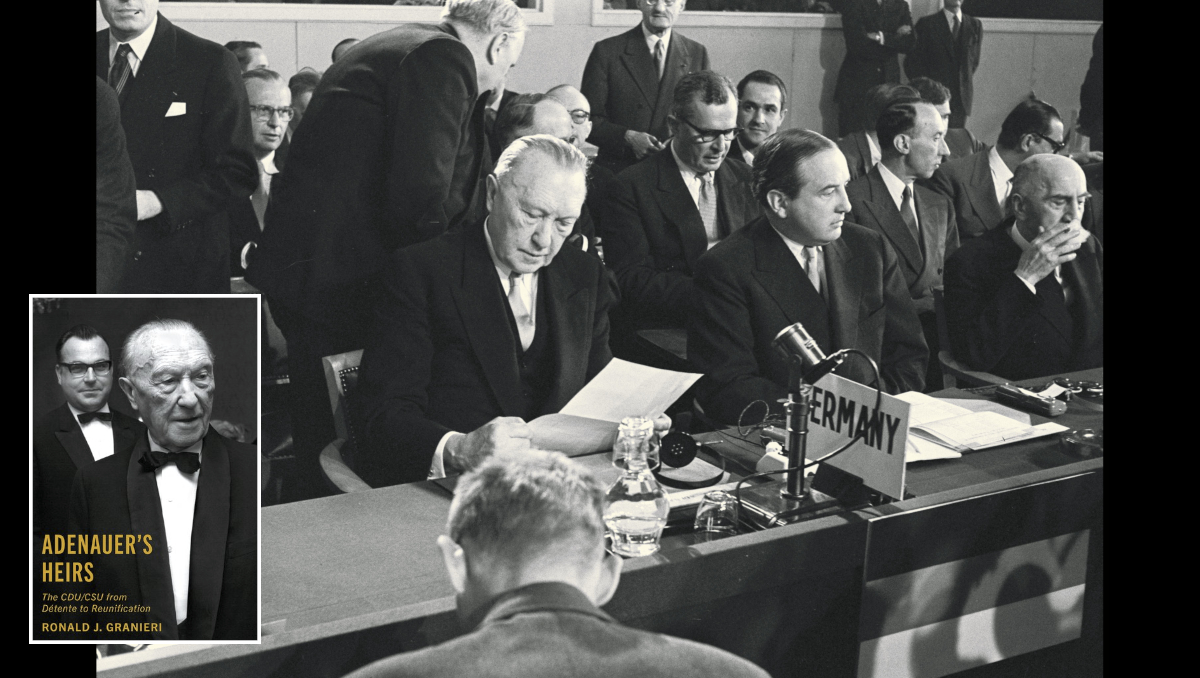
The question of how a divided Germany became a pillar of Western stability is more relevant today than ever. In a rare appearance as a guest, podcast editor Ron Granieri sits down in the studio with host Jadwiga Biskupska to discuss his latest book, Adenauer’s Heirs: The CDU/CSU from Détente to Reunification.
They trace the political evolution of the German Christian Democratic Union (CDU) and the Christian Social Union (CSU) from the deep Cold War through the dramatic reunification of 1990. Granieri argues that German reunification was the ultimate success of Konrad Adenauer’s Westbindung – a strategy of anchoring Germany to NATO and Western democratic institutions to build international trust.
Their conversation reveals that modern debates over European integration, strategic autonomy, and national identity are deeply rooted in the existential challenges that West German leaders navigated decades ago.
As late as the summer of 1989, people still viewed German unification as something that was just not going to happen. And then it did.
Podcast: Download
Ron Granieri is Professor of History and the Chair of the Department of National Security and Strategy at the U.S. Army War College and the Editor of A BETTER PEACE.
Jadwiga Biskupska is associate professor of military history at Sam Houston State University and co-director of the Second World War Research Group, North America. She is the Harold K. Johnson Visiting Chair of Military History at the U.S. Army War College for AY26. She received her PhD from Yale University. Her first book, Survivors: Warsaw under Nazi Occupation (Cambridge University Press 2022), won the Heldt Prize and an honorable mention for the Witold Pilecki International Book Award.
The views expressed in this presentation are those of the speakers and do not necessarily reflect those of the U.S. Army War College, U.S. Army, or Department of War.
Photo Description: The Federal Republic of Germany becomes a member of NATO Paris, France. Germany (Chancellor Konrad Adenauer) takes his seat at the Council table, 6 May 1955.
Photo Credit: Courtesy of the NATO Archives




Probably not a well-informed, well-understood and/or even properly framed question, but here goes:
In deciding to pursue and achieving Westbindung — the strategy of anchoring Germany to NATO and Western democratic institutions to build international trust — what amazing things did Adenauer and the CDU and CSU have to give up and/or water down, such as Abendland?
“The most well-known of these visions is arguably that of Europe as Abendland (translated typically as ‘occident’ or just ‘the West’) (for example Granieri, 2004; Conze, 2005; Mitchell, 2012, pp. 92–9; Forlenza, 2017; Forlenza and Turner, 2018). Endorsed especially by Catholic Christian Democrats, the notion of Abendland evoked romanticised imaginaries of uniformly Catholic medieval Europe, the world of Rex Pater Europa Charlemagne and Pope Gregory I. It framed the unification of Europe as a relatively exclusionary cultural-civilizational project to be pursued by countries that ‘share the traditions of Catholicism and confessional politics’ (Kaiser, 2007, p. 235). Less familiar is perhaps the alternative vision of Europe that many leading Protestant Christian Democrats advanced. While also sometimes adopting the language of Abendland, the latter saw free trade as the primary mechanism of integration, and were naturally more sympathetic to including non-Catholic countries like the UK or the Scandinavian countries in a unified Europe (Granieri, 2004; Nelsen and Guth, 2015, p. 246). Theirs was a Europe that was not united by culture but by markets, and less French and German than Anglo-Saxon.”
(See the second paragraph of the Introduction in the item “Where Does Europe End? Christian Democracy and the Expansion of Europe, by Josef Hien and Fabio Wolkenstein, 04 June 2021, in the Journal of Common Market Studies. Herein to note that Ron Granieri is prominently referenced in many places in this such article/item.)
At about the 40:50 point in this podcast, Niall Ferguson, and the question of whether, today, we are in a New Cold War, comes forward. As to that such question, let us look at this description of the Old Cold War, in this case, from Hans Morgenthau in his “To Intervene or Not to Intervene.” (Therein, look to the paragraph which begins: “While contemporary interventions serving national power interests … “):
“… The United States and the Soviet Union face each other not only as two great powers which in the traditional ways compete for advantage. They also face each other as the fountain heads of two hostile and incompatible ideologies, systems of government and ways of life each trying to expand the reach of its respective political values and institutions and to prevent the expansion of the other. Thus the cold war has not only been a contest between two world powers but also a contest between two secular religions. And like the religious wars of the seventeenth century, the war between communism and democracy does not respect national boundaries. If finds enemies and allies in all countries, opposing the one and supporting the other regardless of the niceties of international law. Here is the dynamic force which has led the two superpowers to intervene all over the globe, sometimes surreptitiously, sometimes openly, sometimes with the accepted methods of diplomatic pressure and propaganda, sometimes with the frowned-upon instruments of covert subversion and open force.”
Herein to ask: Today, do we find the characteristics of the Cold War, as described by Hans Morgenthau above, to be present in the relationship between the U.S. and its opponents?
Or, today, are we more likely to find the characteristics of the end of the Cold War/the beginning of the post-Cold War as being present in the relationship between the U.S. and its opponents? These such end of the Cold War/beginning of the post-Cold War characteristics being that:
a. The United States of late — much like the Soviet Union cir. 1990 — seems to have abandoned/quit its effort to “try to expand the reach of its political values and institutions and to prevent the expansion of the other”? And that:
b. The United States of late — much like the Soviet Union cir. 1990 — seems to have abandoned /has quit its effort — related to its ideology — to see and “find enemies and allies in all countries, opposing the one and supporting the other regardless of the niceties of international law”?
(Thus, today, not similar to the Cold War but, rather, similar to the end of the Cold War/the beginning of the post-Cold War?)
Question — Based on the Above:
Where does Europe, Germany, etc. “fit” — and what do they do — this, in a world in which (a) the Soviet Union abandons/quits is raison d’etre cir. 1990 and (b) the United States, approximately 35 years later, abandons/quits its raison d’etre also?