
Carol Stauffer, U.S. Army Pacific G2, joins host Tom Spahr in the virtual studio to explore the critical role of Theater Army intelligence in the Indo-Pacific theater. Drawing on her deep regional expertise, she explains how her team synchronizes operations across 35 nations to maintain deterrence and prevent conflict. Stauffer highlights a pivotal shift from traditional “kill chains” to a “kill mesh”—a persistent tapestry of collection that integrates kinetic, cyber, and space effects across every domain. Because the Indo-Pacific lacks a formal security framework like NATO, she emphasizes that her mission relies as much on human relationships and bilateral interoperability as it does on data. Stauffer describes bridging the gap between immediate operational needs and the long-term strategic goals that will shape the region for decades to come.
My mission as the Theater Army G2 is to integrate and synchronize Army intelligence operations across the combatant command’s area of responsibility.
Podcast: Download
Subscribe: Apple Podcasts | Spotify | Amazon Music | Android | Pandora | iHeartRadio | Blubrry | Podchaser | Podcast Index | TuneIn | Deezer | Youtube Music | RSS | Subscribe to A Better Peace: The War Room Podcast
Carol Stauffer is a colonel and a career Intelligence Officer in the U.S. Army. She has commanded intelligence units from company to the theater army, including a company command in Korea, battalion command of the 109th Expeditionary Military Intelligence Battalion and brigade command of the 500th MI Brigade Theater. She became the U.S. Army Pacific Command G2 in June 2024.
Thomas W. Spahr is the DeSerio Chair of Strategic and Theater Intelligence at the U.S. Army War College. He is a retired colonel in the U.S. Army and holds a Ph.D. in History from The Ohio State University. He teaches courses at the Army War College on Military Campaigning and Intelligence.
The views expressed in this presentation are those of the speakers and do not necessarily reflect those of the U.S. Army War College, U.S. Army, or Department of Defense.
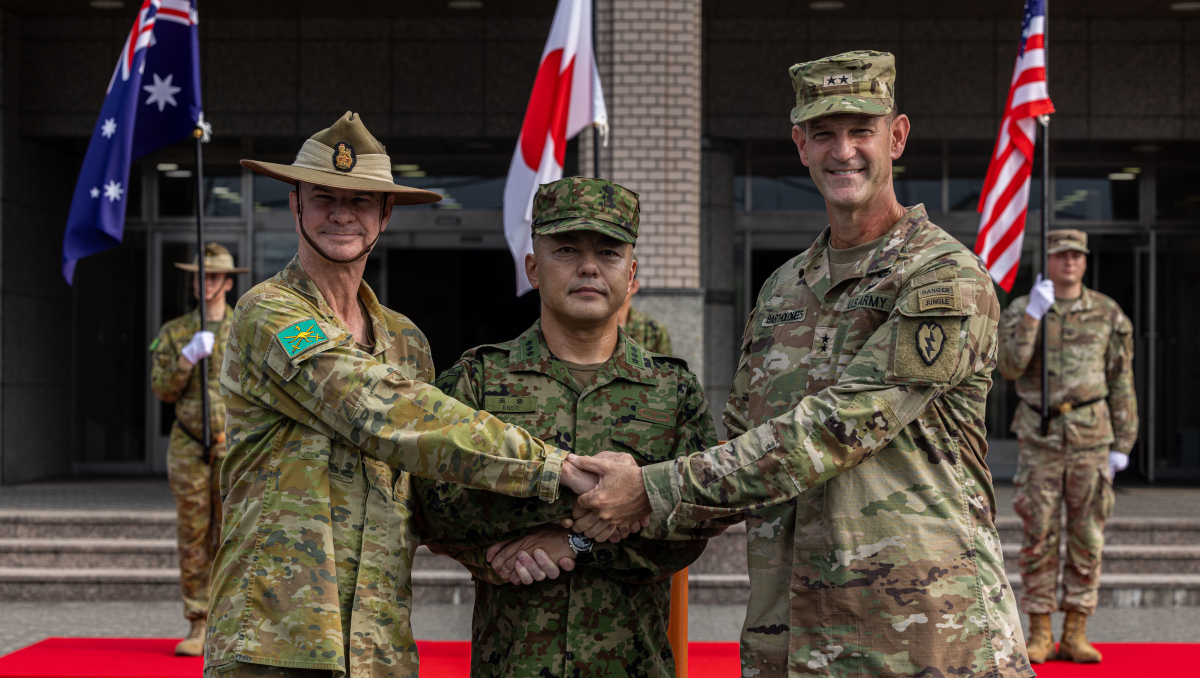
Photo Description: (L-R) Australian Brigadier General Shane Gabriel, Deputy Commanding General of 1st (Australia) Division, Lieutenant General Makoto Endo, Commanding General of the Middle Army, Japan Ground Self-Defense Force (JGSDF) and Major General Jay Bartholomees, Commanding General, 25th Infantry Division, U.S. Army, shake hands at the opening ceremony of Exercise Yama Sakura 89 on JGSDF Camp Itami, Japan, Aug. 25, 2025.
Photo Credit: U.S. Army photo by Spc. Abreanna Goodrich

Question:
If one were to view “warfighting” more holistically, for example, as including how a nation (such as China) might “exert its influence” over another nation (such as the United States); this, so as to cause it (in this case the United States) to consider abandoning or modifying, in whole or in part, certain of its own long-standing political, economic, social, values, etc., ideas, norms, beliefs and/or institutions — and consider embracing, in whole or in part, certain of the political, economic, social, and/or value, etc., ideas, norms, beliefs and/or institutions of the “influencing” nation (such as China),
Then, in “warfighting”/China attempts to “win without fighting” circumstances such as these, would it not be important for someone — for example the U.S. Army Pacific/the Indo-Pacific Theater Army G2 — to make this such “exertion of influence” aspect of China’s strategy and effort a MAJOR PART of its (the U.S. Army Pacific/the Indo-Pacific Theater Army G2’s) “integrating and synchronizing Army intelligence operations across the combatant command’s area of responsibility” analyzing, evaluating and routinely reporting on duties and responsibilities?
(If victory can be determined, defined and/or understood as “bending an opponent to one’s will,” then must not a potential Chinese victory over the United States be considered — and be kept up with — exactly in the manner that I describe above?)