
Samuel Helfont joins host Ron Granieri to discuss his book, The Iraq Wars: A Very Short Introduction, which covers the Gulf War of 1991, the overthrow of Saddam Hussein in 2003 and subsequent years of civil war and insurgency, and the campaign against the Islamic State that began in 2014. Helfont argues that to understand any of these three distinct conflicts, they must be understood in relation to each other as well as the periods in between. Their discussion highlights the friction between policy and strategy, noting that while regime change became the de facto U.S. goal as early as the 1990s, the strategies employed at the time were never equipped to achieve it. Ultimately, they reflect on the heavy cost of these wars, the difficulty of maintaining peace with insufficient troop levels, and the complex, ongoing legacy that continues to shape global politics today.
These [wars] are all connected in one giant war… looking at one in isolation isn’t as helpful as seeing them as a broader project.
Podcast: Download
Samuel Helfont is an Associate Professor of Strategy and Policy in the Naval War College program at the Naval Postgraduate School in Monterey, California. He is a Senior Fellow at the Foreign Policy Research Institute in Philadelphia and the author of Iraq against the World: Saddam, America, and the Post-Cold War Order (Oxford University Press, 2023) and The Iraq Wars: A Very Short Introduction (Oxford University Press, 2025).
Ron Granieri is Professor of History and the Chair of the Department of National Security and Strategy at the U.S. Army War College and the Editor of A BETTER PEACE.
The views expressed in this presentation are those of the speakers and do not necessarily reflect those of the U.S. Army War College, U.S. Army, or Department of War.
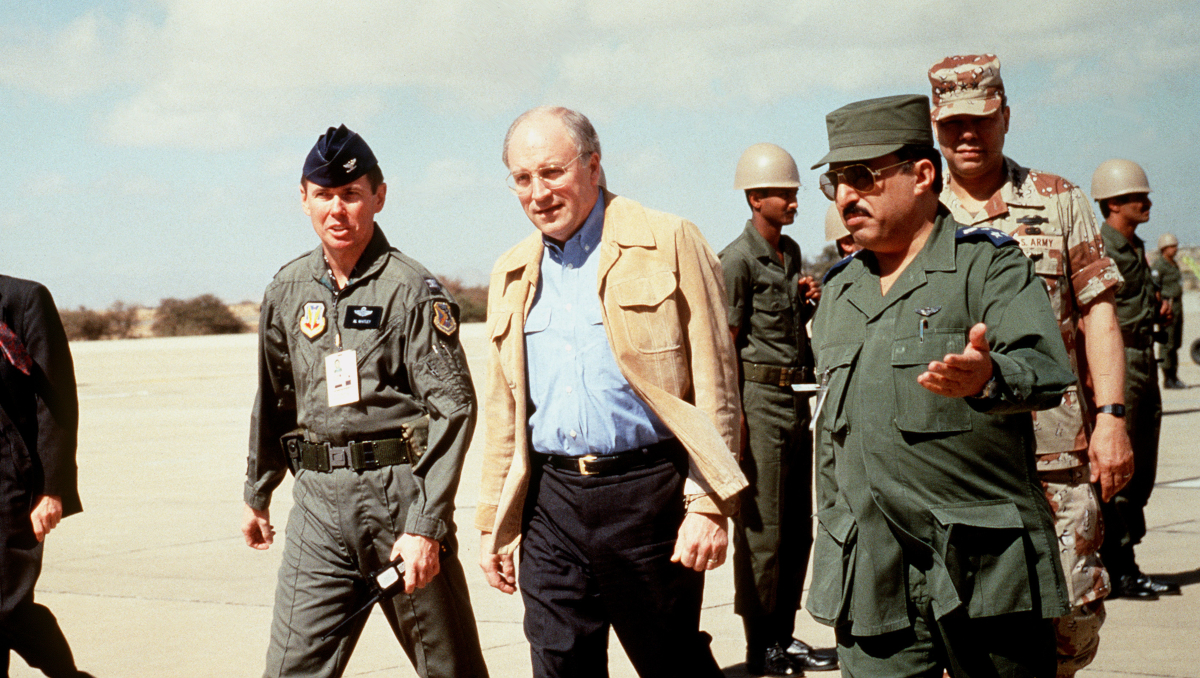
Photo Description: Secretary of Defense Richard Cheney converses with COL. Alton Whitby, commander, 37th Tactical Fighter Wing, and Brig. GEN. Abdul Aziz Bin Khalid Al-Sudairi, commander of Joint Forces, Saudi Arabia, as he and GEN. Colin Powell, chairman, Joint Chiefs of STAFF, walk along the airfield following their arrival for a conference. The men will be discussing U.S. military intervention against Iraq during Operation Desert Storm. 6 February, 1991
Photo Credit: TSGT Rose Reynolds



From the written introduction, above, to this podcast:
“These [wars] are all connected in one giant war… looking at one in isolation isn’t as helpful as seeing them as a broader project.”
But what if we should be looking at the Iraq wars in an even larger “one giant war” context, this being, the post-World War II/post-Cold War “one giant transformative war” context which (a) seems to be suggested by Sir Adam Roberts below and which (b) seems to be in clear violation of international humanitarian law or jus in bello:
From the first two paragraphs of Sir Adam Roberts “Transformative Military Occupations: Applying the Laws of War and Human Rights:”
“Within the existing framework of international law, is it legitimate for an occupying power, in the name of creating the conditions for a more democratic and peaceful state, to introduce fundamental changes in the constitutional, social, economic, and legal order within an occupied territory? This is the central question addressed here. To put it in other ways, is the treaty-based international law relating to occupations, some of which is more than a century old, appropriate to conditions sometimes faced today? Is it still relevant to cases of transformative occupations — i.e., those whose stated purpose (whether or not actually achieved) is to change states that have failed, or have been under tyrannical rule? …
These questions have arisen in various conflicts and occupations since 1945 — including the tragic situation in Iraq since the United States-led invasion of March-April 2003. They have arisen because of the cautious, even restrictive assumption in the laws of war (also called international humanitarian law or, traditionally, jus in bello) that occupying powers should respect the existing laws and economic arrangement within the occupied territory, and should, therefore, by implication, make as few changes as possible. … ”
Questions — Based on the Above:
1. Given the larger, more all encompassing post-World War II/post-Cold War one giant “transformative” war thesis — which seems to be suggested by Sir Adam Roberts above — could and should we not say that (a) the First Iraq War/the Gulf War might be considered only as an odd ball, an exception? And that (b) such things as “sanctions,” these, also, might be considered from the perspective of attempting to achieve (via different ways and means) “transformative” political, economic, social and/or value ends — in Iraq and/or in other countries?
2. As to the Cold War aspect of this “one giant transformative war” thesis, could same be considered from the “transformative” perspective offered by Hans Morgenthau below?:
“… The United States and the Soviet Union face each other not only as two great powers which in the traditional ways compete for advantage. They also face each other as the fountainheads of two hostile and incompatible ideologies, systems of government and ways of life, each trying to expand the reach of its respective political values and institutions and to prevent the expansion of the other.” (See Hans Morgenthau’s “To Intervene or Not to Intervene.”)
Conclusion:
Thus, whether the U.S. or the Soviet Union had lost the Cold War, the winning party (such as the U.S. after the Cold War) would be expected, sooner or later and much as they had post-World War II, to continue (quite understandably and logically now that they were much less impeded and much less challenged as during the Cold War) to “try to expand the reach of their political values and institutions” — via war, sanctions, etc. — in “not yet transformed” places such as Iraq.
Herein to understand that — for “expand” countries such as the U.S. and the Soviet Union — “hands off” peace — as per jus in bello above — this WAS NOT the post-World War II and post-Cold War “one giant war” objective. Rather “hands on” “transformation” — via war and/or via other means and in clear violation of jus in bello above — this WAS the post-World War II and post-Cold War “one giant war” objective — of both the U.S. and the Soviet Union.
(The Iraq Wars [etc., etc., etc.] — and questions and answers relating to same — thus, to best be seen from this such “long arc of [transformative] war” perspective?)
In places in this podcast, Dr. Helfont says that the policy of the U.S., re: Iraq, was “regime change.”
But, with regard to Sir Adam Roberts thoughts in my initial comment above, might we say that the policy of the United States, re: Iraq (etc., etc., etc.), this was, more accurately, to achieve comprehensive — and indeed REVOLUTIONARY — political, economic, social and value change?
(That is [a] “to create the conditions for a more democratic and peaceful state” and [b] “to introduce fundamental changes in the constitutional, social, economic, and legal order” — all of which seems to be consistent with the “one giant transformative war” — post-World War II and post-the Cold War — that Roberts discusses in the quoted matter that I provide in my initial comment above? [“These questions have arisen in various conflicts and occupations since 1945 — including the tragic situation in Iraq since the United States-led invasion of March-April 2003”])
As to that such suggestion (the policy, actually, was to achieve REVOLUTIONARY CHANGE in places like Iraq), consider the thoughts of David Kilcullen and Robert Egnell below:
Kilcullen:
“Similarly, in classical theory, the insurgent initiates. Thus, Galula asserts that ‘whereas in conventional war, either side can initiate the conflict, only one – the insurgent – can initiate a REVOLUTIONARY war, for counter-insurgency is only an effect of insurgency’. Classical theorists therefore emphasise the problem of recognising insurgency early. Thompson observes that ‘at the first signs of an incipient insurgency … no one likes to admit that anything is going wrong. This automatically leads to a situation where government countermeasures are too little and too late.’ But, in several modern campaigns – Iraq, Afghanistan, Pakistan and Chechnya, for example – the government or invading coalition forces initiated the campaign, whereas insurgents are strategically reactive (as in ‘resistance warfare’). Such patterns are readily recognisable in historical examples of resistance warfare, but less so in classical counter-insurgency theory.” (The capitalization of the word “revolutionary,” in the quoted matter above, this is mine. See David Kilcullen’s “Counterinsurgency Redux.”)
Egnell:
“Robert Egnell: Analysts like to talk about ‘indirect approaches’ or ‘limited interventions’, but the question is ‘approaches to what?’ What are we trying to achieve? What is our understanding of the end-state? In a recent article published in Joint Forces Quarterly, I sought to challenge the contemporary understanding of counterinsurgency by arguing that the term itself may lead us to faulty assumptions about nature of the problem, what it is we are trying to do, and how best to achieve it. When we label something a counterinsurgency campaign, it introduces certain assumptions from the past and from the contemporary era about the nature of the conflict. One problem is that counterinsurgency is by its nature conservative, or status-quo oriented – it is about preserving existing political systems, law and order. And that is not what we have been doing in Iraq and Afghanistan. Instead, we have been the REVOLUTIONARY actors, the ones instigating REVOLUTIONARY societal changes. Can we still call it counterinsurgency, when we are pushing for so much change?” (The capitalization of the words “revolutionary,” in the quoted matter above, this is mine. See the 2013 Small Wars Journal article “Learning From Today’s Crisis of Counterinsurgency” by Octavian Manea: An interview with Dr. David H. Ucko and Dr. Robert Egnell.”)
Conclusion:
If we were to change our thinking, re: our “policy” re: Iraq, from “regime change” to more all-encompassing “revolutionary political, economic, social and value change” — which seems to be consistent with the “one giant transformative war” (from the end of World War II and continuing on after the end of the Cold War) discussed by Sir Adam Roberts above — and which seems to be supported by the quoted items provided from David Kilcullen and Robert Egnell above,
Then, from that such different perspective, might we be better able to consider such things as (a) the adequacy of our strategy(ies) and (b) whether we pursued same with adequate resources, ways, means, etc.?
In the quoted Small Wars Journal item — from Robert Egnell in my comment immediately above — in this such item, note that Egnell suggests that (a) re: U.S. policy re: BOTH Afghanistan and Iraq, (b) this such policy was not just regime change but, in fact, was more comprehensive and complete state and societal revolutionary change:
“And that is not what we have been doing in Iraq and Afghanistan. Instead, we have been the revolutionary actors, the ones instigating revolutionary societal changes.”
Given Egnell’s such lumping together of our policy, re: both Iraq and Afghanistan, consider the following from Robert Egnell’s Joint Force Quarterly article “A Western Insurgency in Afghanistan.” (Therein see Page 12 and, there, the bottom of column “a” and the top of column “b”.):
“First, an insurgency strategy provides a more accurate description of the nature of the problem in Afghanistan, as well as the means needed to address it. Given that the international coalition’s aim is not merely counterterrorism but also broader societal transformation, the main hurdle is not the existence of Taliban fighters, the Haqqani Network, or other groups currently categorized as insurgents; they are simply actors that cause friction in the struggle to transform Afghan society. The challenge is to transform not only the political system that, in part, is an unfortunate post-invasion creation of the West, but also societal ideas at large. Rather than assuming that the West is the protector of the existing Afghan political order, as the counterinsurgency approach does, an insurgency approach would acknowledge that Afghan society is in fact far from permeated by Western notions of governance, justice, and economic management, and that the international coalition is instead the agent of change. The aims of operations in Afghanistan thereby take a much more ambitious turn, and the tactics that must be used to achieve the more ambitious aims change from defense to offense — not least along the civilian lines of operations, including governance and development.
Thus:
a. If Egnell’s suggestion is that the policy of the U.S., re: BOTH Iraq and Afghanistan, that this such policy was not just regime change but, in fact, was “broader societal transformation,”
b. Then, as to that such suggestion, does Engell’s final sentence — in the quoted Joint Force Quarterly item immediately above — does this apply to — not just Afghanistan — but to Iraq also?
Our interviewee — Samuel Helfont above — has suggested that we should see the recent Iraq wars via the long arc of one giant long-running Iraq war, with an understanding that the common goal of the U.S., throughout this such war, was to achieve regime change.
In the alternative — in my comments and quoted matters above — I have suggested that we might be better served by seeing the Iraq wars more from the perspective of an even larger, more long-running, and even more giant war — to wit: the post-World War II/post-Cold War war — within which, the understanding was that the common goal of the U.S. was to achieve a more complete and comprehensive “transformation” of numerous outlying states and societies.
As to my such alternative thought, might we say that the even longer-running and even larger and more giant post-World War II/post-Cold War “transformative” war — to which I refer to immediately above — might we say that this such war:
a. Does not end when the Soviet Union, cir. 1990, abandons its efforts to achieve more complete and comprehensive state and societal transformations, of outlying states and societies? (In the USSR’s case, more along communist political, social, economic and value lines.) And, indeed,
b. Only really ends when the U.S., cir 2025 (or even as early as 2017?), finally abandons its efforts to achieve more complete and comprehensive state and societal transformations, of outlying states and societies? (In our case, more along market-democracy political, economic, social and value lines.)
Related question:
If my understanding, above, of when the “transformative”-based post-World War II/post-Cold War war actually comes to an end is correct (to wit: not 1990 but, indeed, 2025, or even as early as 2017),
Then must not our recent interventions — for example in places like Venezuela and Iran — must not these such interventions be seen from that such perspective also?