
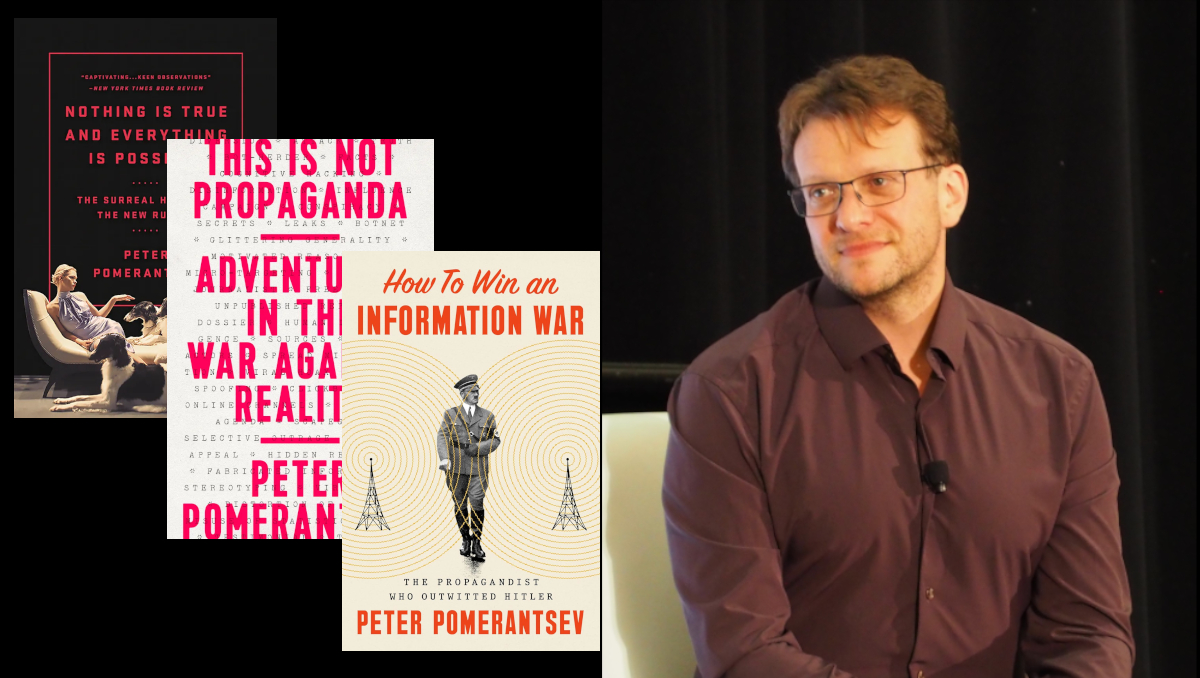
For those of you familiar with our On Writing host, Michael Neiberg you know he can’t sit still. He’s a rambling man. He has ants in his pants and in 2024 he headed off to the Chalke Valley History Festival (CVHF) in Chalke, England. While there he hosted a discussion with journalist, author and TV producer Peter Pomerantsev. Their conversation explored the history of propaganda, specifically drawing parallels between World War II and the current war in Ukraine. Pomerantsev’s book How to Win an Information War: The Propagandist Who Outwitted Hitler, examines the British effort to counter Nazi propaganda. The book focuses on the central figure, Sefton Delmer, who pioneered “fake news” tactics, including operating covert radio stations broadcasting into Germany. CVHF shared the audio, and the exchange offers important lessons for understanding current events.
And then I discovered this largely forgotten story from the Second World War, where in a very good cause to fight Nazi propaganda, to subvert the power of Hitler’s propaganda inside Germany and inside Europe, we, the British, developed what one might call fake news.
Podcast: Download
Subscribe: Apple Podcasts | Spotify | Amazon Music | Android | Pandora | iHeartRadio | Blubrry | Podchaser | Podcast Index | TuneIn | Deezer | Youtube Music | RSS | Subscribe to A Better Peace: The War Room Podcast
Peter Pomerantsev is a Ukrainian-born British journalist, author and TV producer. He is a Senior Fellow at the Institute of Global Affairs at the London School of Economics, where he co-directs the Arena program. He is also an associate editor at Coda Media, a position he has held since 2015. He is the author of Nothing Is True and Everything Is Possible (2014), This Is Not Propaganda (2019)—and a third, How to Win an Information War: The Propagandist Who Outwitted Hitler (2024).
Michael Neiberg is the Chair of War Studies at the U.S. Army War College.
The views expressed in this presentation are those of the speakers and do not necessarily reflect those of the U.S. Army War College, U.S. Army, or Department of Defense.
Photo Description: Peter Pomerantsev at National Book Festival, 24 August 2024
Photo Credit: Photo by Frypie via Wikimedia Commons



Rather than “exploiting the void” today, might not contemporary U.S. opponents’ propaganda be described more as “exploiting potential truths” or “exploiting the amazing post-Cold War role reversal,” for example, as described and discussed below?:
“During the Cold War, the USSR was perceived by American conservatives as an ‘evil empire,’ as a source of destructive cultural influences, while the United States was perceived as a force that was preventing the world from the triumph of godless communism and anarchy. The USSR, by contrast, positioned itself as a vanguard of emancipation, as a fighter for the progressive transformation of humanity (away from religion and toward atheism), and against the reactionary forces of the West. Today positions have changed dramatically; it is the United States or the ruling liberal establishment that in the conservative narrative has become the new or neo-USSR, spreading subversive ideas about family or the nature of authority around the world, while Russia has become almost a beacon of hope, ‘the last bastion of Christian values’ that helps keep the world from sliding into a liberal dystopia. Russia’s self-identity has changed accordingly; now it is Russia who actively resists destructive, revolutionary experiments with fundamental human institutions, experiments inspired by new revolutionary neo-communists from the United States. Hence the cautious hopes that the U.S. Christian right have for contemporary Russia: They are projecting on Russia their fantasies of another West that has not been infected by the virus of cultural liberalism.” (See the December 18, 2019, Georgetown University, Berkley Center for Religion, Peace and World Affairs article “Global Culture Wars from the Perspective of Russian and American Actors: Some Preliminary Conclusions,” by Dmitry Uzlaner. Look to the paragraph beginning with “Russia and the United States as screens for each other’s projections.”)
Question – Based on the Above:
With potential truths such as those described above — and/or with the potential role reversal that is described above — is there really any great need for a U.S. opponent, today, and re: these such fundamental issues, to resort to such things as “fake news?”
(As to our own desire or need to do “fake news”, re: the “truths” and/or the “role reversal” described above, what would be an effective Sefton Delmer-type/like approach to dealing with these such matters? A good challenge/a good exercise — in finding out if we had achieved any learning/had achieved an understanding as to Sefton Delmer’s propaganda approach, that is discussed in the podcast above?)
Re: “Exploiting the Void: The Psychology of Modern Propaganda” (see the title of this podcast):
a. Beginning at about the 09:50 spot in this podcast, Dr. Neiberg speaking, generally, as follows:
“You suggest that propaganda works best when it fills an empty space, what, then, is the empty space that Putin’s people are trying to fill and exploit today?”
Peter Pomerantsev, answering the question posed by Dr. Neiberg above, again generally, as follows:
“Historically speaking, propaganda of specific kind — that which seeks to build a sense of community and a very aggressive sense of identity and superiority — this type of propaganda comes forward to fill an identity void; an identity void which becomes manifest as a result of periods of massive political, economic, social and technological change.”
Question — Based on the Above:
Is it really “an identity void” — brought on by a period of massive political, economic, social and technological change — which, historically, has brought forth the type of propaganda described by Peter Pomerantsev above?
Or, possibly, is it the existential threat posed by a new viable identity (or identities) — which have become manifest within periods of massive political, economic, social and technological change — which, in fact historically, bring forth the “defense of the status quo” propaganda — and/or the “restorative of an already compromised status quo ante” propaganda — described by Peter Pomerantsev above?
(Thus, not a “void” — but, rather, viable identity “interlopers,” viable identity “challengers” and, thus, grave and existential threats to identity status quos — and/or to identity status quo antes — which, historically, and in times of massive political, economic, social and technological change, bring forth the kind of propaganda described by Mr. Pomerantsev above?)
As to my argument immediately above, consider the following Chinese example. In this such Chinese example, ask yourself whether (a) it is a “void” that is in play here — caused by massive political, economic, social and/or technological change — which explains China’s contemporary propaganda of the “a strong sense of community,” and the “very aggressive sense of identity and superiority” kind, described by Mr. Pomerantsev. Or, in the alternative, whether it might be (b) the existential threat posed to those dependent on the status quo — and/or on the status quo ante — and which was and is in fact posed by the interloper/the challenger western liberalism — which best explains these such contemporary Chinese propaganda moves:
“Whatever one thinks of this position, there is probably some truth to the claim that the Chinese intellectual world of the 1980s and 1990s was both predominantly liberal on political and economic issues, and distinctly hostile to traditional culture. The enormously influential documentary series River Elegy, which combined express attacks on Confucianism with thinly veiled criticisms of the party-state apparatus, is but one example of this. Chinese liberalism was indeed often critical of traditional family structures, social hierarchies, and what it perceived as backwards elements of Confucian political and economic thought. In the intellectual world, at least, Chinese cultural conservatism and leftism did share two important commonalities: Both were minority positions facing a perceived liberal majority, and both encountered significant hostility from this perceived majority.
This may, in fact, be the missing explanatory element. Ideologies regularly define themselves against a perceived “other,” and in this case there was quite plausibly a common and powerful “other” that both cultural conservatism and political leftism defined themselves against. This also explains why leftists have, since the 1990s, become considerably more tolerant, even accepting, of cultural conservatism than they were for virtually the entire 20th century. The need to accumulate additional ideological resources to combat a perceived Western liberal “other” is a powerful one, and it seems perfectly possible that this could have overridden whatever historical antagonism, or even substantive disagreement, existed between the two positions.”
(See the April 24, 2015 Foreign Policy article “What it Means to Be ‘Liberal’ or “Conservative in China: Putting the Country’s Most Significant Political Divide in Context by Taisu Zhang.)
Question — based on a dilemma — related to the matters that I have presented above:
If the propaganda of the “strong sense of community” — and of the “very aggressive sense of identity and superiority” kind (which is being deployed not just by Russia and China but even by the United States today?) — if this such type and/or kind propaganda has been brought on — not by an identity “void,” created by massive political, economic, social and/or technological change but, rather, by an identity challenger (less-constrained western liberalism?), which, in fact, has brought about these such massive changes,
Then, in circumstances such as these — where Russia, China and even the United States today all seem to see, not each other, but rather less-constrained western liberalism/capitalism as their most pressing, and indeed common, enemy/opponent — in circumstances such as these, (a) how does the United States counter present-day Russian and Chinese anti-western liberalism/capitalism propaganda, positions and agenda; this, without (b) compromising and undermining our own anti-western liberalism/capitalism propaganda, positions and agenda???
(As to the matters that I present immediately above, is there/are their any good historical example[s] that we might look to/consult for guidance?)
As to the past historical example question, that I pose in my last sentence immediately above, consider the following from the Mar-Apr 2017 edition of Foreign Affairs and, therein, the article by Walter Russell Mead entitled “The Jacksonian Revolt: American Populism and the Liberal Order:”
“In this new world disorder, the power of identity politics can no longer be denied. Western elites believed that in the twenty-first century, cosmopolitanism and globalism would triumph over atavism and tribal loyalties. They failed to understand the deep roots of identity politics in the human psyche and the necessity for those roots to find political expression in both foreign and domestic policy arenas. And they failed to understand that the very forces of economic and social development that cosmopolitanism and globalization fostered would generate turbulence and eventually resistance, as ‘Gemeinschaft’ (community) fought back against the onrushing ‘Gesellschaft’ (market society), in the classic terms sociologists favored a century ago.”
Thus, let us ask ourselves: In this Foreign Affairs article, do we think that author Mead is describing a “void,” which “community” seeks to, and/or steps forward into, to fill?
Or, in this article, do we think that author Mead is describing an interloper/a challenger (to wit: market society), who poses an existentially threat to the power, influence, control, prestige, privilege, status, safety, security, etc., enjoyed by — or previously enjoyed by — “community,” and which community, thus existentially threatened, “fights back” against?
“The current conflict is one of several possible wars of the market-states as they seek to open up societies to trade in commerce, ideas, and immigration which excite hostility in those groups that want to use law to enforce religious or ethnic orthodoxy.” (From an 11 April 2012 “Exclusive Interview of Philip Bobbitt” [author of the book The Shield of Achilles] in the London Evening Standard/The Standard.)
Question:
a. As to those “community” individuals and groups — yesterday and/or today — who have used and/or wish to use “propaganda of the strong sense of community and of the very aggressive sense of identity and superiority” kind (as discussed by interviewer Dr. Neiberg and interviewee Mr. Pomerantsev beginning at about the 09:50 point in this podcast above?);
b. As to these such “community” individuals and groups, can their use of this such type and/or kind of propaganda be traced to the threat posed to religious and/or ethnic orthodoxy (and those who have achieved or hope to achieve power, influence, control, etc., via same); a threat which, historically, has been, and still is, (a) posed by those in “market society” who (b) “seek to open up societies to trade in commerce, ideas, and immigration?”