
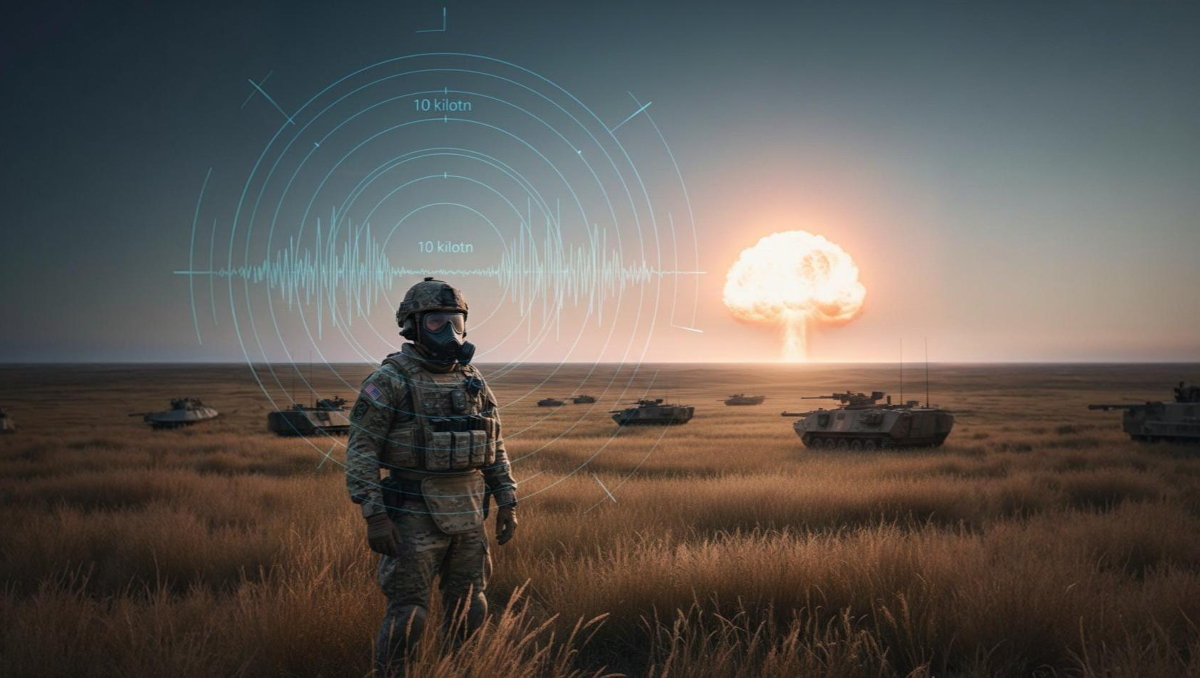
Nuclear operations are back, and it’s time for the joint force to catch up. Jeremiah Aeschleman sits down with host Tom Spahr to discuss the implications of recent nuclear coercion from Russia and the rapid expansion of China’s arsenal. To meet these challenges, the joint force must move beyond the “ENDEX mindset,” in which any use of nuclear weapons leads to the end of the training exercise. Instead, the military must prepare for the reality of a nuclear-armed battlefield. Aeschleman provides commanders with clear advice about how to bring conventional-nuclear integration back to the forefront.
The first piece here is having our staffs understand there is life after the detonation. It’s big, lot of effects, but there’s life after that.
Podcast: Download
Jeremiah Aeschleman is a colonel and a Nuclear and CWMD (FA52) officer with 35 years of service in the U.S. Army. He is an AY19 graduate of the U.S. Army War College Resident Course and is grateful to be back teaching in the Department of Military Strategy, Plans, and Operations. He served in all aspects of the nuclear enterprise including, command and control, consequence management, targeting, weapon effects, non/counter-proliferation, and DOE’s mission to build the deterrent.
Thomas W. Spahr is the DeSerio Chair of Strategic and Theater Intelligence at the U.S. Army War College. He is a retired colonel in the U.S. Army and holds a Ph.D. in History from The Ohio State University. He teaches courses at the Army War College on Military Campaigning and Intelligence.
The views expressed in this presentation are those of the speakers and do not necessarily reflect those of the U.S. Army War College, U.S. Army, or Department of Defense.
Photo Credit: Generated by Gemini

From the written introduction to our podcast above:
“The first piece here is having our staffs understand there is life after the detonation. It’s big, lot of effects, but there’s life after that.”
In the recent Lawfare article “The Chinese Military Is Built for Politics, Not Fighting Wars,” it is suggested that China’s and other major powers’ militaries — even if they are successful in significantly increasing the size and capabilities of the nuclear arsenals — these such major powers’ militaries are unlikely to be able to prevail against the United States in large-scale combat operations war; this, given that (a) these such nations’ militaries are built for politics and not for warfighting and that (b) the U.S. military is built for warfighting and not for politics. (I hope I got that right.)
Question — Based on the Above:
But, if the U.S. military, for various potential reasons, becomes more built for politics, and less built for warfighting, then (a) does not this such advantage disappear and, thus, (b) does not such things as the ability to prevail in large-scale combat operations, such things as “life after detonation” (etc., etc., etc.) have to be reconsidered — at least somewhat — in this new light?
Addendum:
Given the amazing differences/distinctions between (a) the capabilities of nations with militaries built and maintained more for warfighting and (b) the capabilities of nations with militaries built and maintained more for politics (for example, as presented in the matters and Lawfare article that I provide in my initial comment above); given these such differences/distinctions, which of these such nations’ militaries might be expected to perform best and prevail in “after the detonation” situations and why? (Questions which deserve, and indeed demand, more than cursory/knee-jerk considerations and answers?)
From the written introduction to our article above:
“To meet these challenges, the joint force must move beyond the “ENDEX mindset,” in which any use of nuclear weapons leads to the end of the training exercise. Instead, the military must prepare for the reality of a nuclear-armed battlefield.”
This, however, (the military must prepare for the reality of a nuclear-armed battlefield) would only seem to be a sixth order consideration, with the following 1 – 5 order matters needing to be (a) determined first and then (b) be “plugged in?”:
1. A determination as to whether one’s opponent’s military is built and maintained more for politics and, thus, less for warfighting (or vice-versa). (See my initial comments above),
2. A determination as to whether one’s own military is built and maintained more for politics and, thus, less for warfighting (or vice-versa). (Same),
3. A determination as to whether large-scale scale combat operations — for example with “after the detonation” possibilities — will take place on the opponent’s soil, air, space, seas and/or surrounds.
4. A determination as to whether large-scale combat operations — for example with “after the detonation” possibilities — will take place on one’s own soil, airs, space, seas and/or surrounds, and, finally:
5. A determination of whether (and how) the matters, that I present at my 1 – 4 above, are expected to effect various things related to conflict?
(Rationale example: If the conflict will take place on the enemies’ soil, etc. — and if this such enemies’ military forces have been built and are maintained more for politics and less for warfighting — then does this such configuration of our enemies’ military forces provide that our opponents will have an advantage in this such scenario (they can hold their populations “in check”) — an advantage that the U.S. military — presently built more for warfighting and less for politics — might not have — this, if the conflict, for example in this case, were to occur [a] on our soil, etc., and [b] with our population?)
Question — Based on the Above:
How can one develop and/or deploy a proper exercise — for example, in large-scale combat operations cases in which “after the detonation” scenarios are to be present — this, without first making a determine of (a) where the combat will take place (our or their soil, etc.), (b) how the military in this area is configured (for warfighting or for politics) and (c) how is this such configuration expected to effect (positively or negatively) the outcome there???
Good podcast and glad to see the effort to keep this topic in the view of the Institutional Army! Several articles in Countering WMD Journal have noted this need and offered ideas. One main challenge is showing that incorporating nuclear into training events and exercises need not derail it, and that the Army has people that can help. The other challenge is the need for leadership at echelon to incorporate nuclear (not just Chem) into training and accept the “opportunity cost” of doing so.