Victory goes to the side that correctly identifies its strategic problem, masses the right technology and combined arms advantages, and fully resources the will to win.
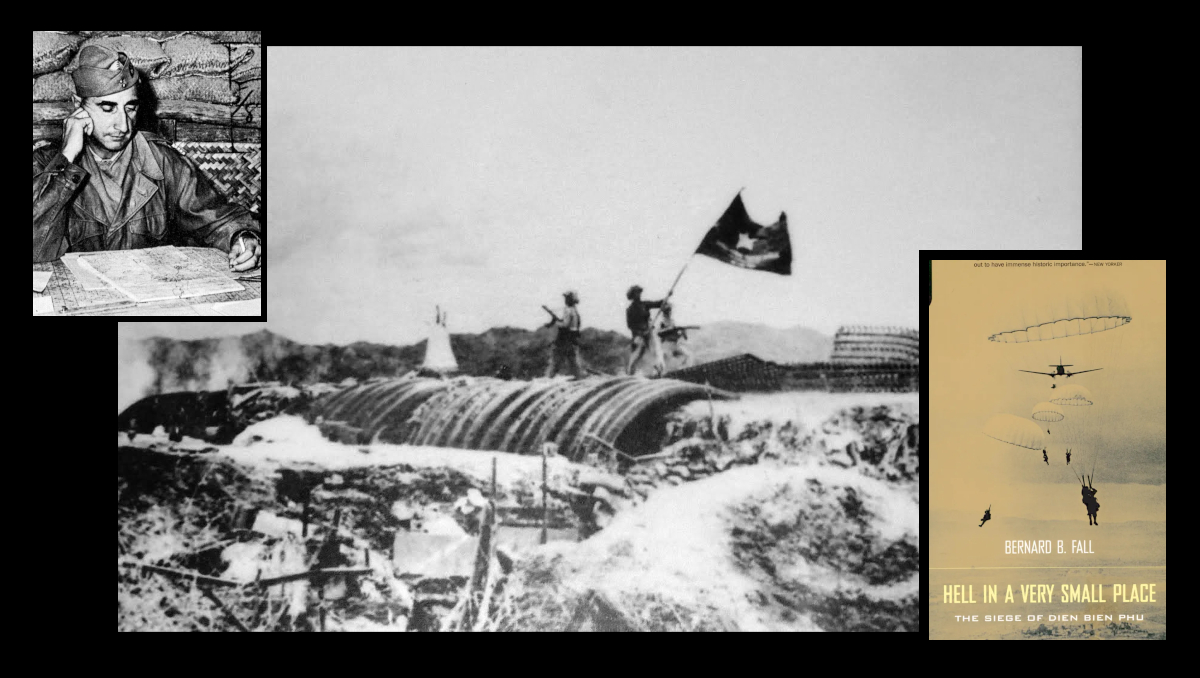
Bernard B. Fall was fascinated by Indochina, ultimately meeting his end in Vietnam in 1967 while patrolling with U.S. Marines. At the time of his death, he had authored seven books on French involvement in Laos and Vietnam. Hell in a Very Small Place: The Siege of Dien Bien Phu, his final book, published in 1966, proves timely 60 years after its publication. It chronicles the final major battle for Indochina, from the French airborne operation, Operation Castor on 20 November 1953, through the start of the siege on 13 March 1954, and then to capitulation of the garrison after fifty-six days on 7 May 1954. Hell in a Very Small Place shows that multi-domain advantages do not guarantee victory. Rather victory goes to the side that correctly identifies its strategic problem, masses the right technology and combined arms advantages, and fully resources the will to win.
Strategic Purpose and Policy Context Always Matter
A cursory look at the maps in the book inspires the question “Why was this place so important?” Dien Bien Phu was comprised of two small airstrips in a valley exposed to surrounding mountains and devoid of cover and concealment in the northwest corner of Vietnam. It was ten kilometers from the Laotian border, close to the border with China, and over 450 kilometers from Hanoi and the supposedly vital Red River Delta. Why did General Henri Navarre, commander of French forces in Indochina, seize the valley with a major airborne operation? The answer lies in strategic purpose and the policy context. For Fall “France had entirely lost sight of any clearly definable war aims.” (ix). The Viet Minh held one goal in mind: independence.
Operationally, the French, Navarre in particular, wanted to use a base at Dien Bien Phu as an economy of force mooring point for mobile groups to penetrate and disrupt Viet Minh supply lines near both borders. They also hoped to force the Viet Minh into a fixed battle, similar to their success in the Battle of Na-san (24), an example of recency bias in strategy. For the Viet Minh, the Dien Bien Phu garrison stood in the path of logistics lifelines for weapons, ammunition, and advisors from communist China. After fighting and attriting the French for six years, the Viet Minh accurately determined their strategic purpose was to move into the Geneva Conference with an overwhelming battlefield victory (384). The French garrison was merely an obstacle standing in its way. Each side had a different strategic purpose, but only one side was resolutely agreed on that purpose and dedicated mass to solving it.
A second question arises, namely, if the operation mattered so much to the French, why wasn’t it better supported? Over the course of the book, Fall explains how varying opinions about basing, resource allocation, and inability to mass French forces in Indochina crippled the garrison’s success. He also rightly places the larger battle in its appropriate early-Cold War context. The Korean war armistice was signed on July 27, 1953, providing communist China opportunities to reinforce the Viet Minh with advisors and materiel (ix, 294-295). France was fighting the decline of its colonial empire on a shoestring budget with waning political and social capital for large-scale war with the trauma of the Second World War not even a decade old (viii-ix). This, coupled with disagreements between the overall commander, Navarre, and his two chief subordinates, the commander of French forces in the Red River Delta, General Réne Cogny, and the Dien Bien Phu Commander, General Christian De Castries, led to indecision and disaster (27-37, 338, 388).
A final question cuts the fold: Why didn’t the French just abandon the garrison before the Geneva Conference? Fall asserts that American pressure persuaded the French to remain and reinforce Indochina as a bolster against communism, especially after Mao’s victory in China (viii, 460-461). Multiple French and allied visitors to the camp, including the U.S. commander of Army Forces in the Pacific, General John O’Daniel, did not raise objections as to the survivability of the garrison (108-109). Once committed, the indecision and infighting between Generals Navarre, Cogny, and De Castries affected everything: resupply timelines, priorities and loads, available aircraft sorties, and personnel reinforcements (248, 453). General Navarre repeatedly denied requests for breakout or reinforcement, all while several Viet Minh divisions, over 50,000 soldiers, tightened their siege (292). Once the battle was initiated, there was no option to retreat. Pride and prestige, again tied to the policy context, kept both sides engaged until one capitulated.
Mass, Combined Arms, the Right Technology, and Attrition
It was the Viet Minh who held the correct mix of combined arms technology and the mass to maximize it. The French held the air power advantage, but the Viet Minh negated this advantage with well-trained and well-equipped air defense units that shot down French fighter-bombers and cargo aircraft (337). Flak also negated France’s airborne resupply advantage. The French did not have the operational reserves of crews or aircraft to maintain the 150 tons of supplies Dien Bien Phu required daily (317). Each downed aircraft caused pressure on the besieged garrison and French Forces in Indochina overall, as loss and damage rates exceeded what could be sustained (455). The Viet Minh massed five divisions and multiple separate battalions by foot, truck, and bicycle in the valley. Accurate Viet Minh flak caused tons of food, ammunition, and medical supplies to fall into Viet Minh hands (224). In the end, it was Viet Minh artillery that broke the ability of the Dien Bien Phu garrison to resist. With “at least 200 guns above 57-mm caliber” the Viet Minh destroyed nearly every vehicle, tank, and artillery piece available to the General de Castries (127). The French garrison stood little chance of success.
Force management decisions made years before a conflict have operational impact on every conflict.
Fall asserts towards the end of the book that a massive airpower operation could have negated Viet Minh flak advantages, broken the siege, or at least prevented the surrender of the garrison before the Geneva Conference (455). However, he acknowledges the unlikeliness of that counterfactual case, especially as the French military did not prioritize bombers or ground-attack aircraft (456-458). Fall’s points are worth considering. In future conflict, the United States may have multi-domain advantages, but will we have the mass of the right advantages? Force management decisions made years before a conflict have operational impact on every conflict. As Fall asserts, it was both a lack of mass and a lack of the right tools that prevented General Navarre from exercising certain options.
Whatever other options were available to the French, they all depended on convincing a reticent United States to intervene on its behalf (312). In the immediate aftermath of the Korean War, and with President Dwight D. Eisenhower’s “New Look,” the United States was unwilling to take such risks. The policy of containment sought to avoid direct military confrontation, especially without allied, in this case British, support. Furthermore, the U.S. Joint Chiefs recommended against “an immediate offer of assistance” to the French. It was the beginning of the end for France’s imperial ambitions.
Resourcing the Will to Win
Regardless of the outcome, the will to win was expressed by both sides; however, the Viet Minh properly aligned their resources with the will to solve their tactical, operational, and strategic problems. The Viet Minh maintained a five-to-one attack ratio when tunneling towards and assaulting strongpoints with dedicated artillery and indirect fire support. Thousands of coolies cut roads for sustainment and could transport over 400 pounds of supplies on a single bicycle (452). For their part, French units thrown from strongpoints furiously reorganized and counterattacked.French volunteers kept parachuting into the besieged garrison until the bitter end (381-382). However, tactical will is no match for overwhelming mass or poor operational choices, and it cannot overcome strategic indecision. When a leader, be they general or politician, decides a battle is lost, soldiers are merely delaying the inevitable. A will to win without resources, mass, and relentless pursuit of victory is just hope, and hope is not a viable method.
The Viet Minh understood their strategic and operational problems correctly and applied every resource at their disposal to solve them. Reinforcements and supplies arrived at a steady rate, with some of the sustainment coming from captured airdrops meant for the French. Wavering or degraded Viet Minh units were replaced, re-educated, and reinforced. The Viet Minh demonstrated their will to win not just by individual or collective bravery but by resourcing their units to achieve victory.
War is Hell, So Don’t Underestimate Your Opponent.
The phrase “hell in a very small place” is apt for almost any combat condition. Whether it is the French besieged by Viet Minh artillery in northwestern Vietnam in 1954 or the Ukrainians battling for Izium against massed artillery with one-way drones, the soldier in the mud or at the breach point pays dearly. Ukrainian weapons reach into the Russian strategic deep area, yet the Russians maintain their will to fight. Future war may be fought from air-conditioned offices, but those offices are still under threat. It is foolish to think an enemy commander will not channel creativity, drive, and will to place mass where they can be most effective, just as the Viet Minh hauled artillery and anti-aircraft guns atop the mountains of the Muong Thanh valley (Fall, 127-129).
A final note about Fall’s masterpiece on Dien Bien Phu. Fall asserts the French lost the battle months before it even began because French commanders failed to acknowledge the military reality of the terrain, their enemy, and overestimated French artillery and air support (51). The French also failed to appreciate the strategic problem they faced, placed resources against incorrectly identified operational problems, and constantly underestimated the Viet Minh (454). Over 10,000 dead and wounded—French, Vietnamese, Moroccan, Algerian, and T’ai—paid the price for strategic hubris and bias. If there is bias to be had, it should be a bias towards reality and doing what is required. Correctly identifying the strategic and operational problems and then leveraging unified effort to win victory by mass and resources is one necessary step closer to reality, and thus one step closer to victory.
For Further Reading: For a critical look at Bernard B. Fall, resistance fighter, journalist, and political scientist, see Nathanial L Moir’s Number One Realist: Bernard Fall and Vietnamese Revolutionary Warfare. For another assessment (and more photos) of Dien Bien Phu published 30 years after Fall’s book, see Dien Bien Phu: The Epic Battle America Forgot by Howard R. Simpson. For a critical study of Vo Nugyen Giap, see Victory at Any Cost: The Genius of Viet Nam’s Gen. Vo Nguyen Giap by Cecil B Currey.
Marshall McGurk is an active-duty Special Forces Officer in the U.S. Army. He is a graduate of West Point (2005), the School of Advanced Military Studies (2023), and was a 2025 Irregular Warfare Initiative Fellow.
The views expressed in this article are those of the author and do not necessarily reflect those of the U.S. Army War College, the U.S. Army, or the Department of War.
Photo Description: Inset top left: Col. Christian de Castries, French commander at Dien Bien Phu.; Center: An image of Viet Minh troops planting their flag over the captured French headquarters at Dien Bien Phu, 1954.
Photo Credit: Inset top left: Stanley Karnow: Vietnam: A History, The Viking Press, New York 1983; Center: Vietnam People’s Army Museum System