
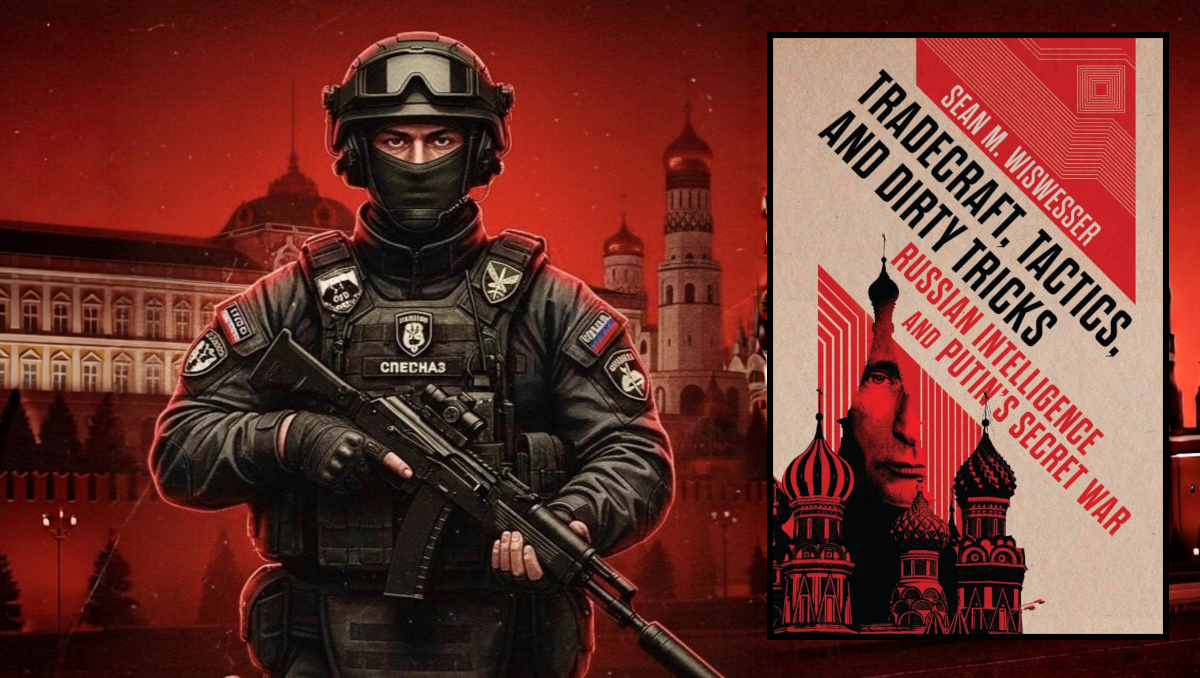
Career CIA senior operations officer Sean Wiswesser joins host Tom Spahr to pull back the curtain on the secretive world of Russian intelligence. Drawing from over 30 years of experience and his new book, Tradecraft, Tactics, and Dirty Tricks, Wiswesser explores the inner workings of the SVR, GRU, and FSB.
Their conversation moves past the “ten-foot-tall” spy myths often seen in movies to reveal a system frequently hampered by internal corruption and a culture of dishonesty. Wiswesser explains how these systemic flaws contributed to Russia’s intelligence failures during the initial invasion of Ukraine. He also provides a sobering warning about Russia’s strategic strengths, particularly their expertise in “active measures” designed to sow political discord and distrust within Western democracies. It is an essential listen for anyone seeking to understand the modern face of the Kremlin’s secret war.
They’re so riddled with a dishonesty. They can’t be honest with themselves or their leadership or President Putin, for that matter… That led them to disaster in Ukraine.
Podcast: Download
Subscribe: Apple Podcasts | Spotify | Amazon Music | Android | Pandora | iHeartRadio | Blubrry | Podchaser | Podcast Index | TuneIn | Deezer | RSS | Subscribe to A Better Peace: The War Room Podcast
Sean Wiswesser is a veteran national security professional with 30 years of experience in intelligence and defense. A former CIA senior operations officer and Chief of Station, he served multiple overseas tours, including in war zones. Sean is an international lecturer on Russian espionage and author of the forthcoming book Tradecraft, Tactics, and Dirty Tricks(U.S. Naval Institute, 2026). He holds degrees in History and Russian Linguistics, and a Master of Strategic Studies from the Air War College. His award-winning research on Russian intelligence and hybrid warfare has been widely published by the Army War College and Routledge.
Thomas W. Spahr is the DeSerio Chair of Strategic and Theater Intelligence at the U.S. Army War College. He is a retired colonel in the U.S. Army and holds a Ph.D. in History from The Ohio State University. He teaches courses at the Army War College on Military Campaigning and Intelligence.
The views expressed in this presentation are those of the speakers and do not necessarily reflect those of the Central Intelligence Agency, U.S. Army War College, U.S. Army, or Department of War.
Photo Credit:Created by GENIUS


I suggest you look up the reporting of Jason Jay Smart, PHD. He is a Special Correspondent in Kyiv, and reports nearly daily on his You Tube Channel. His Master’s Thesis and Doctoral Dissertation were both in Russia, focus on Putin and the intelligence services. He agrees with a lot of what you said. You could even get his perspective by having him on your podcast.
From the written introduction to our podcast above:
“He also provides a sobering warning about Russia’s strategic strengths, particularly their expertise in “active measures” designed to sow political discord and distrust within Western democracies.”
But should we be looking at Russia’s “strategic strengths,” and associated approaches, from different point of view; this being — not so much “to sow political discord and distrust within Western democracies” — but, rather, more (a) to win the battle for the hearts and minds of the populations of the world (to include Western hearts and minds); this, (b) via the reverse Cold War approach noted below?:
“During the Cold War, the USSR was perceived by American conservatives as an ‘evil empire,’ as a source of destructive cultural influences, while the United States was perceived as a force that was preventing the world from the triumph of godless communism and anarchy. The USSR, by contrast, positioned itself as a vanguard of emancipation, as a fighter for the progressive transformation of humanity (away from religion and toward atheism), and against the reactionary forces of the West.
Today positions have changed dramatically; it is the United States or the ruling liberal establishment that in the conservative narrative has become the new or neo-USSR, spreading subversive ideas about family or the nature of authority around the world, while Russia has become almost a beacon of hope, ‘the last bastion of Christian values’ that helps keep the world from sliding into a liberal dystopia.
Russia’s self-identity has changed accordingly; now it is Russia who actively resists destructive, revolutionary experiments with fundamental human institutions, experiments inspired by new revolutionary neo-communists from the United States. Hence the cautious hopes that the U.S. Christian right have for contemporary Russia: They are projecting on Russia their fantasies of another West that has not been infected by the virus of cultural liberalism.”
(Certain “paragraphing,” above, is by me. See the December 18, 2019, Georgetown University, Berkley Center for Religion, Peace and World Affairs article “Global Culture Wars from the Perspective of Russian and American Actors: Some Preliminary Conclusions,” by Dmitry Uzlaner. Look to the paragraph beginning with “Russia and the United States as screens for each other’s projections.”)
Conclusion:
The lesson that Russia, et. al (China, Iran, etc.) learned from the Old Cold War, this was that if you champion significant political, economic, social and/or value change (such as the communists did in the Old Cold War and such as the U.S./the West did post-the Old Cold War), then you have, essentially, existentially threatened the status quo power, influence, control, status, security, privilege, prestige, etc., of nearly every dominant group in the world everywhere. This massive group, of such existentially threatened folks, can then become your (in the current case, Russia’s, China’s, Iran’s, etc.’s) “Army.” (This, if you can play your cards right/if you play these cards and this opportunity to best advantage.)
Thus, as to the U.S./the West’s “strategic strength” during the Old Cold War — and as to Russia’s, China’s, Iran’s, etc., “strategic strength” in the post-Cold War — look (a) beyond “active measures” and (b) more to the strategic matters, and opportunity for Russia, China, etc., that I present above?