
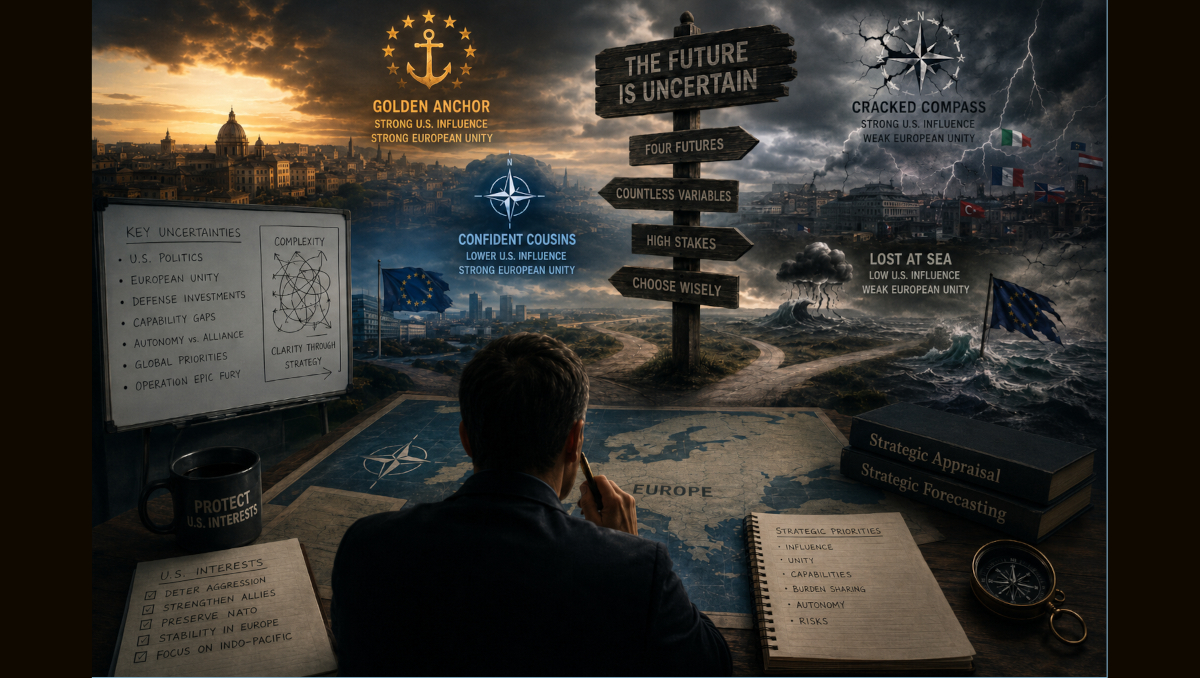
To avoid getting lost in the seemingly endless range of variables and possibilities, strategic appraisal begins with what can now be observed to narrow the range of possible future outcomes.
What will the trans-Atlantic security relationship be in ten years? It is an essential question for strategists to ponder, but the complexity of the problem is daunting. There are so many variables to consider: shifting domestic politics, uneven European defense expenditures, overreliance on U.S. military enablers, and the inevitable ripple effects of Operation Epic Fury (OEF) are just a few. Fortunately, there are tools for strategists looking to wrap their minds around such wicked problems. This article uses the evolving security relationship between the United States and Europe as a case study to illustrate how strategic appraisal and forecasting models can identify key strategic drivers, expose trade-offs, and shape policy in a complex security environment.
Navigating Complexity using a Strategic Appraisal and Forecasting Model
To avoid getting lost in the seemingly endless range of variables and possibilities, strategic appraisal begins with what can now be observed to narrow the range of possible future outcomes. In the case of trans-Atlantic relations, there are several important trends: defense burden-sharing, European reliance on high-end U.S. military enablers, and calls for increased European autonomy following the United States’ increasingly transactional approach to security commitments. These trends reflect a contested strategic environment in which they present multiple plausible trajectories, given the actors, interests, dependencies, constraints, and assumptions that shape the evolving transatlantic security system.
Despite this complexity, strategists can begin to make sense of it by combining Peter Schwartz’s scenario-planning model in The Art of the Long View with a strategic appraisal to assess the situation and avoid linear prediction. The first step involves identifying critical variables, determining how they interact, and considering how combining them with policy actions might drive towards different strategic futures. Strategists can then use intersecting axes to analyze the two most critical variables identified during strategic appraisal, generating four plausible futures and their projected conditions.
Using the evolving transatlantic security relationship as a case study, the first critical variable selected is the level of U.S. strategic influence in Europe, as it shapes deterrence, support for shared national interests, and European confidence in U.S. security commitments. Uncertainty in this variable arises from competing domestic pressures and shifting global security priorities. The second critical variable selected is European unity and NATO alliance cohesion because uncertainty posed by European capability growth could strengthen the existing alliance system or fragment into competing security frameworks. Assessing these variables together reveals a central problem—competing priorities and the U.S. transactional approach will simultaneously drive European capability and autonomy. How that autonomy develops—within the existing NATO framework or outside it—may undermine the long-term U.S. interest in maintaining a strong transatlantic security system, thereby enabling the United States to reprioritize resources to the Indo-Pacific and the Western Hemisphere.
Plotting Potential Transatlantic Courses
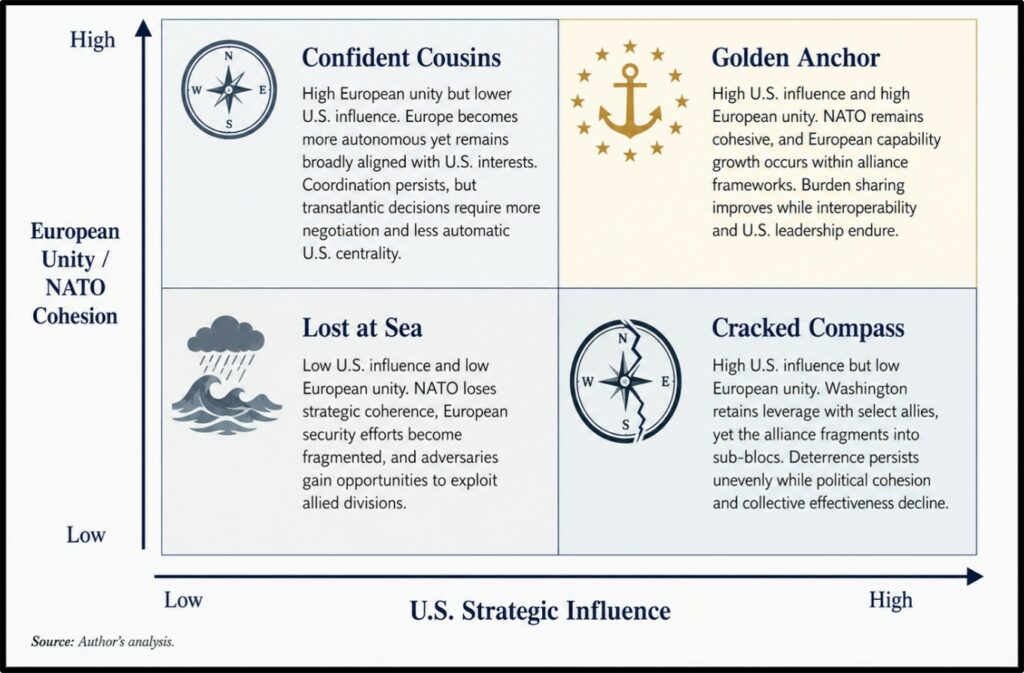
Now that the two critical variables have been identified, it is possible to plot their interaction and show how different combinations of U.S. influence and European unity could pull transatlantic security in distinct directions. Strong or weak U.S. influence forms one axis and, strong or weak European unity the other, creating four possible alternative futures. Rather than making a single forecast of either alliance renewal or collapse, this structure forces strategists to consider how policy choices may move the system toward or away from preferred outcomes while still keeping the analysis grounded in observable trends. Each future’s furthest point represents its most extreme realization, but strategic reality will likely remain fluid as additional variables and trends interact with the dominant trajectory, creating hybrid conditions. The four futures below, therefore, serve less as predictions than as reference points for developing adaptive policy pathways in a changing strategic environment.
The first future, termed Golden Anchor, is the product of strong U.S. influence and strong European unity. The existing NATO alliance remains the principal framework for security and European capability development rather than some other competing structures, such as the European Union. NATO member states increase defense investments that maximize interoperability and reduce capability gaps while relying only on specific U.S. capabilities for strategic deterrence. This future shifts the European security leadership burden to regional allies while maintaining deep integration that preserves U.S. influence.
The second future, Confident Cousins, emerges from strong European unity paired with reduced U.S. influence. This future assumes Europe produces credible defense capabilities and remains politically aligned, assuming leadership for European security using both NATO and European Union (EU) frameworks. While still broadly aligned with American interests, increased European security autonomy reduces America’s central role in European security defense procurement and decision-making and increases coordination costs. A more capable, unified, and autonomous Europe will require more negotiations, show less deference to U.S. interests, and increase tolerance for policies divergent from those of the United States’.
The third scenario, Cracked Compass, arises from high U.S. influence and declining European unity. This fragmented future leaves the United States in close relationships with select allies, likely those most concerned about Russian aggression. Institutional cohesion within NATO and the EU is weaker due to transactional relationships and uneven alliance commitments. Eastern European countries may deepen bilateral military cooperation with the United States, while others, such as Germany and France, shift toward independent capabilities or limited defense cooperation outside NATO. This future may temporarily deter Russia in some regions but risks creating a two-tiered alliance system that weakens collective defense across the continent by reducing collective planning, political alignment, and the comprehensive security architecture provided by NATO.
The fourth and most dangerous future, Lost at Sea, results from the unfortunate combination of low U.S. influence and low European unity. Institutions like NATO and the EU remain formally present but lose all coherence as their members drift apart strategically. This future results in European countries failing to replace U.S. leadership under a unified defense framework, and the United States can no longer broker agreement among its European allies due to past political disagreements. Uncertainty and distrust lead countries into duplicative, redundant, and non-integrated capability development, leaving significant capability gaps that the United States can no longer fill. Neither NATO nor the EU can align its members on threat perceptions, resource requirements, or crisis responses, creating gaps that adversaries like Russia can exploit, especially among weaker states that relied heavily on the previous collective defense frameworks.
Charting Pathways Through Difficult Waters
The outputs from the strategic appraisal and forecasting model above can help strategists assess changes in the strategic environment and develop options to achieve policy aims that advance U.S. national interests despite uncertainty and complexity. In this case study, the model provides a clearer lens for charting pathways by showing how each policy option could move transatlantic security toward or away from the four futures identified above. This lens is especially useful for navigating the accelerating transition to European strategic autonomy without allowing alliance tensions over OEF to fragment transatlantic security. By comparing policy pathways against the model’s projected futures, strategists can evaluate each option’s advantages, risks, and likely effects on U.S. influence, European unity, and long-term alliance cohesion.
The first policy pathway is selective reinforcement, under which the United States would concentrate security cooperation, rotational forces, military assistance, and high-end enabling capabilities on the most capable or strategically exposed allies rather than distributing support evenly across NATO. In practice, Washington would prioritize states that meet agreed defense-investment and readiness standards, occupy critical geographic positions, or provide capabilities essential to deterring Russia. This could include expanding bilateral access agreements, pre-positioning equipment, increasing combined exercises, integrating air and missile defense networks, and accelerating arms sales to allies along NATO’s eastern and northern flanks. U.S. intelligence, surveillance, reconnaissance, logistics, and command-and-control support would be allocated first to countries capable of generating deployable forces and sustaining them in combat.
The principal advantage of selective reinforcement is that it aligns finite U.S. resources with allies capable of producing immediate operational effects. It would strengthen deterrence in the Baltic, Nordic, Black Sea, and Arctic regions; reward allies that invest seriously in defense; and reduce the expectation that the United States will compensate indefinitely for chronic underinvestment elsewhere. It could also create regional clusters of highly interoperable forces capable of acting before the full alliance reaches political consensus. However, this efficiency would come at substantial institutional cost. States excluded from preferred access, assistance, or planning arrangements could conclude that Article 5 protections are becoming conditional in practice, even if they remain unconditional in treaty language. Western and southern European allies might respond by developing separate defense arrangements, withholding support for U.S. priorities, or resisting NATO force-planning decisions. Selective reinforcement could therefore improve localized deterrence while gradually producing a two-tiered alliance, pulling the system toward the Cracked Compass scenario.
A second pathway is a new transatlantic bargain, under which the United States and its allies would formally renegotiate the distribution of costs, forces, and responsibilities within NATO. Rather than relying on general political commitments to “burden sharing,” the revised bargain would establish measurable expectations for defense spending, readiness, force generation, munitions production, infrastructure, and contributions to specific regional missions. Continued access to certain U.S. capabilities—such as extended nuclear deterrence, strategic lift, intelligence support, missile defense, and forward presence—could be tied to allied performance against those benchmarks. Allies that meet agreed targets would receive priority access to U.S. planning, technology, exercises, and assistance; those that do not would face reduced U.S. support or greater responsibility for their own defense.
The risk is that a bargain framed too narrowly around financial thresholds or the threat of withdrawal could be interpreted as coercion rather than partnership.
This option would make explicit what is increasingly implicit: U.S. political support for European security depends on Europe assuming a larger share of the military burden. It would give European governments a clear planning horizon and could accelerate investment in air defense, long-range fires, logistics, command systems, cyber defense, military mobility, and munitions stockpiles. A successful agreement could produce the Golden Anchor future by preserving NATO as the central security institution while shifting conventional defense responsibilities toward Europe. The risk is that a bargain framed too narrowly around financial thresholds or the threat of withdrawal could be interpreted as coercion rather than partnership. Allies may meet spending targets by purchasing nationally preferred systems that do not improve NATO interoperability, or they may pursue EU-centered alternatives designed to reduce dependence on Washington. Negotiations could also become consumed by disputes over what counts as a sufficient contribution, whether frontline states deserve different standards, and whether U.S. guarantees should ever be made conditional. If the bargaining process reduces trust or alliance consensus, it could move the system toward either Confident Cousins, in which Europe becomes more capable but less responsive to U.S. leadership, or Cracked Compass, in which responsibilities fragment along regional and bilateral lines.
The third pathway, managed autonomy, would accept that Europe will become more militarily capable and politically independent, but would seek to shape that process so that autonomy develops within NATO rather than against it. Under this option, the United States would deliberately transfer greater responsibility for conventional deterrence, force generation, and regional crisis response to European allies while retaining leadership in the capabilities that bind the alliance together. European states would assume primary responsibility for land forces, regional air and missile defense, military mobility, sustainment, and conventional munitions production. The United States would continue to provide extended nuclear deterrence, strategic intelligence, global logistics, selected high-end enablers, and political leadership within NATO, while permanently reducing the number of forces stationed and transferring responsibility for regional stability missions, such as NATO’s Kosovo Force.
Implementation would require a phased division of labor rather than an abrupt U.S. retrenchment. NATO could designate European framework nations to lead regional defense plans, establish capability milestones for replacing U.S. enablers, and create transition timelines linked to demonstrated readiness rather than spending alone. The United States could support European capability development through co-production agreements, shared standards, integrated command structures, technology transfer, and joint exercises designed to test whether European forces can operate with progressively less direct U.S. support. Washington would also encourage EU defense initiatives when they strengthen NATO requirements, while opposing duplicative command structures or procurement policies that exclude U.S. and non-EU allies.
The final pathway is comprehensive NATO reform, which would redesign the alliance to meet 21st-century challenges rather than merely adjust burden-sharing within the existing structure. Reform could include revising command arrangements, strengthening force-generation and readiness requirements, expanding common funding, improving multinational formations, and integrating cyber, space, the Arctic, China, critical infrastructure, and technological competition into alliance planning. If successful, this approach could reduce duplication, improve interoperability, and produce either a Golden Anchor or Confident Cousins future by combining stronger European capabilities with a transatlantic security framework that matches the emergent threat environment.
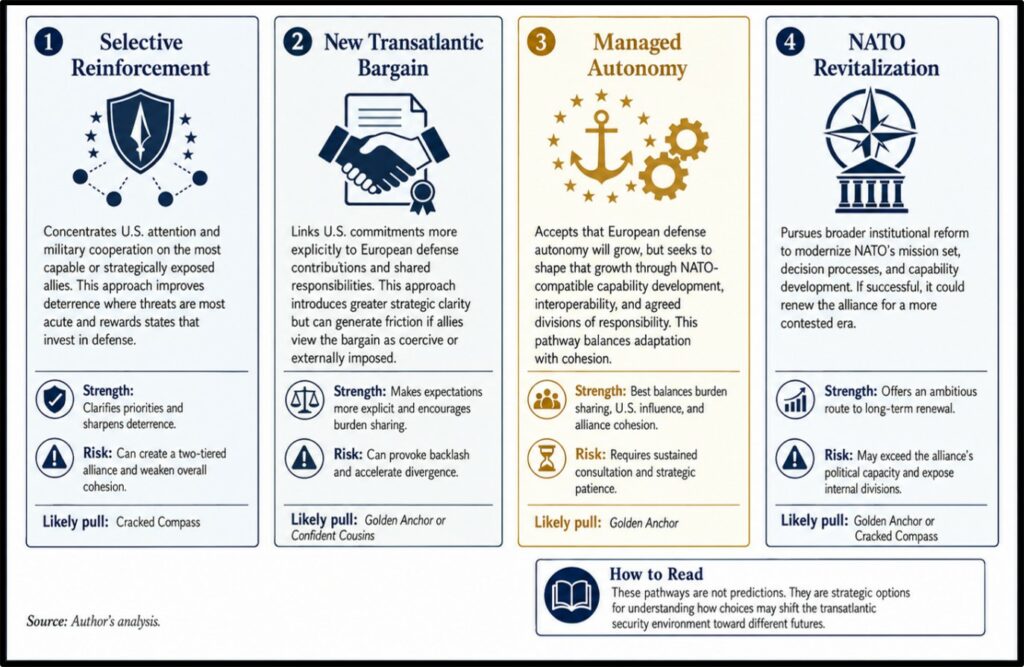
The principal risk is that the reform would demand immense consensus on threat priorities, spending, industrial policy, geographic focus, and political authority at a time when allies already disagree over Ukraine, defense expenditures, Greenland, China, and participation in U.S.-led operations. Negotiations could expose and deepen existing divisions, encourage regional or EU-led alternatives, and weaken confidence in NATO’s collective purpose. Rather than revitalizing the alliance, an overambitious reform effort could accelerate movement toward Cracked Compass or, in the worst case, Lost at Sea.
Conclusion
Strategic appraisal and forecasting do not tell policymakers exactly what will happen. They show what can happen, what choices may push events in one direction or another, and where the biggest risks lie. In the transatlantic case, the basic challenge is clear: Europe must carry more of the defense burden, while the United States must reduce its exposure without breaking NATO in the process. The question is not whether Europe will become more independent. It is whether that independence strengthens the alliance or pulls it apart. The United States has difficult choices ahead. It can reward a small group of capable allies, strike a new bargain, guide Europe toward greater responsibility inside NATO, or try to rebuild the alliance itself. Each path has costs, and none guarantees success.
The value of the model is that it helps strategists identify costs, trade-offs, and warning signs before making difficult-to-reverse policy recommendations. Its use also extends well beyond transatlantic security because strategic problems rarely unfold as planned. By testing assumptions, comparing possible futures, and tracing how actors may respond, the strategists can develop adaptive strategies and policies that can pivot as conditions change. It does not eliminate uncertainty, but it reduces surprise and gives decision-makers a clearer view of the consequences of each choice.
Josh Yarbrough is a lieutenant colonel, an Army strategist and deputy commander of U.S. Army Support Activity, Fort Dix, New Jersey. With more than 20 years of Army Reserve service, he has held strategic planning roles at U.S. Army Reserve Command and U.S. Army Pacific, as well as tactical leadership positions during deployments to Afghanistan and the Middle East.
The views expressed in this article are those of the author and do not necessarily reflect those of the U.S. Army War College, the U.S. Army, or the Department of War.
Photo Credit: Created by GhatGPT


From our article above:
“Using the evolving transatlantic security relationship as a case study, the first critical variable selected is the level of U.S. strategic influence in Europe, as it shapes deterrence, support for shared national interests, and European confidence in U.S. security commitments. Uncertainty in this variable arises from competing domestic pressures and shifting global security priorities. The second critical variable selected is European unity and NATO alliance cohesion because uncertainty posed by European capability growth could strengthen the existing alliance system or fragment into competing security frameworks.”
Given that the 2025 National Security Strategy of the United States “suggests that Europe is facing ‘civilizational erasure’ and does not cast Russia as a threat to the U.S.” (See the 7 December 2025 BBC News article “US Security Strategy Aligns with Russia’s Vision, Moscow Says” by Rachel Muller-Heyndyk),
Then how did this/does this — if at all — effect the two most critical variables, identified in my first quoted paragraph above, and the four associated plausible futures, and their projected conditions?
One way to look at the matter that I present above, this is from the perspective of the U.S., currently, seeing Russia as a civilization (think older “traditional values”) defending ally, and Europe as a civilization (again think older “traditional values”) compromising enemy. Potential examples as to this such thought process:
“Liberal democratic societies have, in the past few decades, undergone a series of revolutionary changes in their social and political life, which are not to the taste of all their citizens. For many of those, who might be called social conservatives, Russia has become a more agreeable society, at least in principle, than those they live in. Communist Westerners used to speak of the Soviet Union as the pioneer society of a brighter future for all. Now, the rightwing nationalists of Europe and North America admire Russia and its leader for cleaving to the past.” (From “The American Interest” article “The Reality of Russian Soft Power” by John Lloyd and Daria Litinova.)
“Compounding it all, Russia’s dictator has achieved all of this while creating sympathy in elements of the Right that mirrors the sympathy the Soviet Union achieved in elements of the Left. In other words, Putin is expanding Russian power and influence while mounting a cultural critique that resonates with some American audiences, casting himself as a defender of Christian civilization against Islam and the godless, decadent West.” (From the “National Review” article entitled: “How Russia Wins” by David French.)
From that such perspective, thus, to ask how same might have (or might not have) (a) effected the selection of the two most critical variables identified in our article above and (b) the matters which follow from this such selection?
Given the aspect/the perspective — that I provide immediately above — to wit:
a. A conservative/godly/virtuous Russia (and the U.S.?) — like the West in the Old Cold War — now suggested as the civilization-defending “good guys.” And:
b. A revolutionary/godless/decadent Europe — like the communists in the Old Cold War — now suggested as the civilization-attacking “bad guys”;
Given this such perspective, “what will the trans-Atlantic security relationship be in ten years?”
B.C..- thanks for the thoughtful replies. The old adage goes all models are wrong, some are useful. Definitely could select different variables from multiple lenses/perspectives as the most critical, then work analysis by comparing how those variables and environmental conditions might interact/unfold in the strategic environment to create a more holistic assessment. Ideally, given sufficient time, even apply this model from friendly, adversary, and other partner perspectives to help mitigate blindspots. Still, the goal here is not to solve or predict the future, rather understand how strategic forecasting can help make sense of wicked problems like you’ve highlighted above.
JY: Roger. And thanks.
Washington warned against foreign interventions. Start there.