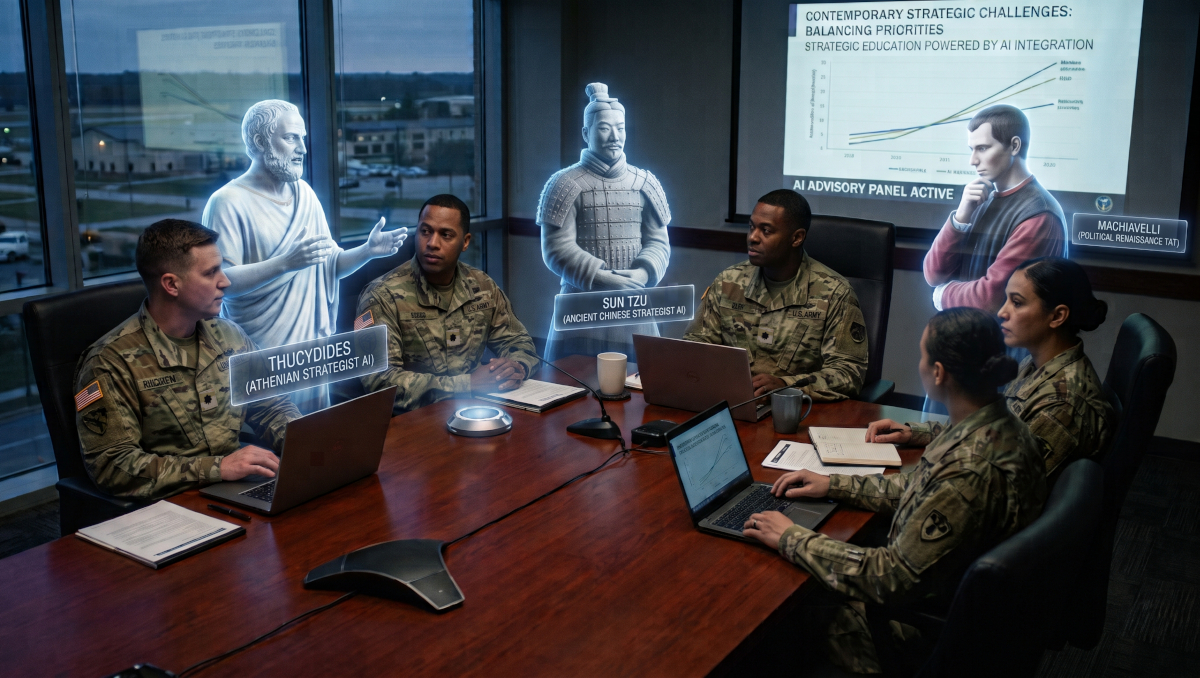
Dead strategists and dusty empires offer enduring and relevant wisdom across time and geography to modern warfighting concerns.
As the U.S. Army War College works to deliver the best education for our nation’s senior military leaders, AI adoption has moved apace. Many faculty and staff in the college have engaged in significant experimentation and reflection on the best methods to integrate AI while preserving academic rigor, ethics, and critical thinking. To further the discussion and empower other course directors, I offer a pedagogical review of my elective, Strategic Thought from Antiquity to the Present, as an example of how to train students in ever more advanced AI techniques while preserving human judgment and learning course material.
Course Design Philosophy
I built the Strategic Thought elective around two ideas. First, dead strategists and dusty empires offer enduring and relevant wisdom across time and geography to modern warfighting concerns. Second, AI could help me bring those ancient ideas to life for interactive engagement on present concerns. In short, AI just might make old ideas seem more relevant to today’s strategic leaders.
I designed the course to develop disciplined AI use as an aid to strategic and critical thinking skills, while learning more about ancient strategic thought and its applicability to problems of today. To help students move through the material and increase AI proficiency, I arranged the course into three blocks. First, students get foundational grounding in the difference between strategy and grand strategy, and where the achievement of one might run counter to the other. After setting that meta-framework, students are exposed to strategy in the ancient world (Block 2) and progress through strategic thought in the Enlightenment and present (Block 3). In every block, the course integrates progressively more advanced AI use in evaluative requirements. Early assignments introduce AI skepticism and transparency in use. Later assignments expand AI’s role while reinforcing student judgment and critical thinking.
AI Use Philosophy
AI use is expected and built into the course at every evaluative requirement. In the assignments and the initial course director brief, I direct the students to use AI but also to challenge AI outputs rather than accept them at face value. I frame AI as an assistant, not an authority. Throughout the course, AI is portrayed as an action officer that can speed up certain aspects of work so that the student would have more time for reflection, exploration, and analysis. Several students called one AI system “Major Chad GPT” as if it were an action officer working for them to produce products for them to evaluate and refine. I encouraged my students to leverage the speed of AI to explore ideas they didn’t have time for earlier in their War College experience. I told them to have fun, experiment, fail, try again, and share their process with others. The only requirement is to document their work and reflect on the course material and AI process.
Following the detailed, often multi-step, assignment requirements made AI use radically transparent. Students often posted copies of entire AI chat threads showing how they had worked with AI to get an answer or product. Some students shared their initial AI-generated products they improved later and talked about the learning process of refining work when the first attempt to produce an AI agent or PPT slide deck did not generate the outcome they needed. By putting all the AI work out in the open, students were less concerned about academic integrity problems with using AI and could explore their ideas on strategy. The voluminous student-provided material made it easy for me as the instructor to see how the student was thinking as he or she engaged AI, and it also helped other students see ways of using AI they had not previously considered.
Course Evaluative Requirements
Students had to complete progressively more complex assignments in the following order.
The first graded assignment–a reflective journal on a military operation they had engaged in (or studied)–immediately introduced AI use and transparency. Students analyzed the alignment or misalignment between strategy and grand strategy of an operation familiar to them. The prompt encouraged reflection on the strategic framework by applying it to a familiar scenario. Students were told they could use AI for research and thinking about the strategic frameworks as applied to the operation. In this journal, students answer the prompt and, if they used AI, explain how they used it. The journal was individual work and allowed me, as the instructor, to provide feedback on AI use to drive towards critical use and sound student judgment.
The second major assignment required students to employ AI to produce a comparative or synthesis podcast between two strategists presented in the course. Students provided the podcast audio file and listed the strategists being compared, the input source material, their podcast prompt, and their analysis of the podcast’s accuracy (stating where they agreed, disagreed, or gained new insight about the strategists) and how the AI use worked. Students were also encouraged to reflect on and integrate any previous coursework in the podcast, resulting in interesting discussions of ethics, strategic leadership, and operational art and design. To help cross-pollinate learning on the strategists and AI techniques, the students also had to listen to two other student podcasts and respond to their peers with their reflections.
In the third major assignment, students had to build and train an AI bot to personify a strategist or nation-state strategy listed in the course. This step was designed to bring ancient strategists and empire strategies to life for active engagement, much like the question “If you could have dinner with these three people no longer alive today, who would they be and what would you talk about?” I gave the students clear step-by-step instructions on how to build the bot and talk about their process. They trained the AI bot by feeding course and external source material from that strategist/nation and checked to make sure it would answer modern queries from its assigned point of view. The students then had to ask their bot for advice on a problem they were facing at work and evaluate the bot’s response. The students then had to engage two bots that other students had made. In this way, students engaged three different strategists with their questions and got a wider array of advice and input, which helped them learn more about the course content and showed them other ways of designing a bot they might not have considered.
I designed the capstone project to make the course practical and useful for the student, rather than an isolated exercise in abstract strategic thinking with the use of AI tools.
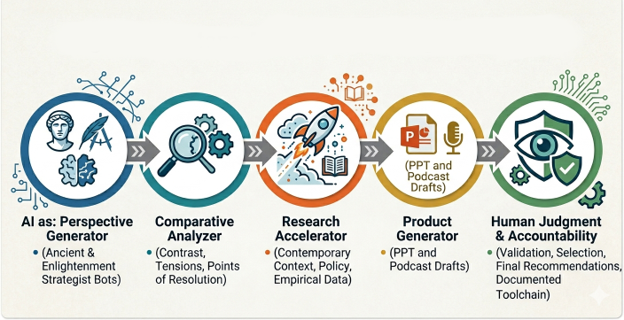
For the capstone project, students had to follow a multi-step process of AI engagement to address a current problem they were facing at work or would face in their next job and reflect on their use of AI and its products along the way. The exercise helped students see the relevance of ancient strategists to their current problems, assess AI’s utility in current research, and explore its use in visual presentations. I designed the capstone project to make the course practical and useful for the student, rather than an isolated exercise in abstract strategic thinking with the use of AI tools. The capstone project steps are shown below in an AI-generated graphic.
What Students Learned about AI
Student reflections in the capstone project suggest that they perceived that the course design successfully enhanced both their strategic thinking and AI literacy. I copied student capstone project reflection paragraphs, removing all student identification data, into a new Word document and loaded them into ChatGPT for analysis, which provided me with several themes, as listed below:
(1) AI as an accelerator, not a substitute for thinking: Students repeatedly mentioned the speed of work, time saved, and AI efficiency in synthesizing large volumes of data. At the same time, they spoke of the importance of human thought and input, noting that AI could produce PowerPoint, but the substance and creativity came from the user. Student reflections consistently shared the view that AI output quality was driven by user knowledge, creativity, and prompt framing rather than the tool itself.
(2) Awareness of AI limitations: Almost all students discussed AI shortcomings in their reflections, particularly in generating creative or novel ideas. AI experimentation across various platforms and required outputs helped students recognize AI’s limitations and appreciate the importance of actively shaping and challenging output.
(3) Prompt engineering as a skill: A dominant theme was the realization that prompt quality materially affected AI outputs. Students described learning through trial and error how poor prompting led to mis-weighted sources or poorly focused outputs. Many identified prompt engineering as a core competency, like giving clear guidance to an action officer.
(4) Transparency and Trust: Many students expressed caution about using AI systems when you didn’t know how they were trained. This common reflection demonstrated a strong understanding of a key AI weakness that better prepares them to critically analyze AI outputs.
(5) Immediate Professional Applicability: Several students noted the capstone project truly was useful to their current job. Other students found a renewed interest in reading about ancient strategists (after graduation) and considering how frameworks like Thucydides’ concept of fear, honor, and interest might apply to their professional lives. As one student posted on the capstone project:
“I very much have enjoyed the process of learning more about Thucydides and Machiavelli and developing a PowerPoint and podcast to address a very real issue facing the [my branch]and in less than two weeks!”
Conclusion
The Strategic Thought elective responds to President Donald J. Trump’s 2025 America’s AI Action Plan directive to senior military colleges to “teach core AI skills and literacy” and “foster AI-specific curriculum.” I carefully integrated AI into the curriculum to grow in complexity over time, build on earlier work, and train students how to treat AI outputs as objects of critique. AI helped bring to life ancient and Enlightenment strategic thought, allowing students to engage with those theories and concepts via bot conversations while wrestling with a current, relevant work concern.
Over the course, AI helped demonstrate how old ideas and frameworks remain relevant today, trained future leaders in AI-assisted critical thinking, and empowered students with AI skills that will help them be more effective and efficient in their military careers. Not only did the AI integration facilitate student learning of course content, but student capstone reflections also often described the process as “fun” and said that they “enjoyed” the course—high praise indeed for an elective with dense content on dead strategists and dusty empires.
Carolyn Erickson is a colonel in the U.S. Army and an Assistant Professor and Director of Campaign Planning at the U.S. Army War College. An Army Strategist, she previously served as G5 of U.S. Army Cyber Command. A West Point graduate with a Master of Public Administration from Harvard Kennedy School, she was also a War College Fellow at Georgetown University where she taught undergraduates national security strategy.
The views expressed in this article are those of the author and do not necessarily reflect those of the U.S. Army War College, the U.S. Army, or the Department of War.
Photo Credit: Created by Gemini