Shaping an opponent’s expectations can change an entire operation’s course. Tom Spahr sits down with naval flight officer and strategist Mike “Quatto” Posey to break down the craft and impact of military deception.
Posey explains that deception is far more than a fun trick—it achieves real benefits through the manipulation of an adversary’s choices. From World War II’s ghost armies to decoys drawing fire in Ukraine, convincing the enemy to look the wrong way dramatically tilts the odds. Even in a world of ubiquitous sensors, satellites, and drones, human psychology remains the ultimate battlefield. Visibility does not equal understanding, and clever planners exploit confirmation bias by feeding opponents clues they already want to believe.
Adversaries can also target the larger public by exploiting these same cognitive vulnerabilities through social media and news feeds. Resisting manipulation requires sharpening media literacy and practicing critical thinking daily. It’s a great discussion of the history, art, and high-stakes psychology behind military deception.
So at its simplest, military deception is causing an adversary to perceive a situation incorrectly so that they take or fail to take an action that ultimately helps us achieve our military objective.
Throughout this episode Mike Posey referenced a number of publications:
Barton Whaley, Strategem: Amazon.com: Stratagem: Deception and Surprise in War (Artech House Information Warfare Library): 9781596931985: Whaley, Barton: Books
Mark Cancian, “Inflicting Surprise”: Inflicting Surprise: Gaining Competitive Advantage in Great Power Conflicts
Barton Whaley, “The One Percent Solution”: The one percent solution: Costs and benefits of military deception | 1
Ad Fontes Media Chart: Interactive Media Bias Chart
Michael Posey, “MacArthur and the Art of Information Warfare”: MACARTHUR AND THE ART OF INFORMATION WARFARE – War Room – U.S. Army War College
Podcast: Download
Michael Posey is an active-duty U.S. Naval Flight Officer with a subspecialty in Information Systems and Operations. He currently serves as an Assistant Professor in the Department of Military Strategy, Planning, and Operations at the U.S. Army War College in Carlisle, PA.
Thomas W. Spahr is the DeSerio Chair of Strategic and Theater Intelligence at the U.S. Army War College. He is a retired colonel in the U.S. Army and holds a Ph.D. in History from The Ohio State University. He teaches courses at the Army War College on Military Campaigning and Intelligence.
The views expressed in this presentation are those of the speakers and do not necessarily reflect those of the U.S. Army War College, U.S. Army, or Department of War.
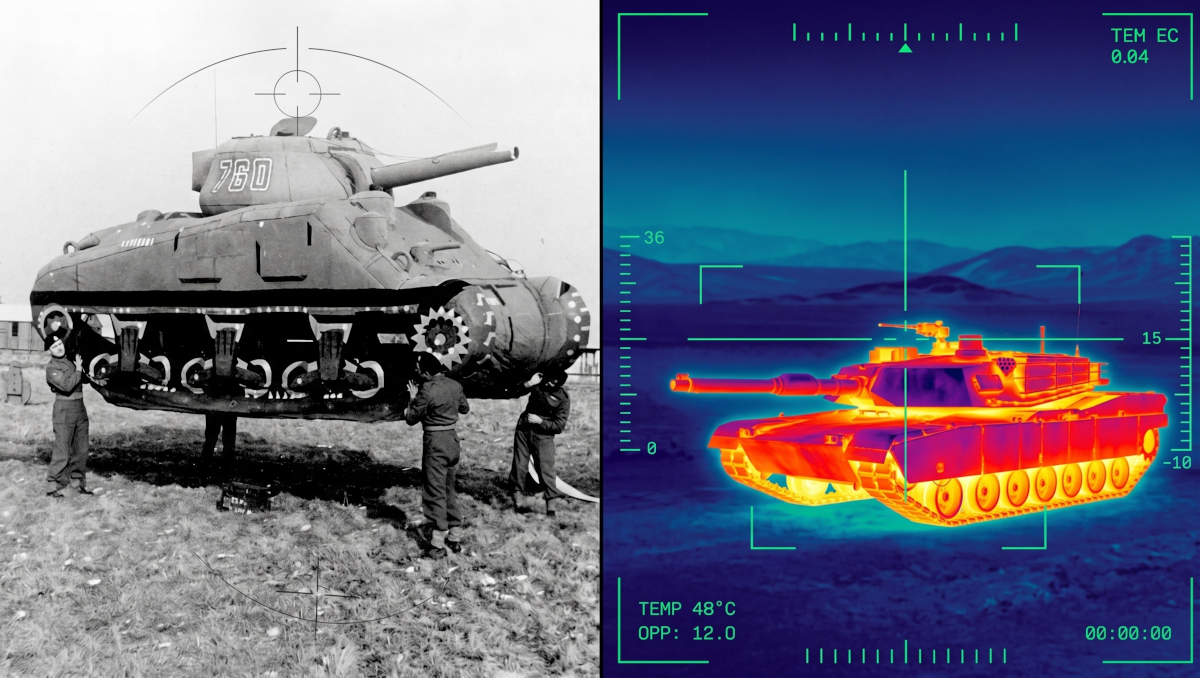
Photo Description: (L) Four soldiers assigned to 23rd Headquarters Special Troops — commonly referred to as the Ghost Army — move an inflatable tank. The 1,000 Ghost Army service members used a variety of unique deception tactics to fool the enemy during World War II. Besides inflatable tanks and dummy equipment, they incorporated sound effects, radio trickery and impersonation. Their efforts were classified until 1993,but are now being highlighted and taught via the Ghost Army Legacy Project. (R) AI generated
Photo Credit: (L) National Archives (R) Created by Gemini