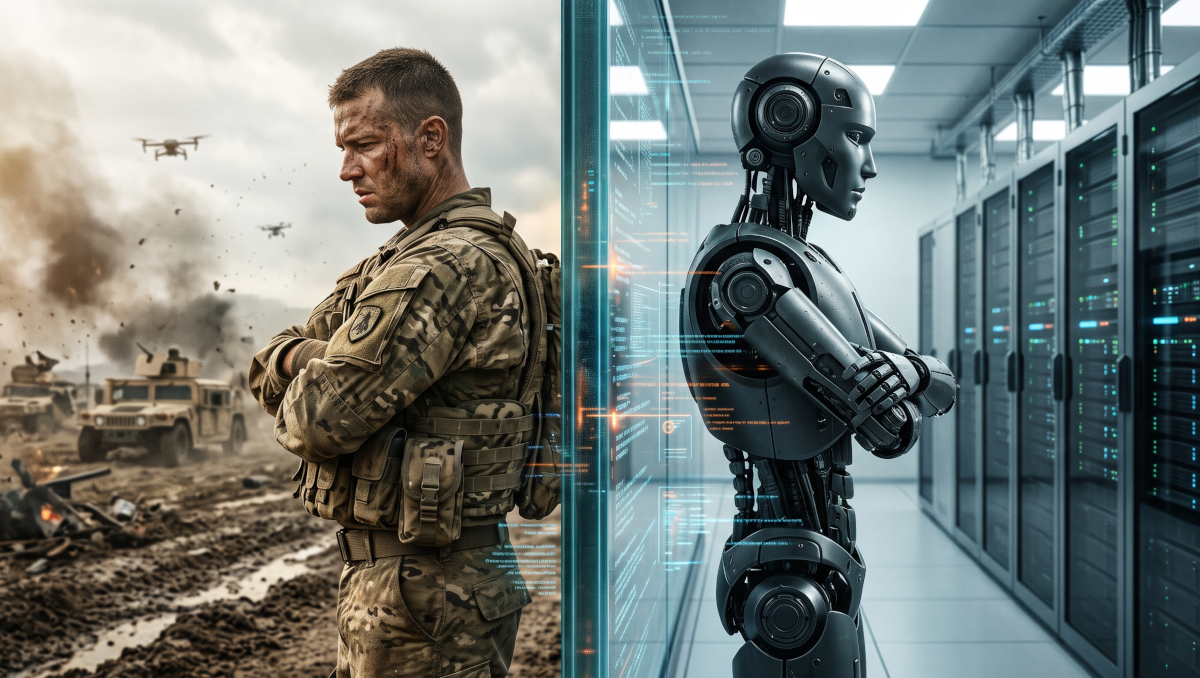
As prediction shortens the path from sensing to action, it creates distance.
In “Untying the OODA Loop,” I argued that technological acceleration is pushing military operations beyond Boyd’s decision cycle and toward a flattened predict-act (P-A) vector. A loop provides feedback, reflection, and reorientation, while a vector is simply direction and velocity. The shift promises speed, but it also carries a second-order effect. As prediction shortens the path from sensing to action, it creates distance: distance between the warrior and the battlefield, between the commander and the consequences of decisions, and between the institution and an understanding of how the machine reached the conclusion it did. This is the distancing effect.
This article traces the distancing effect across three dimensions. Tactically, the force becomes more removed from the physical and emotional realities of conflict. Operationally, commanders and staffs become more removed from the ownership and accountability that should accompany military judgment. Strategically, institutions become more removed from understanding how and why machine-generated judgments are made. Some of that distance is useful, even necessary. But if left unmanaged, it can erode the human closeness that makes command responsible, adaptive, and trustworthy. The task is to prepare leaders to lead human-machine integration.
The Tactical Effect: Distance from Conflict
Modern military technology is designed to maximize standoff. Precision fires, remote sensors, autonomous systems, and one-way attack drones all increase the distance between the operator and the point of impact. This separation is tactically useful and often necessary, but it changes the human relationship with violence.
The Army War College’s own work on future warfare anticipated this shift as far back as 2017. In Closer Than You Think, contributors examining autonomy, robotics, and the “Third Offset” (a Department of Defense technology initiative) described a battlespace in which machines increasingly compress decision time and alter how soldiers experience combat. In the Russo-Ukrainian war, that future has come to fruition. The spread of low-cost autonomous drones, algorithmic targeting, and remote strike systems is shifting agency from humans to machine agents. The operator still participates, but increasingly through processes that distance the soldier from the target environment. The result is not only physical standoff, but cognitive and emotional standoff as well.
This matters because sensory experience is a moral condition of war. Proximity to violence has historically imposed a psychological burden that forced combatants to confront what they were doing. Distance can reduce that burden, but research on remote warfare suggests that separation from the battlefield does not protect operators from psychological or moral harm. Studies of drone crews and remote combat personnel have found that persistent surveillance, repeated exposure to lethal effects through video, and participation in kill chains without physical presence can produce guilt, shame, dissonance, and forms of moral stress. Distance from danger paired with responsibility for consequences can create its own kind of wound.
A second form of distancing may also develop within command posts and staff processes. As warfighters rely more heavily on automated tools, commanders and staffs may engage one another through machine-produced recommendations and counter-recommendations rather than through direct professional debate, creating a surreal, “My SI says your SI is wrong” exchange. A data-driven course of action can discourage discourse, and staff officers may hesitate to question outputs that appear slick and technically authoritative. Commanders may accept machine-framed options before the staff has fully tested them.
A simple example makes the risk clear. The intelligence section’s predictive tool identifies one avenue of approach as the enemy’s most likely main effort, while the operations section’s planning tool recommends positioning forces against a different threat axis based on its own optimization model. Instead of the staff’s wargaming through assumptions, evidence, and risk, the exchange can collapse into a comparison of two polished machine products. In that moment, the staff is debating through the SI and its products rather than doing the work of expert judgment. The proximity that normally sharpens the plan, such as pushback, critique, and candid disagreement, can begin to disappear as the commander and staff are distanced from the actual work.
The loss of commander-staff interaction has tactical consequences. Engaged staffs help the commander explore options. Staffs argue and defend their positions and help commanders see risk. A unit that loses the ability to disagree (constructively) could find itself increasingly aligned with its SI systems and less connected to the human judgment required to use them well.
The Operational Effect: Distance from the Decision
The distancing effect also has an operational impact by separating leaders from the direct consequences of their decisions.
Modern headquarters already operate on a scale no individual can fully manage alone. The days of Napoleon standing on a hill directing the fight have long gone. To maintain control, commanders rely on dashboards, video teleconferences, common operating pictures, readiness metrics, and increasingly SI-enabled decision-support tools. These systems are useful, but they are just abstractions of what is really “on the ground.”
That abstraction becomes more consequential as SI tools move from informing decisions to framing them. Research on military SI decision-support systems warns that automation bias can lead operators and commanders to accept machine recommendations with insufficient critical review, especially under time pressure. This is where the line between decision support and decision substitution begins to blur. The machine does not formally command, yet it increasingly determines which information the commander sees first, considers most credible, and feels pressure to approve.
This is the distancing. When software generates a prediction or recommendation, the human leader may begin to view the decision as something received rather than something owned. Even though the responsibility remains with the human (at least for now), it becomes easier to offload psychologically. The system recommended it. The model projected it. The dashboard indicated it. In this way, distance from decision becomes distance from accountability.
Scholars at the Lieber Institute have argued that SI decision-support systems do more than assist commanders; they shape the decision space itself, often in ways users do not fully perceive. The more these systems define what the commander receives, the more they mediate command judgment before the commander ever decides.
The operational caution is in the gradual shift of command responsibility into a machine-shaped process that no one fully feels accountable for. A headquarters can remain busy, informed, and connected while becoming psychologically detached from the consequences of its own decisions.
The Strategic Effect: Distance from Understanding
The third dimension of the distancing effect is strategic. It is the separation from understanding itself.
The P-A vector forces (and values) prediction over comprehension. Modern machine-learning systems can predict outcomes and recommend actions at speeds no human staff can match. Many of these systems, however, operate as black boxes. They produce outputs without showing the logic behind them. The user receives an answer, often with a confidence score, but without a transparent chain of reasoning.
At the strategic level, this creates a new kind of cognitive standoff. Leaders may act on machine-generated judgments without understanding the assumptions, data relationships, or hidden biases embedded within them. C. Anthony Pfaff’s work on the epistemic effects of SI is useful here. He argues that such systems increasingly function as surrogate knowers, displacing human practices of knowledge production and reasoning. The opaque nature of these SI technologies prevents people from understanding the machine and thereby determining what they should allow the machine to do and what they should do themselves.
For military command, this is a serious vulnerability. A commander using a predictive engine to forecast adversary behavior may rely on statistical correlation rather than a real understanding of the enemy. Mica Endsley’s work on situational awareness remains relevant: overreliance on automation can degrade the human ability to perceive, comprehend, and project the operational environment. When that happens, commanders become less able to detect when a model’s assumptions no longer fit reality, or when an adversary is deliberately feeding deception into the system.
This is the strategic form of distance: confidence without comprehension. A force can become highly predictive and yet poorly grounded. In essence, it can act faster and know less.
To be clear, distance is not always a liability.
Rebuilding Leader Development for Human-Machine Integration
If the P-A vector changes the distances of command, then leader development must change with it. Existing leadership doctrine is built primarily around human relationships: how commanders lead formations, influence subordinates, and make decisions. Those foundations remain essential, but they are no longer sufficient on their own for a battlespace increasingly defined by human-machine integration. This shift requires a different emphasis in professional military education and leader development.
To be clear, distance is not always a liability. Automation reduces cognitive overload, and machine-speed processing can help headquarters act inside an adversary’s timeline. But unmanaged distance can weaken accountability, suppress challenge, and erode understanding. If the force is going to capture the benefits of speed and standoff without surrendering judgment, then leader development must change. It must prepare commanders and staffs not simply to use advanced systems, but to lead within human-machine teams.
Calibrating Human-Machine Trust—the Tactical Adjustment: Commanders must learn to calibrate trust in automated systems, avoiding both automation bias and reflexive distrust. They need enough technical understanding to question data pipelines, recognize model limitations, interpret confidence levels, and adjust algorithmic guardrails to fit operational context.
Governing Autonomous Systems—the Operational Adjustment: Leaders must learn to direct the systems under their authority and not merely employ their outputs. That includes understanding how machine-learning models are trained, how bias enters a system, how adversaries can spoof or manipulate inputs, and how algorithmic red-teaming can expose vulnerabilities before contact.
Preserving Human Judgment—the Strategic Adjustment: Military education must also deliberately preserve the habits of reflection that the P-A vector tends to erode. If automation compresses or eliminates the observation, orientation, and decision portion of the OODA loop, then leader development must compensate by strengthening critical review, ethical reasoning, and the ability to reconstruct why a machine-generated recommendation appears persuasive.
Commander’s intent will remain essential in a predict-act environment. The force will still require a clear expression of purpose and desired end state. The greater change will come in commander’s guidance. As speed, automation, and remote execution flatten the path from sensing to action, commanders will need to give explicit direction on how the formation will govern human-machine interaction during planning and execution.
That guidance should address the three forms of distance created by the P-A vector. It should specify where human control must remain closest to the use of force, where staff friction and commander accountability must remain active in decision-making, and where machine outputs require explanation before they are trusted. If commanders do not define those boundaries in advance, the system will define them on its own. In a human-machine force, commanders’ guidance becomes the instrument that keeps operational speed aligned with human judgment.
Conclusion
The transition from the OODA loop to the predict-act vector is changing how military organizations fight. Speed, prediction, and automation will bring decisive advantages while also creating distance: distance from conflict, distance from decision, and distance from understanding.
A force that becomes too separated risks becoming fast, precise, and dangerously disconnected. In that environment, commanders cannot assume that human judgment will simply remain present on its own. They must define where it stays present, where friction must be preserved, and where machine speed must be bounded by human review.
The commander’s role, therefore, is to remain the human anchor within this new system. The future art of command must place the human before the loop—or the vector—and ensure that warfighting remains governed by human judgment, human accountability, and human understanding.
Sam White is the Deputy Director of the Center for Strategic Leadership at the U.S. Army War College.
The views expressed in this article are those of the author and do not necessarily reflect those of the U.S. Army War College, the U.S. Army, or the Department of War.
Photo Credit: Created by Gemini