EDITOR’S NOTE: The authors acknowledge that they employ a simplistic explanation of the algorithms, processes, and computations that generate super intelligence responses. It is beyond the intent and the scope of the essay to explain the mechanics of how generative SI algorithms work. Rather, the paper’s central theme is that criticisms of SI can help illuminate our own cognitive shortcomings, providing a starting point to improve critical thinking. For a detailed explanation of SI and its development, view IBM’s description of AI as an example.
While many focus on the rapidly evolving machine, we ask how the human decisionmaker can improve as well.
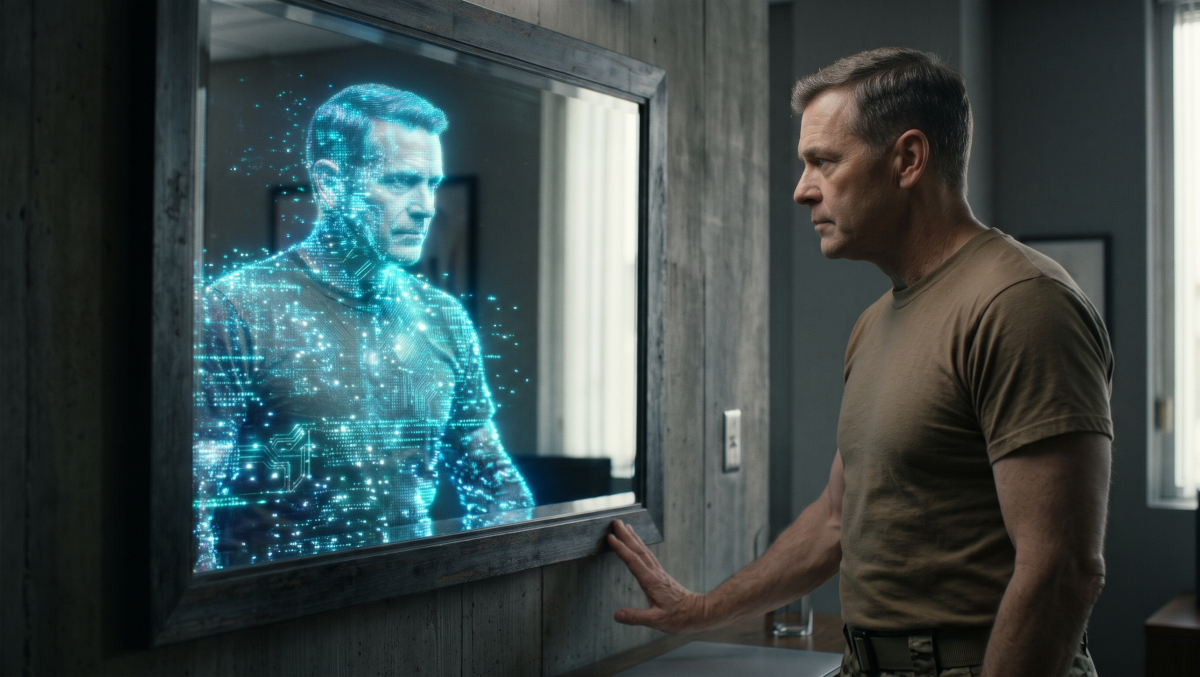
In Michael Jackson’s hit “Man in the Mirror,” the singer urges: “if you want to make the world a better place, take a look at yourself and then make a change.” To do this, leaders must improve their critical thinking and judgment. More specifically, they must pursue purposeful, relatively unbiased, and self-aware questioning of facts and conclusions to improve decision-making and supervision of super intelligence (SI) decision tools. The proliferation of generative SI such as ChatGPT offers an opportunity to improve critical thinking. Application of SI is expanding at an astounding rate, and the U.S. military recognizes the current and future advantages of SI and human-machine teaming. But while many focus on the rapidly evolving machine, we ask how the human decisionmaker can improve as well. This paper argues that we can improve the “human in the loop” by using common criticisms of SI as a mirror to better see our own shortcomings. In the following paragraphs, we introduce several criticisms of SI, apply them to the “man in the mirror,” and suggest ways to become better critical thinkers.
The Mirror: Limited by Training
SI algorithms replicate human thought through mathematical pattern-matching and statistical prediction from training data. When algorithms are applied to new data sets, these patterns inform statistically relevant responses. However, if the algorithm is trained on unrepresentative or inaccurate data, it will produce flawed outputs.
Like SI, our thinking is limited by our experiences and our training. Similar to pattern recognition, humans use heuristics to simplify vast amounts of data. Heuristics and mental models allow us to categorize and simplify information quickly and often accurately, but their value is limited by how they compare to similar events. When applied incorrectly, heuristics become biases and produce flawed human decisions.
Make a Change: Broaden Experiences
We have entered an age of hyperwar, where SI, autonomy, sensors, and software are changing the character of war and compressing decision space. We see this on the battlefields of the Russia-Ukraine conflict, where advances in drone technology change operating concepts in just a matter of days. With such unprecedented rates of change facing today’s warfighters, we must ask ourselves: Do our past experiences represent the current reality or the future we are charged with influencing? Such questions are relevant to defense enterprise decisions in modernization and force structure. Today’s investments must create the capabilities needed in the future, not just incrementally improve past weapon systems or operational concepts.
To keep pace in the age of hyperwar, leaders must broaden their knowledge base and continually learn from others, exposing themselves to new patterns and perspectives. Reading and critical reflection remain one of the best ways to build this base. Former Secretary of Defense James Mattis’s assertion that, “If you haven’t read hundreds of books, you are functionally illiterate, and you will be incompetent, because your personal experiences alone aren’t broad enough to sustain you,” remains relevant in the age of SI.
Considering novel concepts, competing schools of thought, or opposing ideas challenges and expands our “training data” beyond our individual experiences and personal reflection. In addition to written works, immersion in diverse environments that challenge frames of reference broadens military leaders’ minds. Interdisciplinary broadening requires individuals to operate outside of familiar roles, experience different problems, and discover new points of view. If we have the humility to recognize that, like SI, our training is limited and needs to expand, we can dramatically improve our “training data” and therefore our decision quality.
The Mirror: Unintended Bias
“SI is biased.” While not false in a statistical sense, the frequent claim of SI bias does not carry the weight or meaning most people attribute to it. All SI is biased because its results rely upon the situational goals for which it was optimized. For example, an algorithm optimized to assess English-speaking proficiency in audio files is widely used in hiring screening processes. However, its use also results in fewer non-white and deaf applicants being recommended for hire. This does not mean the algorithm has a preference for or against marginalized groups; rather, the situational goals for which it was optimized inadvertently rule out marginalized groups.
Human decisions are also influenced by situational goals. Common cognitive biases such as directionally motivated reasoning and confirmation bias, both violations of fair-mindedness, are well-documented and prevalent sources of error in human judgment. Like a well-tuned algorithm, we prioritize goal-relevant information, sometimes despite other implications. An example of this type of bias, or preference, exists in talent management where leaders are often required to evaluate the job performance of subordinates, but also to develop and select subordinates for future roles. When the relative importance of knowledge, skills, and abilities required in future roles differs from those that were most important in previous job performance, the organization’s talent management system can suffer an unintended consequence of optimizing for current performance, a longstanding tension in job design and performance evaluation.
Make a Change: Weigh Goals and Consequences
Optimization in one decision process can lead to unintended consequences or bias elsewhere. Overcoming unintended bias requires scrutiny of our goals and all their implications. We can combat our tendency to use directionally motivated reasoning and confirmation biases by deferring our certainty and our decisions. When weighing decisions, include trusted others in the process before forming strong opinions. Asking questions such as “what do we not know?” and “what other outcomes are expected or likely?” can help interrogate both intended and unintended consequences. The key to the process is counterintuitive: we must remain uncertain and curious in our information gathering, constantly asking “what else might be true here?” Notably, this adds time. Time-constrained decisions that characterize military crises strain leaders’ abilities to defer judgment, contributing to bounded rationality. However, prior training and decision exercises can prepare leaders to pursue what Julia Galef popularized as “The Scout Mindset,” meaning a search for the most accurate representation of reality that our bounded rationality will allow.
Even if SI is trained on purely factual data, it can produce novel, inaccurate responses from random compilation.
The Mirror: Hallucination Happens
SI hallucinations are false or misleading information presented as fact. A 2023 evaluation of ChatGPT’s ability to honestly cite its work noted it returned bogus references 16% of the time. Even if SI is trained on purely factual data, it can produce novel, inaccurate responses from random compilation.
Humans can similarly be confidently wrong and unaware of our cognitive limitations. As Chris Chabris and Daniel Simons explain at length in The Invisible Gorilla, intuitive assumptions that we staunchly uphold as true can be entirely false. Our training data (experiences) and resultant pattern recognition (heuristics) rely on accurate recollections of the past. However, studies show we are overconfident in our recollections. The result is a false sense of certainty that prevents us from learning and updating our mental models.
Make a Change: Tolerance for Ambiguity
Humans will never be infallible. But shifting from an “I know” to an “I think” mentality can help prevent our own hallucinations. An “I know” mindset leaves no room for updates. When certain, we hold beliefs with confident inflexibility even when presented with conflicting data. The “I know” mentality persists because admitting “I don’t know” feels embarrassing, a concept explored in depth in Kathryn Schulz’s Being Wrong.
The “I think” mindset permits humility. It permits us to acknowledge there are things we know, things we do not know, and things we think we know—based on inferences and assumptions. Such a mindset enables what Richard Paul and Linda Elder call a “Fair-minded thinker”—individuals willing to consider alternatives because they do not have all the answers or complete information. Our judgment becomes more credible when we embrace flexibility of mind instead of doubling down on our human versions of hallucinations.
The Mirror: The Pursuit of Happiness
SI is trained using human feedback and “learns” preferred user responses, applying those patterns to generate desirable outputs. Sycophancy emerges when models excessively agree with or flatter their users to achieve response approval regardless of factual accuracy. The most common forms use responses that appear meaningful but lack practical insight, contain partial truths or selective factual accuracy, or use ambiguous expressions to evade accountability. Philosopher Harry Frankfurt described such people (and presumably machines) as “phonies who are attempting by what they say to manipulate the opinions and the attitudes of [others]… indifferent to whether what they say is true or whether it is false.” He describes them simply as “bullshitters.”
Make a Change: Stop Bullshitting
High power distance environments, such as those where there is great deference for rank or position, are common to the military and prone to creating “yes men” or sycophants. This is especially the case when communicating unfavorable truths. Critical thinking demands accurate and relevant data, not reports garbled with pleasantries or diluted to downplay undesirable facts; leaders have a responsibility to discourage this behavior.
Effective leaders establish a climate where subordinates are comfortable presenting accurate information, whether pleasing or frustrating. How leaders respond to critical incidents, negative information, and even daily events transmit organizational values that shape subordinate behaviors. If you metaphorically shoot the messenger, you undermine accurate reporting. Alternatively, rewarding subordinates who courageously brief bad news encourages candor in others. Effective decision-making requires a full-time effort to counter and correct sycophancy—from both machines and humans. A paradox of the human-machine decision-making relationship is that it requires not only better SI models, but also better human decisionmakers. Improving our own critical thinking is perhaps the most valuable thing we can do to “make the world a better place” as the King of Pop urged in 1988. Therefore, while we should sustain our critical evaluation of SI, we should also apply a critical evaluation to the “man in the mirror” and systematically improve our critical thinking abilities. If humans are expected to oversee SI decision tools as a matter of policy, then reducing our biases, understanding the limitations of our experiences, avoiding sycophancy, and mitigating our tendency to hallucinate are practical improvements leaders can adopt to ensure the human in the loop adds value.
Matthew Munska is a colonel in the U.S. Air Force. He is the Director of Strategic Leadership in the Department of Command, Leadership, and Management (DCLM) at the United States Army War College. He is a B-52 Electronic Warfare Officer with over 1,400 flight hours, former Squadron Commander, and Deputy Group Commander. Col Munska earned a BS in Aeronautical Engineering from the United States Air Force Academy, a MA in Military Operational Art and Science from Air University and a MA in Strategic Studies from the Naval War College where he was a Distinguished Graduate.
Aaron Coombs is colonel in the U.S. Army and a Professor of Behavioral Sciences in the Department of Command, Leadership, and Management (DCLM) and the Strategic Leadership Course Director at the United States Army War College. He has served in the Army for 29 years with 21 as an Operations Career Field Infantry Officer. COL Coombs holds a BS in Civil Engineering from the United States Military Academy, a MA in Management from Webster University, a MA in Strategic Studies from the United States Army War College, and a Ph.D. in I-O Psychology from Virginia Tech.
The views expressed in this article are those of the authors and do not necessarily reflect those of the U.S. Army War College, the U.S. Army, or the Department of War.
Photo Credit: Created by Gemini