
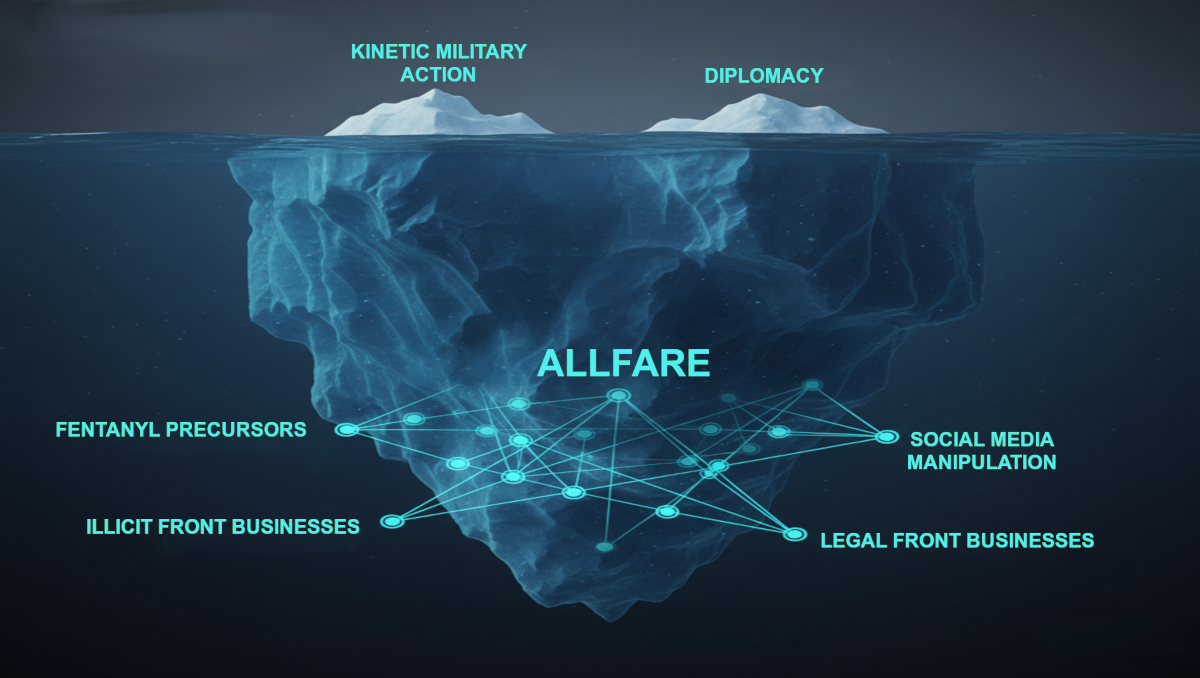
To analyze how states exert their influence, scholars often compartmentalize actions into rigid analytical frameworks, which obscures the holistic scope of the challenge.
Current paradigms of understanding the People’s Republic of China’s (PRC) actions against the West typically use the DIME framework or even the Chinese Communist Party’s (CCP)’s own “Three Warfares.” However, these frameworks that bin actions into discrete categories fail to encapsulate the totality of the PRCs activities targeting the west. While the United States hesitates to admit its “competition” with the PRC is conflict, the PRC appears to leverage all forms of warfare short of kinetic operations in daily affairs. To analyze how states exert their influence, scholars often compartmentalize actions into rigid analytical frameworks, which obscures the holistic scope of the challenge. By decomposing actions and analyzing them through the common frameworks, analysts fail to appreciate the interconnectedness across all elements of national power, particularly clandestine and sub-state illicit activities. These disadvantages call for a new model of analysis.
Adopting the concept of “allfare,” which captures every potential vector of malign action, provides a better appreciation for the strategic scope of PRC activities. Allfare encourages perceptions of linkages and cross-organizational intentions across the entire network, including official party and state instruments, proxies, and even seemingly disparate criminal actors. This last element, the illicit actors that ultimately advance CCP interests are entirely absent from traditional analytical frameworks. These activities are, at minimum, accepted by the party, and are very probably intentionally exploited. Since 2015, U.S. national security strategies have identified a rising Communist China as a threat to the liberal international order and continued American influence, yet policymakers still fail to grasp the broader whole-of-society grey-zone warfare the CCP conducts against the United States. Though they call for countering Chinese actions, the PRC continues their malign actions with no symmetrical or discernable asymmetrical response.. Allfare provides that aperture to see and then effectively defend against these multifaceted threat vectors. Through both planned and opportunistic actions, the CCP is waging Allfare against the West. Some examples include saber-rattling and confronting ships in the international waters of the South China Sea, inciting anti-Western sentiment through pervasive presence in citizen’s social and digital lives, confounding Western initiatives through vetoes and legal maneuvering in international organizations, cyber-attacks, tolerance of narcotics production for distribution to the West, and positioning for irregular warfare.
China’s perception of its own history sets the conditions that embolden a new military powerhouse to potentially reclaim territory it feels is being kept from it. Historically China sees itself as the chosen nation, greater than all others in virtue: the “Middle Kingdom” between Heaven and Earth. However, the “century of humiliation” marred this perception. Now that the PRC possesses the means to reshape the region, it believes it should do so by any means necessary against the corrupt West.
Sun Tzu’s venerated principle of achieving victory without direct military engagement has, for millennia, shaped Chinese military thinking and appears to be a core rationale driving the PRC’s actions to strategically weaken the West. Xi himself stated that “Resolving the Taiwan question and realizing China’s complete reunification is a historic mission and an unshakable commitment of the Communist Party of China.” This reunification with Taiwan would end the century of humiliation and extend the PRC’s ability to project power deeper into the second island chain, establishing itself as the true hegemon in the Pacific. The formidable challenges inherent in a cross-strait invasion for a largely untested People’s Liberation Army necessitate that the CCP meticulously consider non-kinetic or preparatory alternatives. If the PRC can negate the support of any allies of Taiwan and foment divisions within Taiwan’s own citizenry prior to commencing their reunification (through violence or other coercion), greater assurance of success exists.
In a 2018 War on the Rocks article, Peter Mattis highlighted the PRC’s ‘Three Warfares’: opinion, influence, and legal. The CCP has built a formidable information operations enterprise through which it uses pervasive social media engineering to shape Americans’ opinions and influence U.S. domestic politics. This is all the more frightening when one considers that China is more than willing to partner with allies like Russia and North Korea in this endeavor and is unconstrained by any moral or ethical boundaries. Regarding influence within U.S. politics, the Council on Foreign Relations reported in 2022 that the PRC sought to leverage pro-PRC politicians who would support their agenda in the Pacific Rim and beyond. The expenditure of over $200 million in registered electoral influence raises significant concern regarding the magnitude of their investment in unregistered and clandestine election funding.
The PRC is also attempt to shape the international environment to its benefits through international agreements and governing bodies, such as the Antarctica Treaty and the Arctic Council. China witnessed how fellow Security Council member Russia vetoed the United Nations resolution condemning its own invasion of Ukraine. With that precedent, it is not unlikely that China will feel emboldened to move against Taiwan or other sovereign territory, secure in the knowledge that it can prevent any UN action through its own veto power. While the PRC possesses many legal and appropriate national serving interests for involvement in Antarctica, the Arctic, and elsewhere, the potential for increased dual use presence in strategic lines of communication presents great risks for free trade and navigation.
By attempting to capture an action and force it to conform to a set logical framework, such as DIME or the “Three Warfares,” analysts can miss the interconnectedness of one action to another. Worse, through structural boundaries in U.S. code, such categorization could prohibit national security professionals from working with other agencies to mitigate cross-organization risks. Post-Snowden leaks, restrictions on the intelligence community have opened loopholes in EO12333 for adversaries to exploit, especially in signal intelligence. Organizations like joint interagency task forces and fusion cells exist, are not enough; many in the government may not know they exist. These organizations also cannot overcome a lack of authorities. An adversary unbounded by those same constraints can operate with freedom.
Just as U.S. irregular warfare doctrine calls for the use of proxies with established placement and access, these PRC initiatives—or those simply tolerated by the CCP—provide the PLA and other operatives with exploitable strategic positioning.
The very attributes of transparency, minimal censorship, inclusiveness, and free speech that define an open society also make them vulnerable to PRC efforts to influence open states from within their societal and commercial infrastructure. Though now mostly closed, the United States Department of State designated the Confucius Centers at many colleges and universities as Chinese missions due to their connections with the PRC government. Through telecommunications infrastructure like Huawei, ubiquitous technological surveillance in smart cities around the globe, or commercial and private real estate investments, the pervasiveness of the PRC presence requires acknowledgement, understanding, and appreciation for the scope and risk. Through these initiatives, they possess access for triple-use business initiatives (legal/legitimate, illegal/illegitimate, and options for irregular war). Organizations with a valid legal justification for existence can still be used as fronts for criminal activities or to achieve access for later hostile actions. Just as U.S. irregular warfare doctrine calls for the use of proxies with established placement and access, these PRC initiatives—or those simply tolerated by the CCP—provide the PLA and other operatives with exploitable strategic positioning.
Chinese nationals are purchasing Maine marijuana farms, raising legitimate security concerns, especially considering previous attempts to develop a corn processing plant in the vicinity of Ellsworth Air Force Base in South Dakota. These farms provide a telling example of leveraging legal and illegal business opportunities to further smuggling opportunities into the United States. Through established human trafficking networks, the PRC possesses the potential not just for criminals (who destabilize communities), but for future operatives to wage an irregular war inside the United States should the PRC need U.S. attention diverted from its actions elsewhere. These farms provide opportunities for money-laundering, funding other illicit activities. For southern Maine and New Hampshire, the proximity to ship building and repair facilities either at Bath Iron Works, or Portsmouth Naval Shipyard, both of which are critical in a protracted war with the PRC. The proximity of these farms (and numerous other initiatives) to military or other civil sector infrastructure creates additional security requirements and burdens on the United States.
Separate from the marijuana business, the PRC traffics fentanyl precursor chemicals that work their way into the United States, overwhelming medical capabilities and distracting law enforcement agencies from other illicit activities. The sheer scope of the fentanyl epidemic within the United States presents the PRC with a low-cost weapon of mass destruction.
Ukraine’s Operation Spider’s Web as well as Israel’s campaign inside of Iran highlight the risk of covert actions deep within a nation’s borders. When freedom of movement permits proximity access to sensitive locations, adversaries possess the ability to launch small uncrewed aerial systems (sUAS) which overwhelm defenses. While that seems infeasible, the PRC’s advantage is that disruption of domestic activities regardless of services provided creates a target list bounded only by imagination. Disruptions of hospitals, sewage, traffic, educational, financial, or other institutions present options to curtail American will and ability to counter the PRC actions globally. The deep polarization within the United States makes it likely that a Pearl Harbor or other September 11th event may not unify Americans into action as in the past. Indeed, in such an event the levels of domestic distrust, amplified by social media manipulation, could exacerbate society’s fragmentation within the United States. Seeing the draconian treatment of their own citizens—for example, the Uyghur persecutions or the abusive COVID lockdowns—analysts are concerned about the lengths the CCP will go to in the event of a regional conflict. The convergence of commercial and illicit activities gives the CCP strategic and operational flexibility that it can exploit. When Chinese malign actions are taken as discrete and compartmentalized examples, planners fear them as daunting challenges. When looked at from the Allfare holistic approach, the picture proves far scarier. Rather than a defendable underbelly as defined by borders or avenues of approach, the United States must defend its global flank across all domains and through all facets of society as threats exist wherever U.S. interests exist. The disparate threats of cyber-attacks, illicit trafficking, infrastructure sabotage, civil unrest, racial divides, further pandemics, and more present opportunities or tools for the PRC to leverage in their Allfare campaign to garner advantage without exposing the PLA to great risk. Western planners must prepare to counter a total Allfare campaign intended to create chaos and discontent as a precursor to any attempt to forcibly reassimilate Taiwan. Preserving the PLA as a strong deterrent while executing their campaigns though Allfare means is providing the PRC with the greatest flexibility to achieve victory. The United States and other concerned nations must acknowledge the nature of Allfare and leverage the diversity of Western thought for ways to create challenges to the PRC short of armed conflict.
Michael Margolius is a commander in the U.S. Navy and a faculty instructor in the Department of Distance Education at the U.S. Army War College where he graduated in June of 2024. Previously, he served as the J3 Operations Branch Chief, Joint Personnel Recovery Agency where he oversaw JPRA support to active PR cases, the Non-Conventional Assisted Recovery Program, the DoD Blood Chit Program, engaged with the Inter-Agency as well as allies on operational support matters. He also coordinated the Post Isolation Support Activities for a Canadian Citizen held hostage in Africa, and was the Agency COVID-19 Task Force Commander. He is a graduate of the AY24 Resident Course and the Carlisle Scholars Program at the U.S. Army War College.
The views expressed in this article are those of the author and do not necessarily reflect those of the U.S. Army War College, the U.S. Army, or the Department of Defense.
Photo Credit: Created by Gemini
This is fine work from Michael Margolius, but let me offer two thoughts. Firstly, the name for the concept (“Allfare”) is shallow, awkward, and fails to convey the depth of complexity and ponderous importance of the idea. I suggest Holistic Warfare. “Holistic War” would represent well the whole-of-nation idea and sit well alongside the concepts of Limited War, Total War, and Hybrid War that are well established in the literature.
Secondly, missing nodes include such things as espionage, cyberattacks, propaganda, disinformation, political campaign funding, illegal immigration financing, NGO and PAC underwriting, Communist Party infiltration of academia, national & subnational governments, maritime domain expansion, commerical conquest of vital infrastructure and natural resources, and Hybrid Warfare.
Agree, this is good work. The holistic scope of the PRC challenges the U.S. military planners to both comprehend and develop response options for (when so much malign activity lies outside the realm of DoD responsibility). I also agree with Mr Sinnott, “Allfare” is the wrong name. Recommend using the PLA terminology published in 1999: Unrestricted Warfare (see Qiao Liang & Wang Xiangsui, “Unrestricted Warfare,” Beijing: PLA Literature and Arts Publishing House, 1999). In an interview that the U.S. Foreign Broadcast Information Service translated, COL Qiao was quoted as stating that “the first rule of unrestricted warfare is that there are no rules, with nothing forbidden.” Subsequently, the PLA’s 2001 Science of Military Strategy echoed the tenants of Unrestricted Warfare: “The future high-tech local war is not just a competition of military forces, but an overall contest of political, economic, diplomatic, cultural, and other forces. The competitions in the nonmilitary fields . . . coordinate directly or indirectly with military operations . . . pure military operations cannot get final victory without the powerful cooperation and support of the competitions in every non-military field.” What has been ignored, for far too long, is that the PRC defines both “war” and “warfare” differently than the U.S. This is an asymmetry they leverage freely.
From the beginning of our article above:
“To analyze how states exert their influence, scholars often compartmentalize actions into rigid analytical frameworks, which obscures the holistic scope of the challenge.”
With regard to “the holistic scope of the challenge” — and this, specifically, with regard to states such as Russia and China’s exertion of influence — how, exactly, did these such states (Russia and China) “exert their influence;” this, so as to seemingly cause the United States (the greatest nation in the world after the end of WWI) — and other states also — to (a) consider abandoning or modifying, in whole or in part, their own long-standing political, economic, social, values, etc., ideas, beliefs and/or institutions and (b) consider embracing, in whole or in part, certain of the political, economic, social, value, etc., ideas, beliefs and/or institutions of contemporary Russia and/or China?
Given these such amazing real and/or possible results — of this such specific “how states exert their influence” achievement by Russia and China, should not same be included in any attempt to analyze, understand, name, articulate, etc., “the holistic scope of the challenge?”