
American political, naval, and military leaders at the time understood the threat.
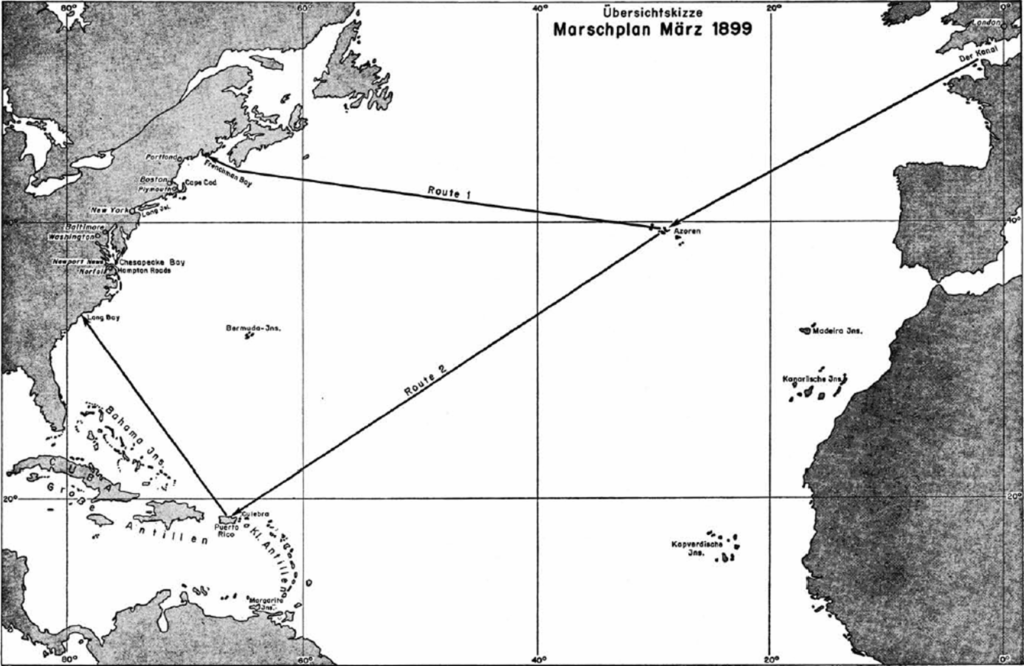
In 1970, German naval historian Holger Herwig published newly discovered turn-of-the-twentieth-century German contingency plans for war with America. The base plans called for the German fleet to sail toward America; directly in the summer, through Puerto Rico in the winter. Along the way they would meet and destroy the American fleet in battle. Then they would head to New York or Boston and bombard the cities. Follow-on iterations considered gathering ground troops for a proper invasion somewhere on the East Coast.
American political, naval, and military leaders at the time understood the threat. They made their own plans for a war with Germany, eventually called War Plan Black, explicitly designed to defend the Caribbean and homeland from German military aggression. Herwig’s discovery of the German plans was a bombshell. The New York Times published a front page article on his work. Then it was quickly forgotten, only to be rediscovered in 2002, and quickly forgotten again.
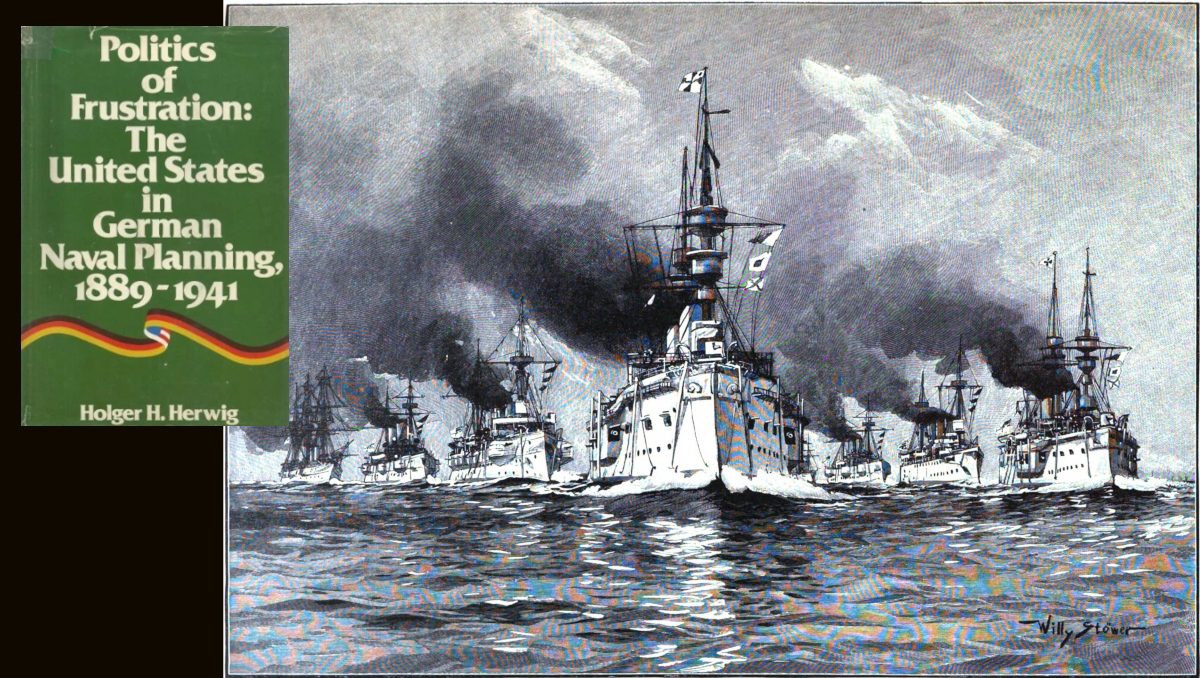
Perhaps these plans were so different from the actual wars fought between the United States and Germany that they come off like harebrained artifacts from the overheated imaginations of early general staffs. But in truth they represent a phase of a long political and military antagonism between the two nations, a perfect example of what we now call “great power competition.” That contest became the subject of Herwig’s Politics of Frustration: The United States in German Naval Planning, 1889-1941 (Boston: Little, Brown and Co., 1976), a forgotten book that is filled with insights on political and military motivations, intrigues, approaches, and, most importantly, the real stakes of great power competitions.
Unified in 1871, Germany stormed onto the world stage as a power amid the so-called Age of Imperialism. As latecomers to the game, they felt they had to play catch-up. Even Germany’s realpolitik chancellor Otto von Bismarck, initially skeptical of the value of overseas expansion, by the 1880s went along with the trend.
The Germans jumped into the European scramble for Africa, getting in wherever they could, eventually taking Togoland, Namibia, Cameroon, and Tanzania. By the mid-1880s, they expanded into the Pacific, looking for places unclaimed by Europeans or Americans or where Spain’s influence was falling. They gained control of parts of Samoa, New Guinea and many of the surrounding islands, eventually including the Carolines and Marianas. By the turn of the century, they had seized Kiaochow (Jiaozhou) in China.
This German expansion in the Pacific was what first put them at loggerheads with the Americans. In 1889, American and German naval forces nearly engaged in a battle over control of Samoa when a typhoon wrecked the contending fleets. An even more dangerous conflict came in the Philippines in 1898, when Commodore George Dewey’s Asiatic Squadron won a decisive battle over the Spanish fleet in Manila Bay. While determining what to do next in the Philippines, the Americans realized that other powers circled the Philippines like vultures. The Spanish might return, and the British, French, or Russians did send warships to the islands. But by far the most aggressive were the Germans.
The fleet under Admiral Otto von Diederichs was pointedly larger than Dewey’s. The German forces attempted to sneak past the American blockade. They tried to make favorable arrangements with Spanish ground forces that were still in possession of the city of Manila. They even put troops on the ground, testing to see how the Americans would react.
America ships twice put literal shots over the bows of German ships in the bay. A British naval captain helped by siding with the Americans to get the Germans to back down. The U.S. Army arrived to occupy Manila, and the Americans sent in more warships. The Germans ended the direct confrontation, but not their efforts for Pacific empire. Given the hostile environment, and unfortunately for the native Filipinos, the Americans at the time did not see a way to grant full independence to the archipelago. In the meantime, Dewey, now the most prominent U.S. naval officer of his day, developed a lifelong mistrust and enmity toward the Germans and their ambitions.
Not satisfied with their growing global empire in Africa and the Pacific, the German extended their ambitions to the Western Hemisphere. Kaiser Wilhelm II, German naval leaders, and German colonial societies believed that the future of Germany depended on establishment of bases and territories in Latin America and the Caribbean. From the 1870s on, they intervened militarily multiple times in Haiti, including bombarding Port au Prince in 1897. Among the places they coveted most was Venezuela, leading to a tense confrontation between the American and German fleets in 1902-1903 in which Dewey enthusiastically played a prominent role. Over the next decade plus, the Germans sought economic and territorial advantages in the revolutionary strife in Mexico.
The Germans were deadly serious about these efforts, as evidenced by the content military plans and prominence of the planners. The chief of staff of the German army was Alfred von Schlieffen. Alfred von Tirpitz was the state secretary of the German navy, and his chief of the Admiralty staff was Otto von Diederichs, Dewey’s rival from Manila Bay. As they explored options, it was Diedrichs who queried Schlieffen to see if ground troops were available for a follow-on invasion. Schlieffen averred—he famously had other plans of conquest in mind—but the stakes and intentions were clear.
In the following years, Germany focused more intently on their continental rivalries and at least superficially tried to temper the rivalry with the United States. In 1904, Kaiser Wilhelm II gifted a statue of Frederick the Great to President Theodore Roosevelt for placement outside the Army War College, then in Washington D.C. Of course there was to be no enduring amity, and the statue went into storage during World War I and again after World War II. It eventually made its way to the new war college location at Carlisle Barracks, where it sits, inconspicuously, today, a tangible artifact of the long and winding competition with the German second and third Reichs, that shared ambitions of world power, including in the Western Hemisphere, and explicitly at the expense of the United States.
The Germans deferred those Western Hemisphere ambitions for a time based on various crises closer to home, but they seethed under the surface. Such a perspective helps better explain how when conditions in World War I forced Imperial Germany to make war with America inevitable by returning to unrestricted submarine warfare in 1917, they coupled that approach with an attempted direct attack on the United States through Mexico with the Zimmermann Telegram (123-124). Likewise, Adolf Hitler’s almost casual declaration of war on the United States was part of a pattern of German disdain and resentment toward American power throughout some seventy years of competition. Politics of Frustration is an apt title.
The emphasis of all the key German players at first was on power as a matter of pride—Weltpolitik—great power for greatness’s sake.
Very clearly, Herwig described great power competition among great and rising nations, replete with diplomacy, border security, deterrence, military postures, shows of force, military plans, spy craft, and what we now call irregular warfare. But a closer look reveals something more than just power politics—equivalent states doing what they must to achieve greater security—and gets at the stakes of great power competition. Affairs of states are about more than just power. They are about the intended use of that power.
Herwig understood that. While he had plenty of critiques of the specific German approaches to the ongoing competition, he also is clear throughout about the motivations driving their efforts. The emphasis of all the key German players at first was on power as a matter of pride—Weltpolitik—great power for greatness’s sake. The tangible benefits of such greatness were an afterthought. That is, until they got colonies, and had to govern them and make them profitable.
For complicated reasons, the Germans adopted mercantilist, autarkic, closed, monopolistic, exclusive, and exploitative policies toward their empire. They established rigid political control of colonies and protectorates through taxation, currency, the media, and land and business ownership. They brutally extracted resources, and they instituted exclusive trade and, to the greatest degree possible, monopoly on shipping into and out of those colonies. Their resulting military plans and operations were highly aggressive, including the aforementioned plans for war with the United States. (Outside of Herwig purview, but not coincidentally, in the colonies, their policy aims led to harsh and eventually genocidal military operations to remove native opposition, most horrifyingly in German Southwest Africa.) These policies picked up a racialized aspect and altogether became the explicit motivation, even reason for being, of the Nazi Third Reich, with even more awful results.
The German worldview also exhibited a fair deal of mirror imaging. When it came to the Americans, they believed the Monroe Doctrine was just a hemispheric power play—asserting power for power’s sake. As such, Bismarck thought it was as arrogant as it was absurd. It infuriated Wilhelm II and most other German leaders throughout the period (72-80, 188).
One of the strengths of Herwig’s work is its comparative nature, even though he spends less time on the Americans. Given the German threat, it became clear once again that the Monroe Doctrine was not about American control of the hemisphere just to have control, although pride of power certainly played a part. It was foremost about denying new oppressive or controlling great power interventions in the hemisphere. Such interventions were and are, in Monroe’s original terms, “dangerous to our peace and safety,” and in Theodore Roosevelt’s updated conception, “to the detriment of the entire body of American nations.” In describing the American responses to the Germans, Herwig makes evident that in their sphere of influence and engagement with the rest of the world, Americans adopted policies based on their foundational and enduring values of freedom and opportunity. Herwig does not make the direct comparison beyond War Plan Black (102-109), but the resulting American war plans and military operations were dramatically different from the German ones. Like War Plan Black, they focused on wars to preserve, restore, or gain access, with military planning and operations oriented towards end states of productivity and development. Whatever the ugly American excesses of the long Philippines occupation, and there were plenty, it was a far cry from the deliberately imposed conditions in German-held territories.
That lesson is vital for today’s great power competition. Hostile great powers like Imperial and Nazi Germany are hostile not because they seek greater power, but because they intend to use that power to impose closed, autarkic, monopolistic, exclusive, exploitative systems. Hostile great powers now are a threat for the same reasons.
On the opposite side, the current “rules based international order” is not just another system of control. It is a reflection of the hard-earned orderly liberty so cherished by America and her allies: free markets, interconnectedness, open systems, fair competition, access, and production. Its destruction would be a catastrophe for the whole world.
Politics of Frustration is a timely reminder that great power competition is not now, and never has been, a game played by morally equivalent states. Nothing less is at stake than a future characterized by suffering and despair, versus one with opportunity and hope. We would do well to remember that, and say it out loud when we do.
Thomas Bruscino is a Professor in the Department of Military, Strategy, Planning and Operations at the U.S. Army War College and the Editor of the DUSTY SHELVES series.
The views expressed in this article are those of the author and do not necessarily reflect those of the U.S. Army War College, the U.S. Army, or the Department of War.
Photo Description: An 1898 illustration from Die Gartenlaube depicting the ships of the German Cruiser Squadron in East Asia: Arkona, Prinzeß Wilhelm, Kaiserin Augusta, Kaiser (flagship of the 1st Division), Kormoran, Irene, Gefion, Deutschland (flagship of the 2nd Division). The image represents the aggressively positioned fleet commanded by Admiral Otto von Diederichs at Manila Bay.
Photo Credit: Illustration created by Willy Stöwer, prominent German maritime artist and illustrator during the Imperial period. Published by Ernst Keil via Wikimedia Commons

From near the bottom of our article above:
“In describing the American responses to the Germans, Herwig makes evident that in their sphere of influence and engagement with the rest of the world, Americans adopted policies based on their foundational and enduring values of freedom and opportunity. Herwig does not make the direct comparison beyond War Plan Black (102-109), but the resulting American war plans and military operations were dramatically different from the German ones. Like War Plan Black, they focused on wars to preserve, restore, or gain access, with military planning and operations oriented towards end states of productivity and development. Whatever the ugly American excesses of the long Philippines occupation, and there were plenty, it was a far cry from the deliberately imposed conditions in German-held territories.
That lesson is vital for today’s great power competition. Hostile great powers like Imperial and Nazi Germany are hostile not because they seek greater power, but because they intend to use that power to impose closed, autarkic, monopolistic, exclusive, exploitative systems. Hostile great powers now are a threat for the same reasons.”
— As to these such matters, consider the following quoted items:
“It may be stated as being beyond controversy that where free trade prevails no class has an interest in the forcible expansion as such. For in such a case the citizens and goods of every nation can move in foreign countries as freely as though those countries were politically their own – free trade implying far more than mere freedom from tariffs. In a genuine state of free trade, foreign raw materials and foodstuffs are as accessible to each nation as though they were within its own territory. Where the cultural backwardness of a region makes normal economic intercourse dependent on colonization, it does not matter, assuming free trade, which of the ‘civilized’ nations undertakes the task of colonization. Dominion of the seas, in such a case, means little more than a maritime traffic police.” (See the first paragraph of Joseph Schumpter’s 1919 “State Imperialism and Capitalism.”)
“Capitalism is the most successful wealth-creating economic system that the world has ever known; no other system, as the distinguished economist Joseph Schumpeter pointed out, has benefited ‘the common people’ as much. Capitalism, he observed, creates wealth through advancing continuously to every higher levels of productivity and technological sophistication; this process requires that the ‘old’ be destroyed before the ‘new’ can take over. … This process of ‘creative destruction,’ to use Schumpeter’s term, produces many winners but also many losers, at least in the short term, and poses a serious threat to traditional social values, beliefs, and institutions.” (From the very first page, of the very first chapter — the Introduction chapter — of the book “The Challenge of the Global Capitalism: The World Economy in the 21st Century,” by Robert Gilpin.)
“By the mid 1790s, Raico writes, ‘The rights of man, popular sovereignty, the French Enlightenment with its hatred of the age-old traditions and religious beliefs of the European peoples would be imposed by military might. To this end, the victorious, irresistible French armies invaded, conquered, and occupied much of Europe.’ The end result was resistance to anything associated with the official ideology of the French regime—which, of course, wasn’t actually liberal at all. As a result, ‘In the nature of things, these invading armies, bringing with them an alien ideology, produced hostility and resistance against that ideology, a militant nationalist reaction. That is what happened in Russia and in Spain. Most of all, that is what happened in Germany. Individualism, natural rights, the universalist ideals of the Enlightenment — these became identified with the hated invaders, who subjugated and humiliated the German people. This identification was a burden that liberalism in Germany had to carry from that time on.” (See the 22 November 2023 “Mises Wire” article “Napoleon: Europe’s First Egalitarian Despot” by Ryan McMaken.)
Thought — Based on the Above:
As to great power rivalry, yesterday and today, note that — before the Cold War — and then again after it — the gravest threat to traditional social values, beliefs and institutions, this was/is the threat posed to same by (from my quoted item from our article above) Western efforts to impose “freedom and opportunity” — and to impose “productivity and development.” Herein, back-in-the-day, and as Schumpeter points out in his “State Power and Imperialism,” forceable expansion, and colonialism, these were all allowed and indeed considered legitimate and necessary; this, so as to deal with the “cultural backwardness.” Herein, provided immediately below, I show that this such rationale, and these such practices, still stand/still are considered legitimate; this, today after the Cold War:
“a. An IDAD (Internal Defense and Development Program) integrates security force and civilian actions into a coherent, comprehensive effort. Security force actions provide a level of internal security that permits and supports growth through balanced development. This development requires change to meet the needs of vulnerable groups of people. This change may, in turn, may promote unrest in the society. The strategy, therefore, includes measures to maintain conditions under which orderly development can take place.” (See our own Joint Publication 3-22, Foreign Internal Defense; therein, see Section II, Internal Defense and Development Program, and there, Chapter 2, Construct.)
It is against this backdrop, I suggest, that — yesterday before the Cold War — and again after it — other great powers (a) adopted the mantle of defenders and preservers of such things as traditional social values, beliefs and institutions and (b) marshalled the power, provided to them, by those whose “cultural backwardness” was/is thus threatened. Today example:
“Liberal democratic societies have, in the past few decades, undergone a series of revolutionary changes in their social and political life, which are not to the taste of all their citizens. For many of those, who might be called social conservatives, Russia has become a more agreeable society, at least in principle, than those they live in. Communist Westerners used to speak of the Soviet Union as the pioneer society of a brighter future for all. Now, the rightwing nationalists of Europe and North America admire Russia and its leader for cleaving to the past.” (See the 21 March 2018 “The American Interest: article entitled “The Reality of Russian Soft Power” by John Lloyd and Daria Litinova.)
Bottom Line: The notion that the expansionist practices of the West, and their rationale, are “good — and that the expansionist practices of our great power rivals, and their rationale, are bad — these such things — based on the matters that I present above — might need to be reconsidered?
(Note: Back during the Cold War, the gravest threat to traditional social values, beliefs and institutions, this was the threat posed to same by the Soviets, the communists and communism. Thus, during this such respite period of the Cold War, the type of great power rivalry, that I describe above, this was, shall we say, put on hold?)
Addendum:
Re: my last, in parenthesis, paragraph above, during the Cold War, was the type of great power rivalry, that I describe above, was this such type of great power rivalry put on hold, or in fact during the Cold War, was it reversed?
From the end of our article above:
“That lesson is vital for today’s great power competition. Hostile great powers like Imperial and Nazi Germany are hostile not because they seek greater power, but because they intend to use that power to impose closed, autarkic, monopolistic, exclusive, exploitative systems. Hostile great powers now are a threat for the same reasons.
On the opposite side, the current ‘rules based international order’ is not just another system of control. It is a reflection of the hard-earned orderly liberty so cherished by America and her allies: free markets, interconnectedness, open systems, fair competition, access, and production. Its destruction would be a catastrophe for the whole world.”
Question — Based on the Above:
If the United States, now, seems to have formally abandoned the “rules based international order,” and seems to have formally embraced a/the version of international order preferred by our great power competitors China and Russia (to wit: a more “closed, autarkic, monopolistic, exclusive, exploitative system?”),
Then, in circumstances such as these, what is the benefit of studying types of great power competitions which, it appears, no longer seem to exist/no longer seem to be valued?
Herein, would we not be better served, accordingly today, and in these such (atavistic?) circumstances, to study great power competitions which have occurred in the past; this, when the competing great powers — like today — were, more or less, all on the same “closed, autarkic, monopolistic, exclusive, exploitative” international system “page?” (If such a past time, indeed, actually existed.)