
Recently, policymakers labeled the PRC a strategic threat, with its “advanced arsenal of nuclear … capabilities that directly threaten the United States.”
The People’s Republic of China’s (PRC) efforts to improve its nuclear-capable forces have been an issue of increasing concern to the United States. Recently, policymakers labeled the PRC a strategic threat, with its “advanced arsenal of nuclear … capabilities that directly threaten the United States.” While the motivations for this build-up are uncertain, experts believe it prudent to continue to analyze such signaling as it relates to Chinese nuclear doctrine, military strategy, and risk manipulation. Examining historical antecedents is valuable also, especially ones involving nuclear weapons where the “pressures and confusion of the moment,” as historian Joseph Stieb points out, affect decision making.
The 1983 U.S. nuclear wargame Proud Prophet, involving NATO and the Soviet Union, is particularly useful in this regard for national security practitioners. While there has been considerable attention to its principal outcome, other relevant lessons have not garnered the attention they deserve and remain relevant regarding how a nuclear war can unfold. This aspect is particularly important for foreign policy learning by policymakers and military leaders. It is also pertinent for the 2023 Joint Staff direction on incorporating China-focused learning outcomes in senior-level professional military education curricula. According to one analyst, “A bigger [nuclear] arsenal and more nuclear rhetoric and signaling will, over time, also shape future Chinese coercion campaigns.”
Information about Proud Prophet remains scarce. The U.S. Defense Department declassified the after action report (AAR), but it is heavily redacted. Nonetheless, there is sufficient declassified information to discuss the game’s objectives, the play, and the results, primarily based on Dr. Paul Bracken’s The Second Nuclear Age, a 2022 interview of Dr. Phillip Karber that the Polish scholar Albert Świdziński conducted, and William Langewiesche’s New York Times article, “The Secret Pentagon War Game That Offers a Stark Warning for Our Times.” Bracken served as a “chronicler” of the game, and Karber was instrumental in creating and executing it.
Background
When President Ronald Reagan assumed office in 1981, the U.S. military leadership’s attention had already turned to the Soviet threat in central Europe after the war in Southeast Asia ended. In the meantime, the Soviet Union had rapidly modernized its nuclear and conventional capabilities. The Reagan defense team now had to assess how best to counter its adversary. The Pentagon and outside experts offered a number of competing strategies.
According to Karber and Bracken, General David Jones, chairman of the Joint Chiefs of Staff, and Andrew Marshall, director of the Defense Department’s Office of Net Assessment, suggested that Secretary of Defense Caspar Weinberger form a strategy group. Weinberger recruited Karber, a well-known defense analyst, to serve as the founding director of the newly- formed Strategic Concepts Development Center (SCDC) at the National Defense University, and designated him “strategy advisor,” reporting directly to the secretary and the chairman. Aided by a small team of civilians and military officers, their purpose was to provide the secretary alone information, advice, and strategic thinking. One of their tasks was to conduct analyses of various strategies, a task which led to the creation of the Proud Prophet wargame.
The noted economist Thomas Schelling, who in the 1950s and early 1960s had conducted wargames at the RAND Corporation, provided the idea. Schelling had wanted to conduct a superpower crisis exercise during the Kennedy presidency, but Secretary of Defense Robert McNamara opposed it. In November 1981, Schelling met with Weinberger and Jones to discuss such a game. The idea was to test existing war plans, especially NATO defense, under stressful crisis conditions, and learn from it, with the secretary and chairman personally involved. Weinberger agreed, but believed that if the players knew of his involvement, it would affect the play or worse, press leaks would reveal its existence to the Soviets at a time when tensions were already high.
It took one and a half years before the top secret, free-play, global game occurred; time was needed to develop scenarios, procedures and rules, conduct a test simulation, and perform an industrial preparedness and mobilization game. The kinetic phase commenced on June 13 and ran for 12 days, 24/7, over seven weeks. Several hundred people participated: all the armed forces and their reserve components, the Joint Staff, the specified and unified commands, Defense agencies, the Central Intelligence Agency, and the Department of State. The red team, composed of Defense Department personnel, intelligence analysts and others, represented the Soviet Union, and used Soviet war plans as U.S. experts understood them. The blue team used existing NATO doctrine: MC14/3 (22 September 1967), mixing conventional, tactical nuclear, and strategic nuclear approaches, and a modified, but realistic Single Integrated Operational Plan (SIOP), the U.S. plan for nuclear war. Weinberger and General John Vessey, who had replaced Jones, served as the ultimate decision makers for the game. Karber would stand in for Weinberger, and retired Air Force Lt. Gen. Ray Sitton represented Vessey to conceal the principals’ active participation. Schelling directed the control team, which acted as umpires responsible for such tasks as scenario control, facilitation, and judgments regarding actions and outcomes.
Game Play
According to Karber and Langewiesche, the game began with the Soviet’s use of a biological agent against Bonn, West Germany. NATO needed four days to determine the source. This discovery prompted NATO forces to respond to an impending attack with a defensive posture along the entire West German border. Soon the Soviets and Warsaw Pact allies attacked and NATO forces held, but the situation in the north near the Netherlands-Belgium border was tenuous. In response, the Soviets used chemical weapons against NATO air bases to dampen sortie rates of NATO aircraft attacking Soviet armor.
Despite both sides using a hotline to explain their actions, neither side trusted the other.
When Warsaw Pact forces started to break through, Weinberger ordered the limited use of tactical nuclear low-yield artillery shells. The Soviets replied in kind with the object being to halt reinforcements from the NATO rear. The front stabilized, but both sides escalated further to the use of theater nuclear weapons. The result was substantial damage to ports, bridges, and other infrastructure in Western and Central Europe, especially in Poland. But it did not end there. Despite both sides using a hotline to explain their actions, neither side trusted the other. The two sides then resorted to strategic nuclear weapons against military targets (counterforce targeting), including Russia’s Baltic naval base at Baltiysk and an air base near Kaliningrad. However, collateral damage to cities occurred. The result was massive vertical escalation, leaving Western Europe and Poland in ruins. Horizontal escalation also occurred, affecting Hawaii, Alaska, and U.S. allies in Asia. The continental United States and European Soviet Union remained untouched. The blue team, following NATO doctrine, had passed through the first two stages: direct defense and deliberate escalation. The situation now warranted the final stage known as general nuclear response: “massive nuclear strikes against the total nuclear threat, other military targets, and urban-industrial targets as required…. It is both the ultimate deterrent and, if used, the ultimate military response.” Weinberger ordered this catastrophic step.
Learning and Outcome Framing
Undoubtedly, the most significant lesson was that although leaders on both sides did not want to fight a nuclear war, by implementing existing strategy, it led to such an event and a half-billion deaths. This outcome is not an aberration; wargames in 2004 and 2018 had similar outcomes. Recent unclassified games note the potential for catastrophic escalation remains. A 2022 Center for a New American Security (CNAS) game studying a potential war over Taiwan concluded: “There is a risk that a future conflict between the United States and China could go nuclear,” even if it involved limited use. Another study concluded, “inadvertent nuclear escalation between the United States and China” could occur in a future crisis. Thus, the likelihood of a nuclear war, albeit one that might have only limited use of nuclear weapons, cannot be easily dismissed. Further analysis is necessary given the stakes.
The theory of how games affect policy learning is expansive but also contested, as literature reviews highlight. Yet, as Jacquelyn Schneider, director of the Hoover Wargaming and Crisis Simulation Initiative, has pointed out, wargames are “evocative experiences for players..” They can be productive in revealing foreign policy choices and “ultimately, international power.”
Unfortunately, the redacted Proud Prophet after action report does not provide the findings and their “real world implications.” Bracken does provide some insights. He states that Weinberger and Vessey found “many strategic concepts … either irresponsible or totally incomparable with current U.S. capabilities and immediately thrown out.” They discarded launch on warning, early use of nuclear weapons, and came to recognize that the Soviets did not react as anticipated to U.S. limited nuclear strikes. That is, the Soviets did not stop and “accept a ceasefire” as was assumed. Instead, as Karber observes, they responded with massive retaliation, not escalating to deescalate. Such a result indicated that U.S. participants misunderstood Soviet doctrine.
But other, intangible, lessons not focused on ways and means are equally critical. Uncertainty was a major variable because decision makers lacked time to collect and analyze information in a crisis, and were unable to gauge the other side’s intentions accurately. Second, deterrence, Karber emphasizes, is “not a material action; it is a psychological phenomenon” and therefore, requires an understanding of how the adversary thinks. Third, the U.S. players were subject to mirror-image misperception: the American “mental models did not fit reality.” As the AAR stated, “What one side believes are simple and clear signals are hard for the other side to understand, even in a game.”
These last outcomes are a critical element of experiential learning, which political scientist Jack Levy defined as, “a change of beliefs (or the degree of confidence in one’s beliefs) or the development of new beliefs, skills, or procedures as a result of the observation and interpretation of experience.” The most profound learning occurs at the individual cognitive level, as changes in organizational repertoires require those in authority to promote organizational change.
Additionally, Bracken has stated elsewhere that the principal “lesson Secretary Weinberger learned from Proud Prophet was that we were woefully unprepared to deal with a crisis because we didn’t really understand the dynamics” (emphasis added). Specifically, Proud Prophet highlights unquestioning adherence to doctrine by decision makers without considering the physical and nonphysical consequences, the probability of uncontrolled escalation, and how the lack of symmetrical capabilities shapes decision making.
For senior-level professional military education institution, these Proud Prophet findings point to the need to consider the dynamics of Chinese decision making regarding the potential use of nuclear weapons. The Department of Defense’s current China-focused learning outcomes do not address this issue in any of the four learning areas the secretary of defense directed for examination: strategy, government, military, and instruments of national power.
Thus, understanding the factors that shape China’s nuclear decision making and employment is critical and requires additions to the curricula’s core courses and to exercises that do not end when reaching this decisive point (the “ENDEX mindset”). There are three areas where the aforementioned learning areas need augmentation. First, in addition to the importance of studying strategic culture, studying political psychology is a requisite. Specific examination of Chinese political and military leaders’ thinking about national security would be valuable. This would include investigating the perceptual factors that potentially mold how China views threats, especially existential ones. It would also consider China’s strategic decision-making calculus, including signaling and crisis behavior. Reading Xi Jinping’s writings on national defense would be a useful start. The second area would focus on bureaucratic politics and group behavior, such as learning about the Politburo Study Sessions as a mechanism for informing that body, or military decision making and command and control (e.g., launch authority) during crisis and conflict. Lastly, studying China’s nuclear policy (perception of its no first-use pledge), strategy, and doctrine with particular attention to escalation and escalation control, assessment of risk, crisis management, and strategic deterrence would be valuable. The current Joint Staff direction contains suitable learning goals, but it is missing the vital nuclear dimension. It is a Cold War lesson that remains relevant: thinking about the unthinkable. Russian nuclear and coercive signaling in its war with Ukraine to deter United States and NATO involvement is another recent illustration of this issue’s significance. As Bracken contends, “Looking at hypothetical possibilities is the only way … to figure out the fault lines, the conflict potential” of what he calls the “Second Nuclear Age.”
Frank Jones is a Distinguished Fellow of the U.S. Army War College where he taught in the Department of National Security and Strategy. Previously, he had retired from the Office of the Secretary of Defense as a senior executive. He is the author or editor of four books and numerous articles on U.S. national security.
The views expressed in this article are those of the author and do not necessarily reflect those of the U.S. Army War College, the U.S. Army, or the Department of Defense.
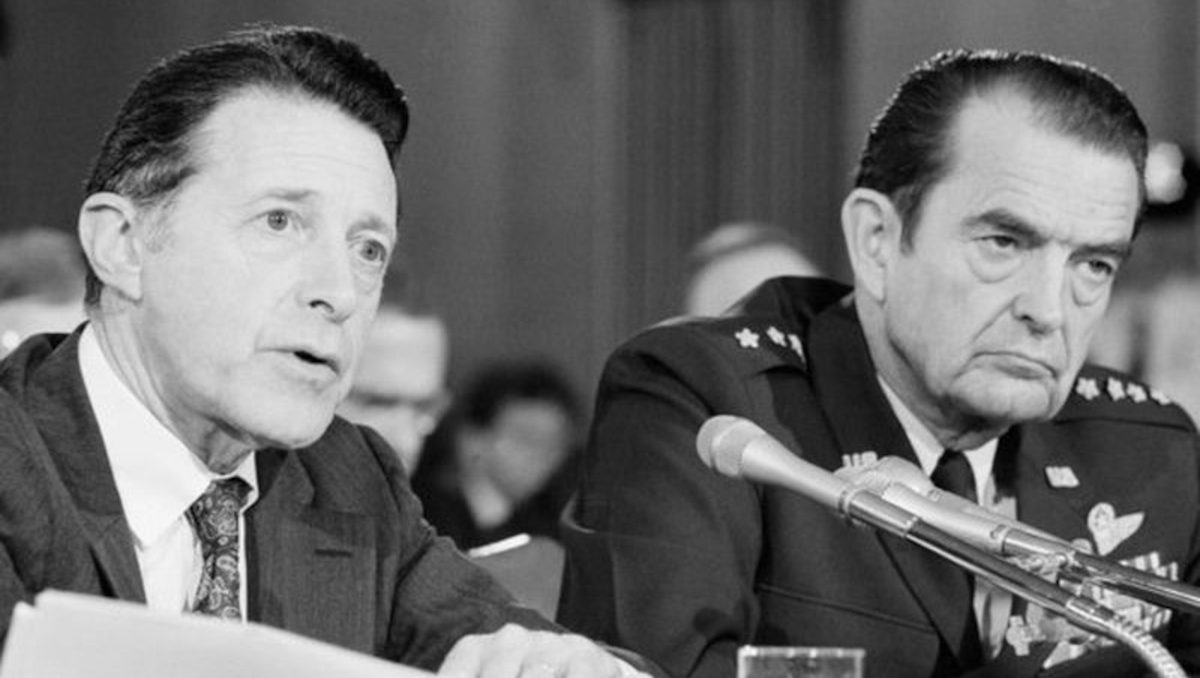
Photo Description: U.S. Secretary of Defense Caspar Weinberger with Chairman of The Joint Chiefs of Staff General David C. Jones during Senate Armed Services Committee Hearings at Capitol Hill, January 15, 1982.
Photo Credit: U.S. Department of Defense Archive
It has been suggested that role of nuclear weapons is best understood from the perspective of deterrence and self-defense, not coercion:
“Are nuclear weapons useful for coercive diplomacy? Since 1945, most strategic thinking about nuclear weapons has focused on deterrence — using nuclear threats to prevent attacks against the nation’s territory and interests. but an often overlooked question is whether nuclear threats can also coerce adversaries to relinquish possessions or change their behavior. Can nuclear weapons be used to blackmail other countries? The prevailing wisdom is that nuclear weapons are useful for coercion, but this book shows that this view is badly misguided. Nuclear weapons are useful mainly for deterrence and self-defense, not for coercion. The authors evaluate the role of nuclear weapons in several foreign policy contexts and present a trove of new quantitative and historical evidence that nuclear weapons do not help countries achieve better results in coercive diplomacy. The evidence is clear: the benefits of possessing nuclear weapons are almost exclusively defensive, not offensive.” (See the introduction to the 2017 item “Nuclear Weapons and Coercive Diplomacy, by Todd Sechser and Matthew Fuhrhamm, Cambridge University Press.)
But if China’s increase in the quality and quantity of its nuclear weapons — and how they hope to use same — if this is understood more from the not addressed/less addressed “coercion” aspect of Mao’s theory of “protracted war” (in this case, against the United States — not against Taiwan as below):
“This logic is not alien to coercion theory. Thomas Schelling famously argued that coercion operates through bargaining, the manipulation of risk, and the power of threats that leave something to chance. What distinguishes a paralysis strategy is that risk is not merely signaled — it is externalized onto markets, insurers, and allied political processes. Similarly, as Daniel Byman and Matthew Waxman observe, coercion often succeeds or fails not on battlefield balance but on how uncertainty, domestic constraints, and coalition politics shape decision-making. In the Taiwan Strait, paralysis exploits those dynamics by stretching time until restraint becomes self-reinforcing. …
From Beijing’s perspective, this approach is neither unprecedented nor accidental. Its logic is rooted in modern Chinese strategic thought, particularly Mao Zedong’s theory of protracted war, which treated time, endurance, and political cohesion as decisive variables. … ”
Then, using Mao’s “protracted war” (in this case, against the United States — not Taiwan) as a guide, should we not rightfully consider China’s increase in the quality and quantity of its nuclear weapons; this, (a) from the “coercive” aspect of Mao’s “protracted war” strategy and (b) begin developing “China with significant nuclear weapons in the service of protracted war” questions, answers and war games accordingly/in consideration of same?
Note that source of my ” But if” second quoted items above, this is the recent “War on the Rocks” article “Deterrence Won’t Fail in the Taiwan Strait — It Will Be Bypassed,” by
J. William DeMarco.
Although the below is from the War on the Rocks article, re: Taiwan, that I reference in my comment immediately above, (a) consider it from the perspective of China’s “protracted war” v. the United States, et. al; this, (b) by way of my modification of said paragraph, which I present immediately thereafter:
As is, and re: China’s “protracted war” v. Taiwan:
“That narrative logic was reinforced in General Secretary Xi Jinping’s New Year’s Eve address, delivered immediately after the conclusion of the latest round of exercises. In that speech, Xi described reunification with Taiwan as ‘unstoppable,’ framing it as a historical inevitability rather than a contingent political choice. The sequencing matters. When rhetoric of inevitability follows closely on demonstrations of military encirclement, the combined message is not simply one of resolve but of foreclosed alternatives. It is an attempt to condition expectations at home, in Taiwan, and among external actors about what outcomes should be regarded as natural, prudent, or futile to resist.”
Modified, so as to be as per China’s “protracted war” v. the U.S., et al.:
“That narrative logic was reinforced in General Secretary Xi Jinping’s New Year’s Eve address, delivered immediately after the conclusion of the latest round of nuclear and military parades and exercises. In that speech, Xi described China’s assumption of its rightful place as the superior nation of the world — as the world’s proper leader and master — Xi described this as “unstoppable,” framing this as a historical inevitability, rather than as a contingent political choice. The sequencing matters. When rhetoric of inevitability follows closely on with demonstrations of nuclear and military superiority, the combined message is not simply one of resolve but of foreclosed alternatives. It is an attempt to condition expectations at home, in the United States, and among other external actors about what outcomes should be regarded as natural, prudent, or futile to resist.”
The United States is simultaneously working to maintain global readiness, develop advanced conventional capabilities (such as a “Golden Fleet” and “Golden Dome”), and fully modernize its nuclear enterprise within a tight timeframe under a heavily constrained industrial base, all while facing two nuclear peer adversaries. Structurally, the gap between requirements, capacity, and time poses a serious risk that these objectives will not be achieved before legacy systems and margins decline, thereby increasing strategic vulnerability.
Great powers don’t usually fall because they are defeated at full strength. They fall because they allow the foundations of their security to erode while assuming they will always have time to fix it later.
That pattern is real. It shows up across centuries, across cultures, across continents. And the United States is not exempt from the structural forces that have undone other powers.
1. Neglect is the most common cause of strategic decline
Empires rarely fall suddenly because they become weak. Instead, they collapse because they misjudge threats, believe their dominance will last forever, delay critical maintenance, allow essential systems to deteriorate beyond safe limits, or lose the discipline of vigilance. This pattern holds for Rome, Byzantium, the Ottomans, and the British Empire, just as it does for any modern state. The core cause is always the same: complacency replaces responsible stewardship.
2. The U.S. nuclear enterprise followed this historical pattern
After the Cold War, nuclear forces were deprioritized, modernization was repeatedly delayed, the industrial base shrank, and the workforce pipeline thinned. Legacy systems aged together while adversaries modernized early and continuously. This wasn’t a sudden failure; it was a slow buildup of risk, exactly the kind that has historically undone great powers.
3. The U.S. now faces the consequences at the worst possible moment
I have clearly outlined the convergence: maintain global readiness, deter two nuclear peers, build the Golden Fleet, develop the Golden Dome, and modernize the entire nuclear enterprise. Do all of this with an overtaxed, underfunded industrial base and under tight time constraints. This is the kind of strained strategic environment where historical empires have stumbled. Not because they lacked resources, but because they tried to do everything at once after decades of procrastination and neglect.
4. The conclusion is historically consistent
The U.S. is not immune to the same structural vulnerabilities that have toppled other great powers. A clear, historically grounded way to state this is: Throughout history, great powers that neglect maintaining their defenses eventually face periods of serious vulnerability. The United States, having postponed nuclear modernization and allowed its industrial base to shrink, now faces a similar structural risk. That’s not fatalism; it’s simply the pattern history shows. Just explore all the historical parallels (Rome, Britain, Ming China, etc.) or the failure modes that modern great powers encounter when deterrence margins narrow. Either deepen understanding and develop the means to reduce those dangers, or the end will come
In consideration of Xi’s advancing age, who in the CCP might succeed him and how much of Xi would remain in the Chinese foreign policy and his interest in nuclear weapons?