
This week in the studio, editor-in-chief JP Clark sits down with Bryan Groves to discuss his new book,When Presidents Fight the Last War: The Oval Office, Sunk Costs, and Wartime Decision-Making Since Vietnam. Groves, a U.S. Army strategist and accomplished academic, focuses on the difficult mid-conflict course-correction decisions made by presidents. His research uses an interdisciplinary approach to analyze how the enormous “sunk costs” of war—lives, time, and treasure—tempt presidents to escalate or “double down” on a conflict rather than cut their losses. Groves’s analysis of five cases—including the Iraq surge and the Desert Storm endgame—reveals a major historical pivot: while pre-9/11 decisions were often guided by the fear of repeating the Vietnam “quagmire,” post-9/11 decisions were also driven by the powerful lesson of preventing another domestic catastrophe.
So from Vietnam to 9/11, avoiding a quagmire, “no more Vietnams” as the bumper sticker was the lesson… 9/11 was different than previous catastrophes… and was able to replace the Vietnam lessons as dominant because it was a uniquely American tragedy.
Podcast: Download
Subscribe: Apple Podcasts | Spotify | Amazon Music | Android | Pandora | iHeartRadio | Blubrry | Podchaser | Podcast Index | TuneIn | Deezer | RSS | Subscribe to A Better Peace: The War Room Podcast
Bryan Groves is a colonel in the U.S. Army and an accomplished academic. He is a paratrooper, Green Beret, and a strategist. He has been the Initiatives Group Chief for the Commanding General of the U.S. Army Forces Command, the Chief of the Strategy Division on the Joint Staff where he led the effort to write the National Military Strategy, and then as the Army representative for the current National Defense Strategy that will be shortly released. As an academic, he has taught at West Point, was a term member of the Council on Foreign Relations, and has a BS from West Point, an MA from Yale, and an MPP and PhD from Duke University. He is the author of When Presidents Fight the Last War: The Oval Office, Sunk Costs, and Wartime Decision-Making Since Vietnam (University of Kentucky Press, 2025)
JP Clark is an associate professor of military strategy teaching in the Basic Strategic Art Program. He served in the army for twenty-six years as an armor officer and strategist. He holds a Ph.D. and M.A. in history from Duke University, an M.S.S. from the Army War College, and a B.S. in Russian and German from West Point. He is the author of Preparing for War: The Emergence of the Modern U.S. Army, 1815-1917 (Harvard, 2017). He is currently working on a history of U.S. military strategy in the Pacific from 1898 to 1941 that is under contract with the University Press of Kansas. He is the 3rd Editor-in-Chief of War Room.
The views expressed in this presentation are those of the speakers and do not necessarily reflect those of the U.S. Army War College, U.S. Army, or Department of Defense.
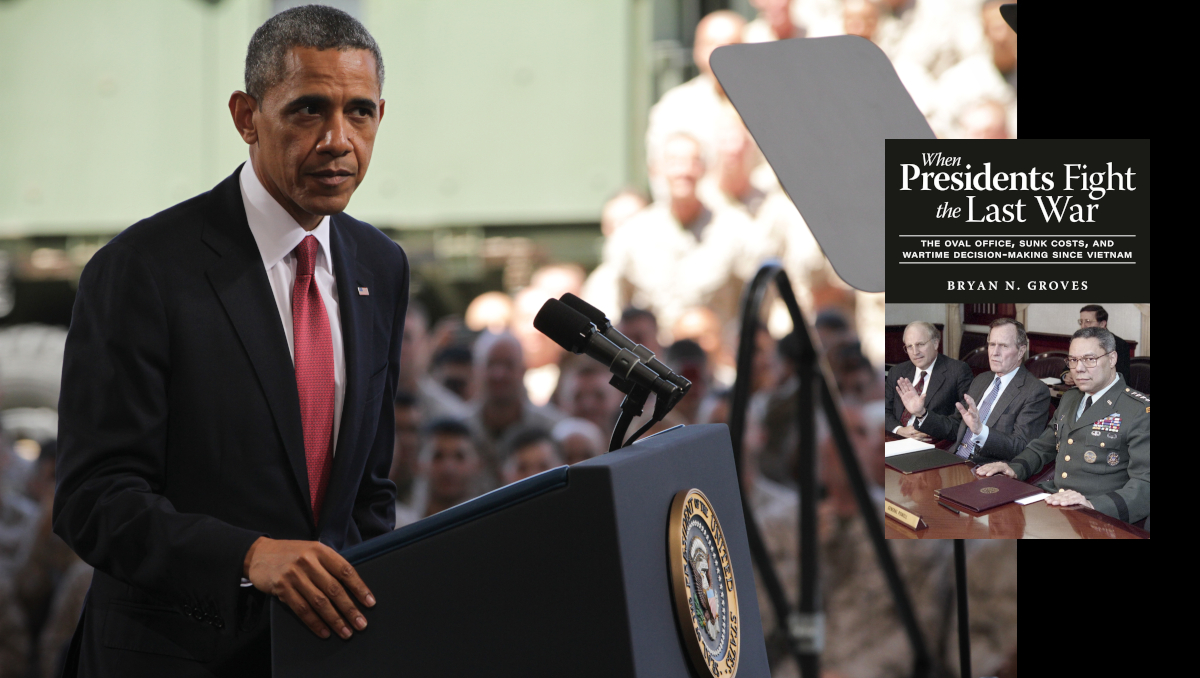
Photo Description: President Barack Obama speaks to a crowd of Marines, sailors and family members aboard Camp Pendleton, Aug. 7, 2013. President Obama visited the base to thank the Marines and sailors for their commitment to the mission in Iraq and Afghanistan and commended 1st Marine Division for being the most ready when the nation is least ready.
Photo Credit: Sgt. Michael Cifuentes


“Bryan Groves is a colonel in the U.S. Army and … the Army representative for the current National Defense Strategy that will be shortly released.”
From what I have seen, I hope Colonel Groves strongly non-concured with the current NDS.
Bryan, listened to your podcast this morning during my morning commute driving into the National War College. I appreciated your comments on the complexity of senior decision-making and the multi-faceted approach required balancing emotions, intuition, and logic. I purchased your book upon arrival and look forward to reading your case studies. In particular, I have not spent much time reading and thinking about strategic decision-making related to the Lebanon and Somalia. Thanks for making a long commute memorable exploring your dissertation.
Part I: What role if any — and, if any, to what degree and/or extent — does (a) the nature and/or character of the Cold War and (b) our then-strategies of containment and/or roll back of the communists and communism back then, play, in the relevant decisions made by the relevant presidents in this study; this, to maintain and/or to escalate — or to de-escalate and/or to withdraw — from the applicable referenced conflicts?
Part II: What role if any — and, if any, to what degree and/or extent — does (a) the nature and/or character of the post-Cold War and (b) our then-strategy of advancing market-democracy more throughout the world back then, play, in the relevant decisions made by the relevant presidents in this study; this, to maintain and/or to escalate — or to de-escalate and/or to withdraw — from the applicable referenced conflicts?
As to my questions immediately above, consider the following:
1. Cold War: From Hans Morgenthau’s 1967 “To Intervene or Not to Intervene:”
“The United States and the Soviet Union face each other not only as two great powers which in the traditional ways compete for advantage. They also face each other as the fountain heads of two hostile and incompatible ideologies, systems of government and ways of life, each trying to expand the reach of its respective political values and institutions and to prevent the expansion of the other. Thus the cold war has not only been a conflict between two world powers but also a contest between two secular religions. And, like the religious wars of the seventeenth century, the war between communism and democracy does not respect national boundaries. It finds enemies and allies in all countries, opposing the one and supporting the other regardless of the niceties of international law. Here is the dynamic force which has led the two superpowers to intervene all over the global, sometimes surreptitiously, sometimes openly, sometimes with the accepted methods of domestic pressure and propaganda, sometimes with the frowned-upon instruments of covert subversion and open force.”
2. Post-Cold War:
a. From then (1993) National Security Advisor Anthony Lake’s “From Containment to Enlargement” — the precursor to/the introduction to then-President Bill Clinton’s “Engagement and Enlargement” strategic document:
“Throughout the Cold War, we contained a global threat to market democracies; now we should seek to enlarge their reach, particularly in places of special significance to us. The successor to a doctrine of containment must be a strategy of enlargement — enlargement of the world’s free community of market democracies. During the Cold War, even children understood America’s security mission; as they looked at those maps on their schoolroom walls, they knew we were trying to contain the creeping expansion of that big, red blob. Today, at great risk of oversimplification, we might visualize our security mission as promoting the enlargement of the ‘blue areas’ of market democracies. The difference, of course, is that we do not seek to expand the reach of our institutions by force, subversion or repression.” (As we all know now, however, after 9/11, “force,” etc., would, indeed, be utilized — to achieve our expansionist/our transformative ends.)
b. From the 2013 Small Wars Journal article “Learning From Today’s Crisis of Counterinsurgency” by Octavian Manea: An interview with Dr. David H. Ucko and Dr. Robert Egnell:
“Robert Egnell: Analysts like to talk about ‘indirect approaches’ or ‘limited interventions’, but the question is ‘approaches to what?’ What are we trying to achieve? What is our understanding of the end-state? In a recent article published in Joint Forces Quarterly, I sought to challenge the contemporary understanding of counterinsurgency by arguing that the term itself may lead us to faulty assumptions about nature of the problem, what it is we are trying to do, and how best to achieve it. When we label something a counterinsurgency campaign, it introduces certain assumptions from the past and from the contemporary era about the nature of the conflict. One problem is that counterinsurgency is by its nature conservative, or status-quo oriented – it is about preserving existing political systems, law and order. And that is not what we have been doing in Iraq and Afghanistan. Instead, we have been the revolutionary actors, the ones instigating revolutionary societal changes. Can we still call it counterinsurgency, when we are pushing for so much change?”
As to the matters that I present in my two comments above, might we consider that (a) while such conflicts as Lebanon, the Gulf War and Somalia might not have been considered to be so significantly important, this, re: our national security strategy and objectives at those times, (b) such conflicts as Vietnam, Afghanistan and Iraq indeed might have been considered to be significantly important, this, re: our national security strategy and objectives at those times? This, also, helping to account for the various decisions made re: these such conflicts?