
The U.S. Army is embracing continuous transformation—a mindset to increase lethality, agility, and survivability in modern warfare. Johnny Ives joins host Tom Spahr in the studio to explain how this transformation involves a shift towards AI and data-centric warfighting with next-generation, transport-agnostic, cloud-centric command and control (C2) systems. Johnny is the Director of Army Integration in the Army G-3/5/7, and their discussion explores the methods to improve decision-making and enable dispersed operations. The Army is also focused on eliminating wasteful bureaucracy through the Requirements Elimination Assessment Program (REAP) to free up soldiers for training and maintenance. Ultimately, this effort encourages grassroots innovation—like soldiers creating deception tools with inexpensive tech—while retaining foundational military knowledge.
We sent a note out to the field several months back and said, “Hey, what kind of things are getting in your way?” and we received over 90 recommendations of things that we should get rid of.
Podcast: Download
Johnny Ives is a colonel and a Military Intelligence Officer in the U.S. Army and is the Director of Army Integration in the Army G-3/5/7. His command assignments include 22 months as the MI Company Commander, 2d BCT, 3D ID where he deployed to Iraq for Operation Iraqi Freedom; 24 months as the Battalion Commander of HHBN, XVIII Airborne Corps where he deployed for Operation Inherent Resolve dual-hatted as the Base Commander, Union III, Baghdad, Iraq; and 24 months as Commander, U.S. Army Garrison Fort Huachuca, AZ (2022-2024). He is a graduate of the AY21 Resident Course at the U.S. Army War College.
Thomas W. Spahr is the DeSerio Chair of Strategic and Theater Intelligence at the U.S. Army War College. He is a retired colonel in the U.S. Army and holds a Ph.D. in History from The Ohio State University. He teaches courses at the Army War College on Military Campaigning and Intelligence.
The views expressed in this presentation are those of the speakers and do not necessarily reflect those of the U.S. Army War College, U.S. Army, or Department of Defense.
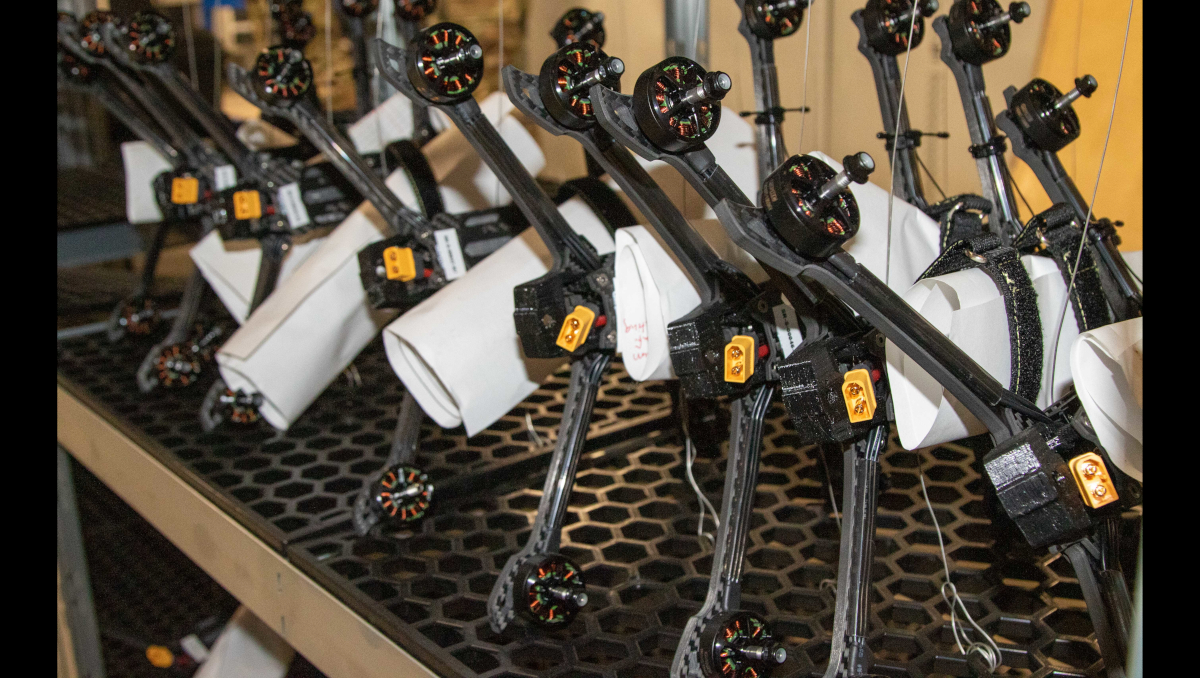
Photo Description: First-person view drones sit on a shelf in preparation for distribution during a tour conducted by U.S. Army Southern European Task Force, Africa (SETAF-AF) and 173rd Airborne Brigade personnel at the Bayonet Innovation Team’s drone lab, Caserma Del Din, Vicenza, Italy, Sept. 9, 2025. SETAF-AF and the 173rd Airborne Brigade continue to spearhead cutting-edge technological integration across the theater, driving modernization and operational agility through forward-thinking initiatives like the Bayonet Innovation Team.
Photo Credit: U.S. Army photo by Maj. Joe Legros



“The U.S. Army is embracing continuous transformation—a mindset to increase lethality, agility, and survivability in modern warfare — with a shift towards AI and data-centric warfighting with next-generation, transport-agnostic, cloud-centric command and control (C2) systems.”
Question: What is the rationale/the reasoning that would help to explain to us why the United States would seem to be so interested in, and so devoted to (a) having its military components embrace such things as “continuous transformation;” to (b) “increase lethality, agility and survivability of its military components in modern warfare;” and to (c) “shift towards AI and data-centric warfighting with next-generation, transport-agnostic, cloud-centric command and control (C2) systems;” this, if — as the new U.S. National Security Strategy seems to suggest (?):
a. Such nations as China and Russia (and likewise Iran, N. Korea, terrorists, etc.?) no longer seem to pose as much of a national security threat to the United States anymore and, thus, “modern warfare” with these such entities is considered to be less likely today. And seems to suggest (?) that:
b. Such issues as U.S. and others nations’ immigration — and, for sure, certain European nations’ immigration and their anti-right wing approaches — THESE such matters now pose the gravest — or at least one of the gravest — threats to the national security of the United States?
Herein, as I hope you can see, I am trying to understand the connection between (a) continuous transformation of our military capabilities; increase in our lethality, survivability, adaptability; and the need to shift towards AI and data-centric warfighting with next-generation, transport-agnostic, cloud-centric command and control (C2) systems and (b) the apparent (?) “downgrading” of certain threats (see the new NSS of the United States?) — which seems to be “at odds” with these such significant U.S. military transformational moves.
(Have I got this right or at least partially right here. Or am I all screwed up on this, and, thus, am totally, or at least substantially and/or fundamentally, wrong?)
Consider the following, which, hopefully, is in line with — and/or will be helpful re: — the matters that I present above:
“In place of that great-power-competition focus is a highly ideological frame that reflects the president’s domestic priorities. The Western Hemisphere is elevated as America’s highest priority, with an emphasis on arresting migration, combating so-called ‘narco-terrorists,’ and assuring U.S. dominance through a ‘Trump Corollary’ to the Monroe Doctrine. The call for U.S. military posture to reflect ‘urgent threats in our Hemisphere’ is a strong signal of what is to come in the National Defense Strategy. …”(From the Council on Foreign Relations paper “Unpacking a Trump Twist of the National Security Strategy,” at the section entitled “Polemics Over Policy: Trump’s New National Security Strategy” by Rebecca Lissner, a senior fellow for U.S. foreign policy at the Council on Foreign Relations and a Brady-Johnson distinguished practitioner in grand strategy and lecturer with the Jackson School of Global Affairs at Yale University.)
Question — Based on the above:
If “great-power competition” is no longer present or is no longer considered to be important anymore — and, instead, “urgent threats to the Western Hemisphere” (migration, narco-terrorists, etc.) (a) have taken great power-competition’s place and, thus, (b) are expected to be discussed, and addressed, as such, in the upcoming U.S. National Defense Strategy —
Then, in circumstances such as these, can the U.S. Army’s embracing of continuous transformation; of adopting a mindset to increase lethality, agility, and survivability in modern warfare; and of shifting towards AI and data-centric warfighting with next-generation, transport-agnostic, cloud-centric command and control (C2) systems” — likewise and accordingly — best be seen, and understood, from this exact same such perspective?
Note that if the U.S. Army’s embracing of continuous transformation; of adopting a mindset to increase lethality, agility, and survivability in modern warfare; and of shifting towards AI and data-centric warfighting with next-generation, transport-agnostic, cloud-centric command and control (C2) systems” ; of adopting a mindset to increase lethality, agility, and survivability in modern warfare; and of shifting towards AI and data-centric warfighting with next-generation, transport-agnostic, cloud-centric command and control (C2) systems;”
Note that if these such U.S. Army moves and efforts cannot best be seen and understood from the perspective of dealing with “urgent threats to the Western Hemisphere” (migration, narco-terrorism, etc.) — and, indeed, can only best be seen and understood from perspective of “great-power-competition,” conflict with Iran, N. Korea, etc. —
Then, in circumstances such as these, must not the U.S. Army — in order to be still be considered relevant today — (a) now need to consider abandoning these such initiatives or (b) now need to consider adapting and/or modifying them (if this is actually really intelligent, necessary and/or possible) to meet the needs and demands of “urgent threats to the Western Hemisphere (migration, narco-terrorism, etc.)?