
No two officers, even if they are from the same branch, need the same professional development during their year here.
Root Hall at the U.S. Army War College is filled with passionate, professional debate on virtually every national security topic. But there is one thing on which the entire faculty agrees: our graduates face a dynamic global environment which will require them to command units, lead staffs, and inform decision makers at the speed of relevance. This truth, however, begs the question, “How does the Army War College prepare its graduates to succeed?”
The trap hidden within the question is that there is no single answer. No two officers, even if they are from the same branch, need the same professional development during their year here. And our student body does not come from just one segment of the national security community: all branches, all components, and all services as well as civilians and international students are represented. Forcing this diverse body into a single development track fails to recognize the need for a wide array of development objectives for different students.
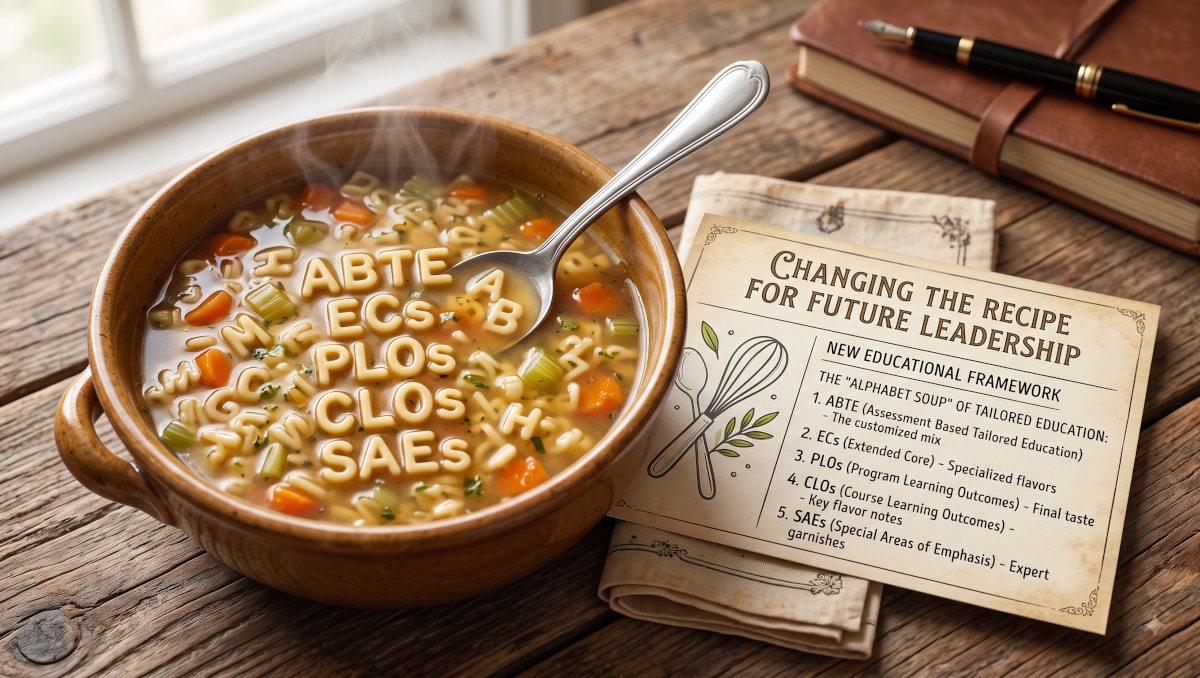
The solution to the riddle—carefully developed over several years of deliberation and experimentation—is embodied within a string of military acronyms undecipherable to outsiders: ABTE, ECs, PLOs, CLOs, and SAEs.
This article explains this alphabet soup to give a peak into the current state of Assessment Based Tailored Education (ABTE) at Carlisle Barracks. The objective is to see what is changing, why it needs to change, and how providing students more ability to shape their course of study will better prepare them to lead the joint force.
In short, the Army War College is changing the recipe. ABTE broadens the available lines of study while ensuring that all students receive the legally mandated elements of Joint Professional Military Education as directed by Congress and the Department of War. These legal requirements arrive in the form of Program Learning Outcomes (PLOs) and Special Areas of Emphasis (SAEs). Together, these inputs directly shape the Course Learning Outcomes (CLOs) for each course in order to achieve the Army War College’s year-long goals. ABTE’s core-for-all curriculum, therefore, simultaneously delivers the required instruction while enabling the students to identify the areas of study from which they can best benefit. The new recipe recognizes no one better understands what a particular student needs to study than that particular student.
To implement these focused studies, ABTE creates a portion of the year known as the Extended Core (EC). The EC period allows the students to explore two elements of the core curriculum in a deeper, more immersive way. By offering more than twenty courses developed specifically to complement the topics covered in the core-for-all program at a survey level, these ECs bring together the students from across the student body most interested in mastering these aspects of the core curriculum with the faculty experts best prepared to enhance their understanding. The ABTE recipe guarantees students remain focused on core concepts selected by strategic policymakers, while leveraging the student’s interests to shape their program of study to deepen their engagement with the material. More than simply additional elective periods exploring an interesting idea, ABTE provides deeper instruction on a necessary aspect of the core curriculum which the student needs for their future roles.
The ABTE approach, however, introduces significant complexities for faculty and course management. For instance, faculty departments enter the year not knowing how many students will enroll in their EC offerings. If a department experiences particularly high demand for its EC, then instructors who would otherwise have been teaching other ECs, developing new elective courses, taking part in group research projects, or answering requests from the operational force might be redirected to meet the higher EC demand. Obviously, for experts in strategic planning and leadership, this complexity is a manageable problem. But, as ever, the devil is in the details. Similarly, as students decide which ECs they want to take, they must weigh course availability against course applicability to determine the best fit. It is likely to take the Army War College a few iterations of trial-and-error to figure out the specific processes to maximize choice while reducing friction.
On the curriculum development side, Army War College faculty are busily reshaping the lessons which will power the EC offerings. While this sounds typical for faculty members, the extended core window represents roughly 20 to 25 new courses. Each of these courses has 10 lessons. This means 200 to 250 lesson plans complete with meaningful readings, thought-provoking discussion, and engaging group activities.
For example, the Department of Military Strategy, Planning, & Operations is creating seven brand new ECs to highlight the diverse challenges of warfighting in the emerging operational environment. The Joint All-Domain Operations Experiential EC centers on how to achieve convergence across domains while the Influence and Information Advantage EC focuses on aligning effective information activities with policy goals and military objectives. Each of these courses builds upon a set of ideas introduced in ABTE’s core-for-all to provide a deep dive for students who either know they will encounter these subjects in their future roles or who recognize they must become more familiar with an area outside of their core expertise.
The million-dollar question is why? Why is the U.S. Army War College investing its time, energy, and resources to overhaul an already successful curriculum?
More curriculum development to flesh out all the new material required by ABTE means the faculty will likely produce less scholarship and have less time available to support the larger army and joint force. Administrators and policymakers will need to actively manage faculty bandwidth to ensure that the Army War College achieves its several different missions.
The million-dollar question is why? Why is the U.S. Army War College investing its time, energy, and resources to overhaul an already successful curriculum? The answer lies in the nature of the challenge that Army War College graduates face. The operational environment is constantly changing, and it is not getting simpler. Adversaries are cooperating with each other against our interests. Technology is advancing at breakneck pace. Supply chains, interconnected economies, and limited resources are causing nations to change how they engage with each other. On top of all of this, military force has reemerged as a central tool in both coercing enemies and protecting our allies and partners.
Graduates know they will face the challenges of this new world. Their countries will demand the very best from them. The U.S. Army War College, therefore, is simply not content to let the existing model persist until it is too late. The ABTE model incorporates the competitive environment of student choice into the Army War College’s core curriculum in order to ensure that the core curriculum remains relevant. Relevant to the needs of students; relevant to the needs of our military services; and relevant to demands of the future.
Implementing this change has taken, and will continue to take, enormous effort. Faculty will adjust to new rhythms. Students will decipher new choices. The U.S. Army War College experience will change. At the end of the day, the Assessment Based Tailored Education model creates a living curriculum driven by both the needs of the Armed Forces and the developmental requirements of the students. While this represents a new approach, it will ensure the courses offered by the U.S. Army War College continue to deliver the educational transformation that potential senior military leaders need to succeed on the battlefields of the future.
Patrick Lysaght is a colonel in the U.S. Air Force currently serving as a faculty instructor at the U.S. Army War College. He is a command pilot with over 2,000 hours in F-16 and T-38 aircraft. Also, he is a School of Advanced Military Studies graduate, and planned both joint operations and crisis response options for the United States Forces Korea and Defense Threat Reductions Agency staffs.
The views expressed in this article are those of the authors and do not necessarily reflect those of the U.S. Army War College, the U.S. Army, or the Department of War.
Photo Credit: Created by Gemini
As a DDE graduate, please explain how DDE students will benefit from this curricular overhaul. They face the same complex operational demands as those in the resident course and should have the same opportunities. After all, the MSS was granted based on the rigor of the DDE curriculum.
This is an important question, and both the Dean’s and DDE staff teams have been working for the last two years on potential ways to implement these changes. Full disclosure: I teach on the resident side side of the college. I believe the current planning is to use the resident class registration and survey results to identify the extended core options which add the most value to the core. These will then be imported into the distance program. The thinking may have changed. I expect this will be a topic of discussion in the upcoming Academic Curriculum Evaluation event the Army War College is running. Thanks for asking the question!
From the second-to-last paragraph of our article above:
“Graduates know they will face the challenges of this new world.”
Herein, as an example of some of the new challenges/the new operating environment/the “new world” facing U.S. Army War College graduates today, consider the following, from the recent Council of Foreign Relations article “The Future of American Strategy: Fighting Without Friends,” by Erin D. Dumbacher:
“For the United States, preparing for and avoiding great power war is, in all likelihood, only going to get harder. The country has lost some of its soft power and ability to shape the security agenda in key regions, deficits that will put pressure on its hard power. Strained relationships with allies and partners will create friction for U.S. military operations and defense planners, who will be forced to make difficult trade-offs in the coming years. As they do, they will need to find creative ways of deterring China and Russia through disciplined investments in flexible and innovative capabilities.
The global leadership role that the United States played starting after World War II is no more. Unable to deter or dissuade allies and adversaries, the United States has undermined its ability to set the global security agenda. Its once strong voice in international forums is now more muted, giving space for China and Russia to set the agenda. New security partnerships are already forming without the United States at the center, such as Pakistan and Saudi Arabia’s new defense pact and France and the United Kingdom’s agreement to cooperate on nuclear weapons to deter Russia. Perhaps most worrisome, as U.S. allies hedge their bets by forming new, untested alliances, the United States will have less control over how they exercise or commit to use their nuclear weapons.
Meanwhile, the Trump administration’s indiscriminate and sudden cutoff of U.S. development aid has bred distrust in the Global South and caused hundreds of thousands of deaths, presenting an opening for U.S. rivals to gain the moral high ground. As China takes advantage, countries receiving its economic support may find that it comes with strings attached—namely, agreement with Beijing’s security preferences. As a result, the United States could find that Chinese (and Russian) preferences come to dominate matters as diverse as space security, climate change, biological weapons, information technology, and nuclear nonproliferation. …”
Question — based on the above:
In preparing today’s U.S. Army War College graduates for the new challenges/the new operating environment/the “new world” described in the CFR article I reference above, how will/should the War College’s — core and other — curriculum be changed; this, so as to accommodate same?
Likewise, how has the U.S. Army War College’s curriculum — core and other — been modified/been changed; this, to accommodate the loss of the “American Way of War” — strengths, approaches and capabilities — (a) previously held by the U.S. and (b) described by LTG (ret.) Charles Cleveland., and GEN (ret.) Joseph Votel, below?
“In the same way that the conventionally focused American way of war is defined by America’s technical and industrial capacity and technological edge, the American way of irregular war is tied to our notions of religious pluralism, democracy, and, above all, human rights. And although the American way of war protects us against near-peer powers and guarantees the lanes of global commerce, the American way of irregular war protects our way of life by both promoting our worldview and giving people the tools to realize the same opportunities that we have had. … ” (See the Introduction chapter to the Rand paper entitled “The American Way of Irregular War: An Analytical Memoir” by LTG [ret.] Charles Cleveland and Daniel Egel; therein, see the beginning at the last paragraph of Page 5.)
“Advocates of UW first recognize that, among a population of self-determination seekers, human interest in liberty trumps loyalty to a self-serving dictatorship, that those who aspire to freedom can succeed in deposing corrupt or authoritarian rulers, and that unfortunate population groups can and often do seek alternatives to a life of fear, oppression, and injustice. Second, advocates believe that there is a valid role for the U.S. Government in encouraging and empowering these freedom seekers when doing so helps to secure U.S. national security interests.” (See the National Defense University Press paper “Unconventional Warfare in the Gray Zone” by GEN Joseph L. Votel, LTG Charles T. Cleveland, Charles T. Connett, and Will Irwin; therein, see the fourth paragraph under the major section entitled “Doctrine.”)
Given the matters presented in my two comments above, should we not say that (a) compared to the very recent times (b) the new challenges/the new operating environment/the new world facing U.S. Army War College graduates today (exs: not being able to rely on allies, having to rely more on conventional warfare alone, not holding the moral high ground), this being AMAZINGLY different — and indeed being SIGNIFICANTLY more difficult and daunting — than the challenges/the operating environment/the world facing U.S. Army War College graduates just a decade or so ago? (This, not being able to be blamed on such things as “great power competition?”)
Thus, with our senior military professionals, today, having much less in their “capabilities” ruck sacks than those senior military professionals who proceeded them, they are now asked to do — not less — but more?
From the third-to-last paragraph of our article above:
“The million-dollar question is why? Why is the U.S. Army War College investing its time, energy, and resources to overhaul an already successful curriculum? The answer lies in the nature of the challenge that Army War College graduates face. … On top of all of this, military force has reemerged as a central tool in both coercing enemies and protecting our allies and partners.”
But has military force, actually, “reemerged as a central tool in both coercing enemies and protecting our allies and partners?”
Or, in fact, has military force, of late, actually been seen to not be able to either (a) coerce our enemies or to (b) protect our allies and partners? (Recent examples: Both Afghanistan and Iran?)
If this latter statement is thought to be more correct today, then:
a. What are the factors that have made this such reality/this such more correct truth to come into being and:
b. What changes to the U.S. Army War College curriculum should be made, accordingly, to deal with this such new reality/to deal with this such new and more correct truth?
“The million-dollar question is why? Why is the U.S. Army War College investing its time, energy, and resources to overhaul an already successful curriculum?”
Not to be disrespectful, but can we actually say, today, that the U.S. Army War College’s curriculum is “successful;” this, given that recent military force, employed by recent war college graduates, this such recently applied military force, so applied, would not seem to be very “successful?”
In this regard, how should the U.S. Army War College’s curriculum be considered for change; this, so as to provide that war college graduates might become more successful — in applying military force — today and in the future?
(Or are there other factors, beyond the control of recent war college graduates, which have made the application of military force, of late, less useful and/or less successful?)