
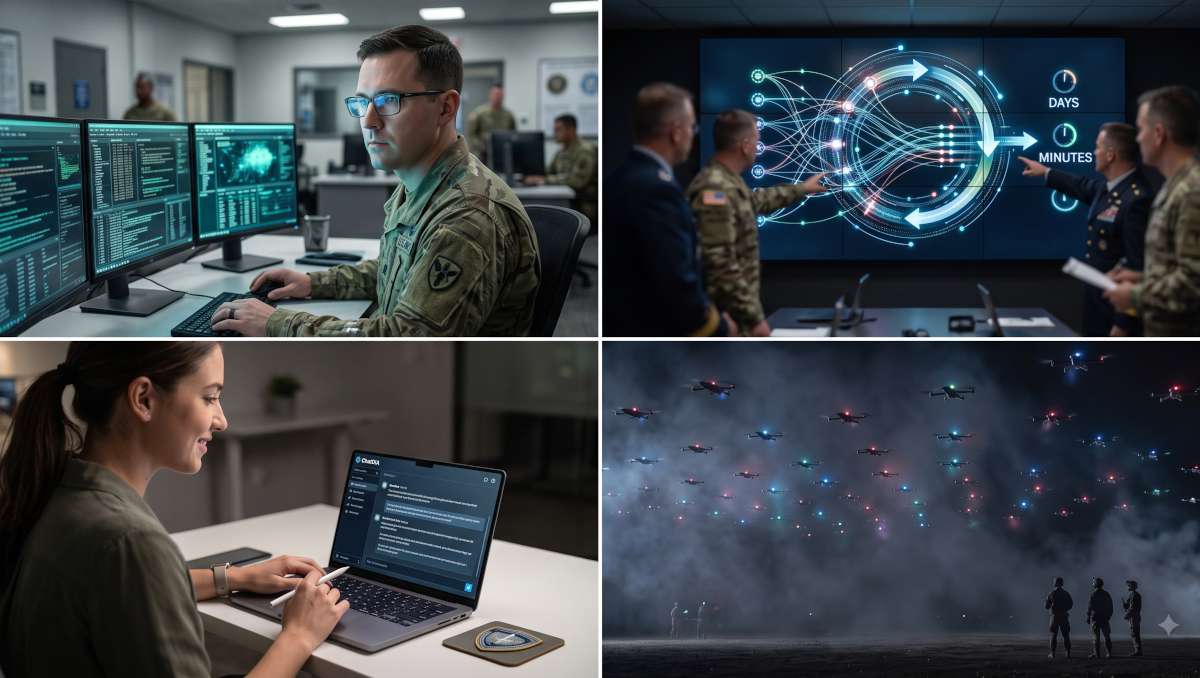
Rapid innovation challenges any large government organization, but for the Defense Intelligence Agency (DIA) embracing artificial intelligence is essential to maintaining the joint force’s competitive edge. Tom Spahr sat down with Major General Robert Kinney, the DIA’s Chief AI Officer, to explore how the agency is navigating this digital transformation.
Rather than replacing human intelligence analysts, the DIA actively uses commercial AI tools to augment everyday processes and better manage the massive amounts of data generated on the modern battlefield. This technology efficiently handles time-consuming administrative tasks.
To overcome cultural resistance, the DIA focused on quick technological wins, such as launching an internal tool called “ChatDIA,” and rolling out mandatory basic AI training for its workforce. Ultimately, Major General Kinney emphasizes that AI integration accelerates the human decision-making cycle, ensuring adversaries never outpace us on the global stage.
The entire thing for me is about the decision cycle and being able to out-decide, out-act, and defend and if necessary, defeat our adversaries because our peer competitors are working on capabilities to essentially outpace us.
Podcast: Download
Subscribe: Apple Podcasts | Spotify | Amazon Music | Android | Pandora | iHeartRadio | Blubrry | Podchaser | Podcast Index | TuneIn | Deezer | RSS | Subscribe to A Better Peace: The War Room Podcast
Robert Kinney is a major general in the U.S. Air Force, who concurrently serves as the Military and Mobilization Assistant to the Director of the Defense Intelligence Agency and as the agency’s Chief Artificial Intelligence Officer. Among his many duties, Maj Gen Kinney is responsible for accelerating digital modernization within the DIA and across the Department of War’s Intelligence Enterprise. As a career intelligence officer, he has served at the Office of the Secretary of Defense as well as at Subordinate and Unified Command, Major Command, Numbered Air Force, and Wing Level Command echelons.
Thomas W. Spahr is the DeSerio Chair of Strategic and Theater Intelligence at the U.S. Army War College. He is a retired colonel in the U.S. Army and holds a Ph.D. in History from The Ohio State University. He teaches courses at the Army War College on Military Campaigning and Intelligence.
Photo Credit: Created by Gemini


From the written introduction to our article above:
“The entire thing for me is about the decision cycle and being able to out-decide, out-act, and defend and if necessary, defeat our adversaries because our peer competitors are working on capabilities to essentially outpace us.”
In this regard, the United States, and its allies and friends, during the “Wars on Terrorism,” these folks certainly were able to (a) massively out-decide, out-act, out-pace, etc., our adversaries and, re: such abilities/capabilities, (b) massively apply “lethality” to our such adversaries. Yet all this did not lead to strategic success. Same/same, it would seem, with our war in Iran today.
Accordingly, if we are going to “modernize the DIA with artificial intelligence,” then should we not do so, today, such a manner as to better support, and better provide for, strategic success?
In this regard, are our peer adversaries today — China and Russia — limiting the modernization of their intelligence agencies, etc., with artificial intelligence; this, so as to exclusively, and/or primarily, achieve tactical ends? Or, more correctly, are our peer adversaries, today, modernizing their intelligence agencies, etc., with artificial intelligence; this, so as to also achieve strategic ends?
Herein, re: AI, if our peer adversaries are significantly concerned with — and acting — more with regard to achieving strategic ends, then why are we not doing the same? (In this regard, please provide us, if possible, with examples of U.S. AI modernization of DIA intelligence — in support of strategic ends — initiatives, efforts, achievements, etc.)
My thought above possibly stated another way. First, again, the quoted item that I provided above:
“The entire thing for me is about the decision cycle and being able to out-decide, out-act, and defend and if necessary, defeat our adversaries because our peer competitors are working on capabilities to essentially outpace us.”
Question:
In the past twenty-five or so years, if our emphasis on the decision cycle, and on being being able to out-decide, out-act, out-pace, etc., our less-powerful adversaries, if this did not result in the U.S. military — and/or the U.S. — being able to (a) “deter” our less-powerful adversaries, and/or being able to (b) achieve a “win” against same (two examples: Afghanistan and Iran),
Then why should we believe that our emphasis, now, on the decision cycle, and on being able to out-decide, out-act, out-pace, etc., our adversaries; why should we believe that this will result in the U.S. military — and/or the U.S. — (a) being able to “deter” our more-powerful adversaries today — and/or (b) being able to achieve a “win” against same (two examples: Russia and China.)
In this regard, should we not consider, and indeed concede, that — due to other factors (important to identify/name these) — superior decision cycles, being able to out-decide, out-act, out-pace, etc., one’s adversaries (large and/or small), this may have much less to do with achieving “deterrence,” with achieving “victory” and/or with being able to “impose one’s will” than we have been led to believe?
This, suggesting that — both we and our adversaries now — are likely to seek to achieve “deterrence,” to achieve “victory” and/or to “impose our will;” this, via other (more effective and more reliable?) ways and/or means? (Once again, important to identify/name these)?