
To fight and win future conflicts, defense leaders must abandon the assumption that interoperability will naturally coalesce
The United States-led International Security Assistance Force (ISAF) in Afghanistan and the Global Coalition to Defeat ISIS are often touted as examples of successful multinational integration. Yet closer examination reveals that these coalitions, despite some strengths, struggled. A RAND Corporation study noted that the counter-ISIS campaign placed a massive, grueling burden on U.S. special operations forces (SOF) to build partner capacity among disjointed local forces. While the United States benefited from secure basing and uncontested control over multiple domains, keeping the coalition together required constant effort. Recent political-military consultations highlighted the importance of diplomatic persistence amidst the immense friction of aligning diverse partner forces, such as the Iraqi CTS and the Syrian Democratic Forces.
The United States is now changing its direction. The 2026 National Defense Strategy demands the immediate, integrated employment of allied forces against peer adversaries. To fight and win future conflicts, defense leaders must abandon the assumption that interoperability will naturally coalesce; instead, they must adopt a predictive, data-driven framework that measures allied readiness across its human, procedural, and technical dimensions before a crisis ever erupts.
Recent discussions among defense scholars and insights from a past U.S. Army War College Carlisle Scholars Program research project highlight a fundamental truth: interoperability is not simply a matter of plugging two radios together. It is a complex architecture built across three distinct dimensions: human, procedural, and technical. Historically, tracking this multi-dimensional readiness across the Global SOF Network has been a decentralized, subjective effort. Staff officers frequently rely on static spreadsheets and anecdotal trip reports to catalog partner capabilities. But static spreadsheets are built to solve past problems. They cannot dynamically model the barriers to interoperability, nor can they predict how a partner nation’s political caveats will manifest during an emerging crisis.
A pragmatic, tailored, and technology-driven solution is required. As highlighted in a Government Accountability Office report, managing and overseeing the sprawling command-and-control structures of special operations forces requires the availability of centralized, standardized data. By utilizing advanced modeling frameworks, potentially augmented by artificial intelligence, defense leaders can ask the right questions to forecast the benefits and effects of SOF assembled from partners. To understand the necessity of this transition, we must examine how the three dimensions of interoperability—human, procedural, and technical—manifest as both barriers and solutions across three distinct geopolitical scenarios in the modern continuum of competition and combat.
Human Interoperability
The foundation of any coalition is the human dimension, which encompasses trust, cultural understanding, and the shared will to fight. Human interoperability encompasses factors and barriers to communication, cooperation, and collaboration. An example of such a factor is spoken and written language. Units who use different languages or dialects may have difficulties operating side-by-side in an operation. Cultural factors, such as power distance between officers and enlisted, can mean that units from different nations may respond to stresses differently. Tools for improving human interoperability may include the use of liaison officers, interpreters, or routine multinational exercises to build mutual confidence.
This dimension is put to the ultimate test when combating transnational criminal organizations and highly militarized cartels in South America. In that theater, the primary barriers to interoperability are rarely rooted in a partner’s tactical incompetence. Rather, they are driven by complex concerns over national sovereignty, equitable burden-sharing, and domestic political optics. If a crisis erupts requiring cross-border cooperation, such as an operation involving forces from Peru, Colombia, and the United States, diplomacy alone will not suffice. Human interoperability dictates how political caveats will manifest on the ground. Will a partner nation share critical human intelligence, or will asymmetric information-sharing create blind spots for the joint force? Will they allow U.S. assets freedom of maneuver within their borders, or will sovereignty restrictions halt a pursuit?
A RAND publication Leader’s Guide to Interoperability recommends leaders not assume that interoperability naturally exists but instead deliberately cultivate it. Leaders must treat interoperability as a necessary characteristic of any capability employed in coalition activities Navigating national sovereignty barriers requires a system based on national ownership, by assessing a partner’s financial and logistical commitments to sustain their own forces. When one formally assesses the human dimension, one can move past any diplomatic challenges regarding what burden each partner is genuinely capable of, and willing to, share.
Procedural Interoperability
Even when each member is trusted, coalitions will fail if they cannot plan and execute together. Procedural interoperabilityinvolves shared doctrine, standardized planning cycles, and compatible rules of engagement. The need for a predictive understanding of procedural readiness becomes acute when addressing strategic competition against peer adversaries.
Consider a scenario where aggressive Chinese influence, infrastructure investments and military basing in Djibouti threaten to disrupt the freedom of maneuver for U.S. and allied forces operating across the seams between the Indo-Pacific and Africa. In this environment, special operations forces must function with extended depth. If primary operational nodes are denied, readiness cannot be assumed based on a static list of regional allies. Instead, true allied readiness depends entirely on whether those partners possess the specific capabilities required to counter the immediate threat, the political will to act under challenging geopolitical conditions, and the legal and procedural permissions, such as basing and overflight access, necessary to enable coalition operations when U.S. access is restricted. If access to the Horn of Africa is restricted, planners must immediately identify which alternative regional partners, such as Tunisia or Morocco, are postured to serve as new staging bases.
This is where cross-theater modeling is vital. If the primary technical communications are jammed or denied, do these secondary partners share the same procedural frameworks? Can their staffs seamlessly plug into a U.S. joint task force using manual planning cycles and shared doctrine? Modern data systems can allow planners to ask these complex “what-if” questions. The aim is to avoid a frantic scramble for unifying efforts and instead concentrate collective energies toward deliberate execution of contingency plans.
If a forward observer from one nation cannot provide location data to an artillery battery from another nation, then there is no capability to provide fire support when needed.
Technical Interoperability
The final layer is technical interoperability, ensuring that systems, sensors, and weapons can securely communicate and share data across the coalition. This dimension faces the greatest friction in regions experiencing acute political volatility. If a forward observer from one nation cannot provide location data to an artillery battery from another nation, then there is no capability to provide fire support when needed. This dimension applies not only to equipment or weapons systems; it also applies to sustainment and logistics.
Consider the counterterrorism fight across Mali, Niger, and especially Nigeria. In recent years, Western security efforts in Sub-Saharan Africa have faced significant antagonism, with military coups and shifting political alliances directly impacting operational access. In such highly volatile environments, planners must continuously evaluate what political triggers might swing a partner nation away from U.S. cooperation. Selling the concept of long-term interoperability to a politically hesitant or transitional government requires a delicate strategy.
How does an enterprise framework treat these rapidly deteriorating problems? It does so by stripping away the emotion and focusing on pragmatic, objective risk calculation regarding technical networks. The framework must account for the rapid introduction of severe caveats and the need for asymmetric information-sharing. If a partner nation downgrades its cooperation due to internal political antagonism, a predictive model helps leaders immediately understand the resulting operational gaps in the intelligence architecture. By formally modeling technical interoperability, U.S. SOF planners can map out exactly how to securely disconnect, partition, or throttle data-sharing networks without compromising the broader system. This allows commanders to identify alternative, good-enough regional forces capable of assuming the burden, ensuring that counter-terrorism pressure is maintained even as diplomatic relations fluctuate.
The Framework for Understanding Allied Readiness and Integration
How do defense leaders institutionalize this multi-dimensional approach across the enterprise? It begins by establishing a formal line of inquiry that translates daily bilateral engagements, key leader meetings, and training exercises into empirical, measurable data.
Currently, much of the data gathered during multinational exercises remains trapped in subjective after-action reports. To build a truly predictive model, every engagement must serve as an objective testbed for the three dimensions. Can the partner operate under mission command (human)? Do their staff understand U.S. planning cycles (procedural)? Can their communications systems connect to the broader network without creating a cybersecurity vulnerability (technical)?
By feeding this concrete performance data into a centralized AI-enabled database, in the same way that all military affairs trends toward AI-assisted capabilities, commanders can move far beyond the limitations of legacy spreadsheets. When a planner asks how a coalition would perform in a denied-communications environment, the system can instantly generate a model based on validated historical performance data. It highlights where asymmetric information-sharing will create bottlenecks and where partner caveats will legally restrict tactical actions.
Conclusion
The era of building coalitions on the fly is over. The threats facing the United States and its allies are too fast, too distributed, and too complex to rely on just-in-time force generation. Whether dealing with human sovereignty concerns in South America, securing procedural freedom of maneuver against peer competitors, or navigating technical antagonism in Africa, the solution remains the same. The U.S. military must embrace a pragmatic, technology-driven framework that assesses allied readiness across all three dimensions. By asking the right questions, modeling the impacts of political caveats, and demanding validated interoperability, we can ensure that our global network of partnerships is transformed into highly lethal, warfighting-ready coalitions.
Oscar Garzon is a colonel and a Special Forces Officer in the Colombian Army. He holds a MA in War Studies from King’s College London. He is a distinguished graduate of the AY26 Resident Course at the U.S. Army War College, as an International Fellow, member of the Carlisle Scholars Program, and recipient of the Colonel and Mrs. Thomas F. Bristol Military History award for outstanding research.
Rachel Bowers is a colonel and a Military Police Officer in the U.S. Army. She has over 22 years of command and staff experience at the tactical, operational, and strategic levels, including two combat and one operational deployments where she conducted Correctional Operations, served as operations officer for Combined Security Transition Command-Afghanistan, and Deputy Provost Marshal for V Corps in support of Operation Assure and Deter. Most recently, she served as the Garrison Commander of U.S. Army Garrison-Okinawa. She is a graduate of the AY26 Resident Course at the U.S. Army War College, and member of the Carlisle Scholars Program.
Gerald Bowman is a lieutenant colonel and a Military Police Officer in the U.S. Army. He previously served in the U.S. Army Criminal Investigation Division at Fort Belvoir, VA, and will serve in the 8th Army in Pyeongtaek, South Korea, beginning in the summer of 2026. He is a graduate of the AY26 Resident Course at the U.S. Army War College, and member of the Carlisle Scholars Program.
The views expressed in this article are those of the authors and do not necessarily reflect those of the U.S. Army War College, the U.S. Army, or the Department of War.
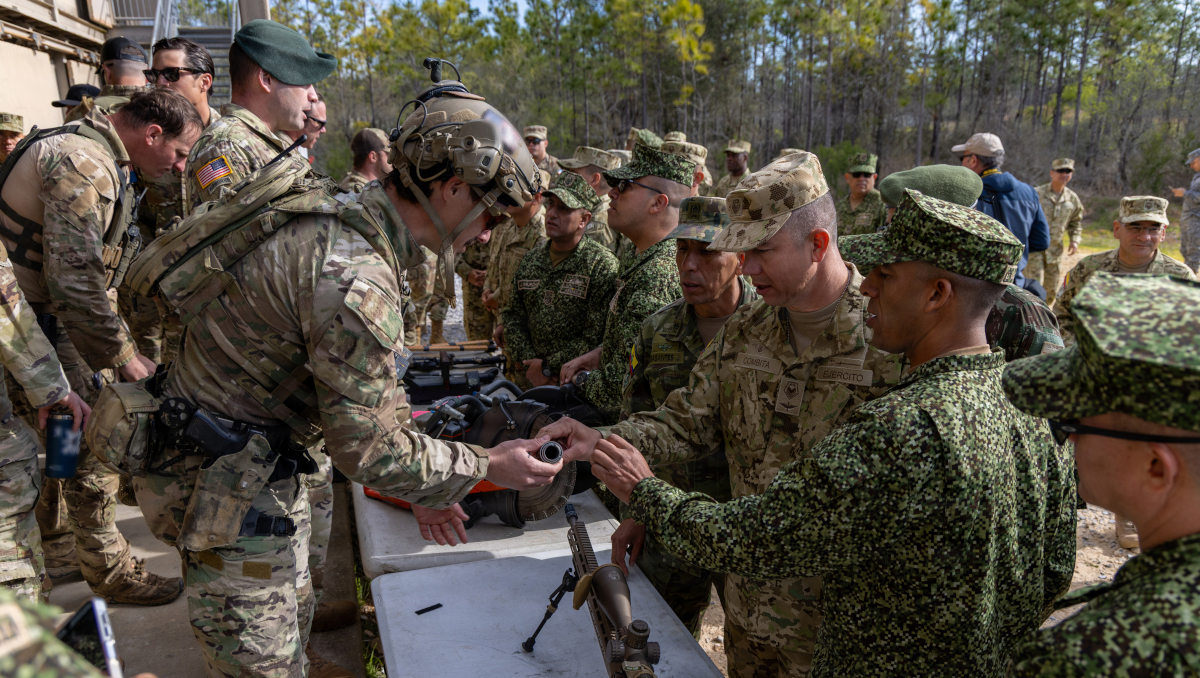
Photo Description: A Green Beret from the 7th Special Forces Group (Airborne) demonstrates the capabilities of a designated marksman rifle (DMR) to Colombian senior enlisted leaders during the 22nd iteration of the Programa Integral para Suboficiales de Alta Jerarquía (PISAJ) at Eglin Air Force Base, Florida, March 18, 2025. The interactive showcase of precision weapons systems promotes knowledge exchange, enhances interoperability, and strengthens professional ties between U.S. and Colombian noncommissioned officers to bolster shared security efforts in the Western Hemisphere.
Photo Credit: U.S. Army photo by Sgt. Jacob Bradford


Here is the final sentence, from the “Conclusion” paragraph of our article above:
“By asking the right questions, modeling the impacts of political caveats, and demanding validated interoperability, we can ensure that our global network of partnerships is transformed into highly lethal, warfighting-ready coalitions.”
Question — based on the above:
If America’s “global network of partnerships” is currently threatened by a combination of “America First” unilateralism, the erosion of mutual trust, global political polarization and the rise of an adversarial axis that (along with the U.S.?) actively seeks to dismantle the U.S.-led international order (for example, in favor of prioritizing national sovereignty?),
Then do these such matters bode well of/are they conducive to — or, rather, are they contradictory to, and, thus, damaging and destroying of — any goal — and capability/ability — of creating, and/or of maintaining, “a global network of partnerships of highly lethal, warfighting-ready, coalitions”?
(Full disclosure: Help from AI here.)
In circumstances such as those outlined above, are “just-in-time coalitions” all that we can really hope for — are they really our only realistic option — this, given the adverse matters — and the choices that we have made (and, more specifically, their adverse consequences?) — that I describe above?
As to creating, and/or maintaining, “a global network of partnerships of highly lethal, warfighting-ready, coalitions” — and as to being able to “assess allied readiness” relating to same —
As to these such requirements, should we not expect that the U.S. (quite logically now, due to the need to be able to measure, evaluate and improve upon “interoperability?”) to soon push to have our “partner” entities rapidly adopt such things as:
a. Our military services’ new physical fitness standards, and training and testing requirements, and
b. Our military forces’ recently announced new testosterone/human hormone testing and replacement therapy approaches?
(“Interoperability, in the modern combat environment — and, thus, in the most basic sense — being utterly unfeasible, and thus not at all being possible; this, if their “so-so” military personnel, on the battlefield, cannot keep up with, and cannot pull their “in-combat” weight; this, as our “super troops?”)
Here is the second paragraph of our article above:
“The United States is now changing its direction. The 2026 National Defense Strategy demands the immediate, integrated employment of allied forces against peer adversaries. To fight and win future conflicts, defense leaders must abandon the assumption that interoperability will naturally coalesce; instead, they must adopt a predictive, data-driven framework that measures allied readiness across its human, procedural, and technical dimensions before a crisis ever erupts.”
From the above, one can see that — as to the focus of this article — it is as relates to (a) “integrated employment of allied forces” to (b) stand tall against “peer adversaries.”
This being the case (we are preparing to deter, fight and defeat peer adversaries, and, thus, such things as interoperability, etc., must be seen in relation to, and be measured as relates to, these exact such tasks/these exact such requirements?);
Then, in circumstances such as these, must not our allied forces be able to:
a. “Run” (physical and hormonal requirments/capabilities) and “gun” (you pick what you want to put in here) with America’s military forces; this,
b. In these exact such “against peer adversaries” fights?
As to “the 2026 National Defense Strategy demand for the immediate, integrated employment of allied forces against peer adversaries” (see the second paragraph of our article here); as to this such requirement, here may — or may not — be important questions:
These being, (a) where, exactly, can we reasonably expect to “engage in combat operations against our peer adversaries,” thus, (b) what allied forces can we reasonably expect to interact with; this, as relates to these exact such peer adversaries fights, in these exact such locales and (c) what do we expect these such peer adversaries fights, in these exact such locales, with these such allies, to look like?
I ask these questions because the answers to same would seem to allow us to focus — by far — the largest measure of our interoperability requirements accordingly.
(Herein, and for example, do we reasonably believe that we will be fighting peer adversaries China and/or Russia in Latin America, in the Middle East, etc.? Or, more reasonably, do we think that we will be fighting peer adversaries China and/or Russia much closer to these nations’ home countries?)
Re: my comment immediately above, note that if we were to remove the word “combat” — from the “engage in combat operations against our peer adversaries” item of my second paragraph there –then, indeed, we might be able to make a better argument as to need to (generally via non-combat means?):
a. Deal with peer adversaries China and/or Russia; this,
b. In places such as Africa, South America, the Middle East, etc. — which, indeed, are far from China and Russia’s shores.
In this regard, consider the (non-combat?) “battle” example item, that I present immediately below:
“As economist Henry Tugendhat noted in a 2021 analysis for the United States Institute for Peace, ‘a battle is unfolding between the United States and Chinese tech firms over who will control what millions of people in Africa can see, hear, read, and say.’ ” (See the third paragraph of the 3 July 2024 “Africa in Fact” article “Africa in the Crossfire of Global Technological Tensions” by Ronak Gopaldas.)
Thus to ask:
a. As to the (generally non-combat?) type of “battle” — against peer adversaries — described in the excerpt provided immediately above,
b. As to our need for “immediate, integrated employment of (generally non-combat?) allied forces” — to deal with these such threats —
c. And as to our need to have “predictive, data-driven framework, that specifically measures allied readiness to deal with these such (non-military?) threats — “across its human, procedural, and technical dimensions before a crisis ever erupts” —
As to these such matters, what (generally non-combat?) agencies and/or entities (State Departments; business entities?) — of our allies (and ourselves?) — should we actually be focusing on ?????
(Herein, we should expect to be able to have “allies” go to war with us against China and/or Russia; this, if these such “allies” have already chosen — or wish to preserve the option/the right to choose — China and/or Russia as their “tech, [etc., etc., etc.] provider?)
Note that, from the perspective that I provide immediately above (current “allies”/”partners” — in places such as Africa, South America, the Middle East, etc. — may choose, may have chosen, or may wish to preserve the right to choose, China and/or Russia as their “tech,” “security,” “trade,” etc., etc., etc., provider);
As to that such perspective, and as to “Global SOF Readiness” relating to same, must not anti-government forces, now in places such as Africa, South America, the Middle East, etc., (a) need to be considered as real and/or potential “allies” and “partners” and, thus, (b) need to be evaluated, measured, etc. — as per the logic, the criteria, etc., as recommended in our “The End of the ‘Just-in-Time’ Coalition: Global SOF Readiness” article above?
Herein, in these such circumstances, to understand (a) how “combat operations against peer adversaries” might actually take place and (b) which of our actual “allies” and “partners” might actually be involved?