
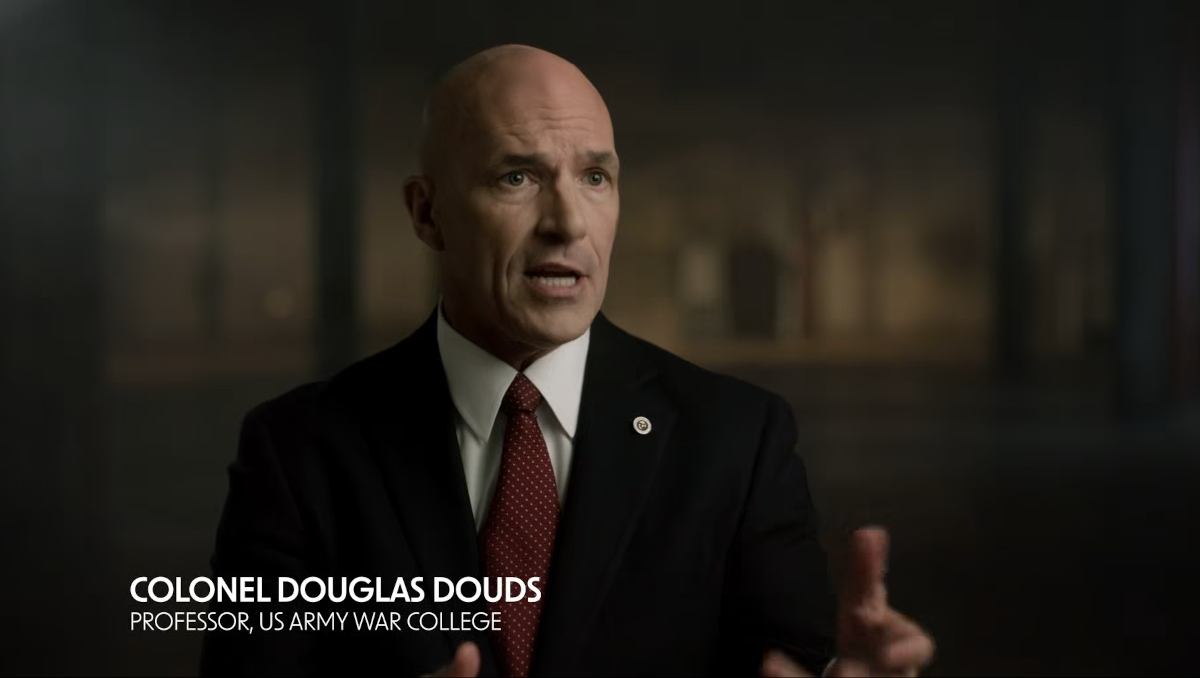
Why does World War II still captivate our historical imagination today? Host Darrell Driver sat down with military historian Doug Douds to explore this exact question.
Douds, who recently provided expert commentary for a new Tom Hanks documentary on the subject, highlights the vital role of storytelling in making complex history accessible to the general public. This discussion delves into why this massive conflict continues to shape modern geopolitics. Together, Driver and Douds unpack pivotal moments—like the battles of Midway, Guadalcanal, and Stalingrad—that decisively shifted momentum toward the Allies.
The conversation also examines technological game-changers and the unsung strategic advisors who quietly influenced top leaders behind the scenes. They even playfully entertain historical counterfactuals, such as what might have happened if Germany had never declared war on the United States.
I think when it comes to public scholarship, what we’re really doing is we’re trying to bridge the gap between academic knowledge and a broader community. And we’re trying to democratize knowledge.
Podcast: Download
Douglas Douds is a Professor and Military Historian with the U.S. Army War College’s Advanced Strategic Art Program (ASAP).
Darrell Driver is Professor in the Department of Military, Strategy, Planning and Operations at the U.S. Army War College.
The views expressed in this presentation are those of the speakers and do not necessarily reflect those of the U.S. Army War College, U.S. Army, or Department of War.
Photo Description: Colonel Douglas Douds, USMC (Ret) as he appeared in the series World War II with Tom Hanks
Photo Credit: Courtesy of the History Channel


Here is the bold-face quote, at the written introduction to our podcast above:
“I think when it comes to public scholarship, what we’re really doing is we’re trying to bridge the gap between academic knowledge and a broader community. And we’re trying to democratize knowledge.”
Question:
But, today, is there something like a war on the democratization of knowledge going on/a serious effort being made to prevent the democratization of knowledge — for example — as relates to “public scholarship” and “trying to bridge the gap between academic knowledge and a broader community” — this, as relates to World War II — and/or to other things?
In this regard, what would someone/anyone not want the broader American (etc.) public to know — and/or to reflect on — about World War II; this, given, for example, that World War II was “the greatest event in human history?”
From “Q&A with Historians Featured in World War II with Tom Hanks,” done by, and/or at, the National World War II Museum, on June 19, 2026, and featuring historians Rob Citino, PhD; Michael S. Bell, PhD (COL, USA, Ret.); Bradley W. Hart, PhD; and John Curatola, PhD, LtCol USMC (Ret):
Q: What do you hope viewers take away from watching such a thorough account of the war that changed the world?
Citino: I want the audience to know that they are still living in the world that World War II created. Our politics, our institutions, our culture, the state of international relations, the global economy: World War II created them all. But beyond that, I want them to think about the young men and women who put their lives on hold to serve a cause greater than their own, and who, in so many cases, never came home. We live in a chain of being: we’re tied not only to our present, but also to those who came before us and those who will come after. I hope that the series makes our viewers think about that.
Bell: I hope they begin to grasp something of the impact of the war on the world we live in. The war changed America, the world, and America’s role in the world, and it brought about, in particular, a postwar world under American leadership that champions freedom, democratic values, and the protection of human rights in an international system crafted to prevent another world war. I hope the series inspires its viewers and gives them an appreciation for the cost of freedom and a sense of awe as to what our forebears were able to overcome and achieve in the service of the wartime alliance of United Nations and the cause of freedom.
Hart: Ultimately, I hope viewers come away understanding that while we know the outcome of this huge war, people at the time couldn’t, and there was no guarantee that the war would turn out the way it did. History is never inevitable, and the Allies prevailing in the largest conflict in human history was far from assured. The war was only won because of the grit, determination, and ingenuity of the WWII generation, and preserving the details and nuances of that history makes the work that we do every day as historians even more important.
Curatola: That the next generations of Americans understand and appreciate that democracies need defending and that such forms of government require active participation by individuals willing to sacrifice all. If we ignore our history, treat democratic intuitions with apathy, and fail to recognize what we have and what we fought for, then this great nation will cease to exist. It is my hope that new generations of Americans will be inspired by the actions that address in this series.
My question:
Given the way the United States seems to be heading today, does all the above now seem rather irrelevant to our current time — and thus now can only be considered as sentimental nostalgia — this, for a time, and a mission, which no longer exists/which is no longer fit for contemporary purpose(s)? (Or words, and/or thoughts, to that effect.)
Paraphrasing the below, and hoping that I have got it right, consider the following from Honorable Secretary/Dr. Condoleezza Rice’s 2 March 2023 PolicyED podcast “Chapter 1 and 2: Great-Power Rivals: Then and Now.” Therein, the Honorable Secretary Rice/Dr. Rice noted three elements that distinguish the post-World War II period from the pre-World War II period, these such elements being, post-World War II:
a. An international economy that was positive-sum game. (This, as opposed to zero-sum game international economy, beggar-thy-neighbor trading policies, currency manipulation and violent great power conflicts over resources of pre-World War II; these such pre-World War II features ultimately leading to the Great Depression and world war).
b. A belief in the democratic peace theory. (Example, the belief that Germany and Japan, if helped to rebuild as democracies, would be unlikely to fight other democracies again, and would not be a threat to the international order. Herein, pre-World War II thinking had been that, after winning wars, you make your rivals as weak as possible.) And, finally,
c. All this would be protected by American military power. (Instead of the United States returning to isolation, as it had after World War I.)
(All of this also, as per George Kennan, denying the post-World War II Soviet Union the “easy path” to expansion and, ultimately, causing them to have to deal with their own internal contradictions?)
Question — Based on the Above:
As might be seen from the above, World War II — and the international system that became manifest thereafter — these would seem to have become necessary, and would seem to have been undertaken; this, so as to deal with, and correct, the problems of the international system(s) that came before same. If this indeed is the case, then why would we, now, be entertaining the idea of returning to these such pre-world war international systems — which, it would seem, were the international systems, within which, the world wars (and the costs related thereto) took place?