
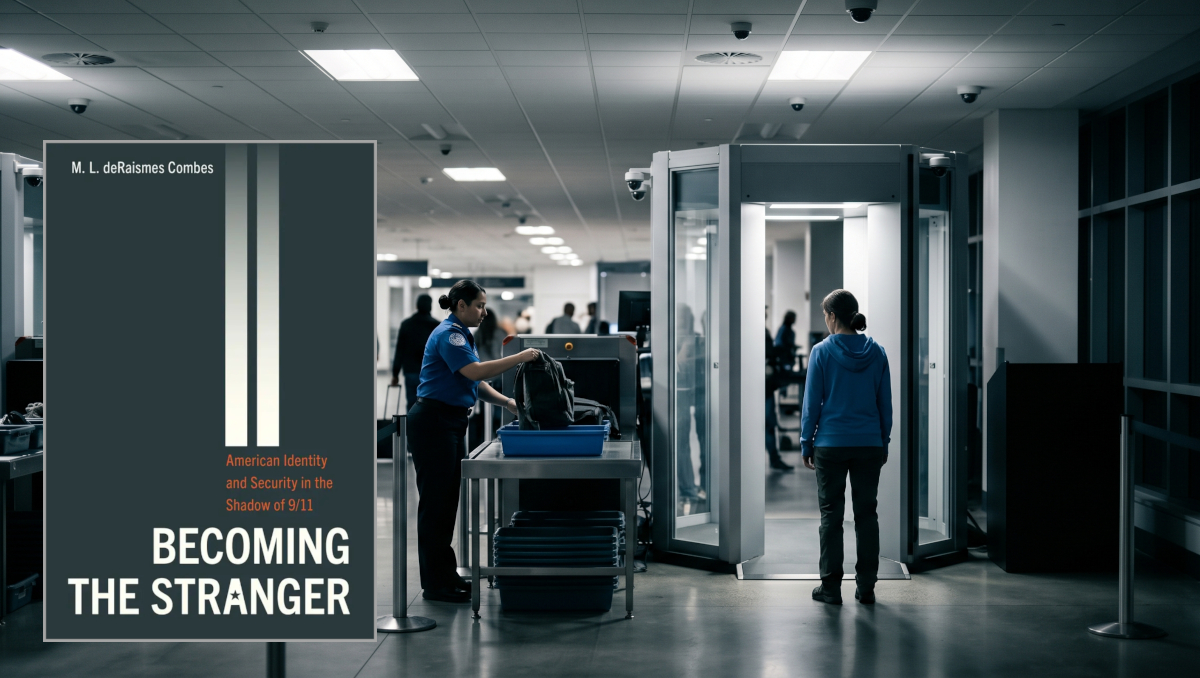
Marking the 25th anniversary of September 11, host Jadwiga Biskupska sat down with deRaismes Combes to explore how that tragic morning permanently reshaped American security, culture, and everyday life. Drawing from her forthcoming book, Becoming the Stranger: American Identity and Security in the Shadow of 9/11, Combes unpacks thousands of public records, media reports, and pop-culture touchstones to examine how our shared national story took root.
Rather than viewing the post-9/11 era as inevitable, she highlights the human choices that elevated counterterrorism into an open-ended state of war. From the routine hassles of airport screening to the expansion of covert drone strikes, daily routines quietly transformed as the lingering perception of threat shifted toward the unknown stranger next door.
Together, Combes and Biskupska tackle the central question of whether these sprawling policies have truly made us safer, or if enduring anxiety continues to sideline critical debate. For both those who remember the day vividly and the rising generation that only knows its aftermath, this discussion offers a vital, reflective look at risk, strategic empathy, and the hidden costs of national security.
The perception of whether we’re safer or not, I think, is where the meat of the question is, particularly, at least in the way I look at 9/11. And right now, every year around this time, obviously we remember 9/11 and we think back to our feelings that day and we kind of refeel that insecurity.
Podcast: Download
Subscribe: Apple Podcasts | Spotify | Amazon Music | Android | Pandora | iHeartRadio | Podchaser | Podcast Index | TuneIn | Deezer | RSS | Subscribe to A Better Peace: The War Room Podcast
M.L. deRaismes Combes is an associate professor of National Security at the U.S. Army War College. Her research focuses on U.S. foreign policy, irregular warfare, and the Middle East. Dr. Combes holds a PhD in International Relations from American University’s School of International Service and was a fellow at the University of Texas at Austin’s Clements Center for National Security. She is the author of the forthcoming book, Becoming the Stranger: American Identity and Security in the Shadow of 9/11.
Jadwiga Biskupska is associate professor of military history at Sam Houston State University and co-director of the Second World War Research Group, North America. She is the Harold K. Johnson Visiting Chair of Military History at the U.S. Army War College for AY26. She received her PhD from Yale University. Her first book, Survivors: Warsaw under Nazi Occupation (Cambridge University Press 2022), won the Heldt Prize and an honorable mention for the Witold Pilecki International Book Award.
The views expressed in this presentation are those of the speakers and do not necessarily reflect those of the U.S. Army War College, U.S. Army, or Department of War.
Photo Credit: Created by Gemini
When looking at such things as how we handled 9/11 — and how we might otherwise have handled it (see beginning at about the 20:00 point in this podcast?) — what role, if any, might such things as our “deep political convictions” have played; this, as to how we did — or might otherwise have done — things?
I ask this question because I reminded of a 1991 article, “The Sandinista Decade,” by the famous Linda Robinson; wherein, she pointed to an observation made by author Stephen Kinzer, in his book “Blood of Brothers,” that suggested that “the deep political convictions” — of the communist Sandinistas in Nicaragua back then — THIS played a/the primary role in their successes and failures.
(Should we need an example of what “deep political convictions” look like, this example, from the Cold War in this case, might prove useful?:
“ … The United States and Russia face each other not only as two great powers which in traditional ways compete for advantage. They also face each other as the fountain heads of two hostile and incompatible ideologies, systems of government and ways of life, each trying to expand the reach of its respective political values and institutions and to prevent the expansion of the other. Thus the cold war has not only been a conflict between two world powers but also a contest between two secular religions. And like the religious wars of the seventeenth century, the war between authoritarianism and democracy does not respect national boundaries. It finds enemies and allies in all countries, opposing the one and supporting the other regardless of the niceties of international law. Here is the dynamic force which has led the two superpowers to intervene all over the globe, sometimes surreptitiously, sometimes openly, sometimes with the accepted methods of diplomatic pressure and propaganda, sometimes with the frowned-upon instruments of covert subversion and open force.” [See Hans Morgenthau’s “To Intervene or Not to Intervene.])
Question — Based on the Above:
Did the U.S. have anything like “deep political convictions” at the time of 9/11; that is, convictions which we might point to, (a) to help explain what we did, (b) to help explain what we might have done differently and/or (c) to help explain our successes and failures?
In the part of the podcast that I point to above, which begins at about the 20:00 point and ends a few minutes later; at this such point in the podcast, such things as “strategic empathy,” and alternative ways of handling things, are addressed — in this case — from the perspective, I believe, of the U.S. having other options, other than, for example, invading two countries, having two hot wars, one of which lasts for 20+ years.
While these are valid, interesting and compelling questions, what I am asking — in my initial comment above — is whether such things as a nation’s “deep political convictions” — whether these such “deep political convictions” act as something of a “countering force” — and/or as something of an “elimination force” — which tends to cancel out, and/or diminish in significance, such “strategic empathy,” etc., considerations?
(Thus, a nation’s “deep political convictions” — and related agenda — these might actually shrink, constrict, shape, determine, etc. how a nation is allowed to approach and/or do, things; this, so as to deal with various problems and/or ambitions? This, effectively putting such things as “strategic empathy,” etc., on the back burner, or, in fact, in the garbage can?)
In this regard, consider the matters that I present below:
a. First, let us again reflect on the “deep political convictions” of the U.S. in the Cold War, as provided in my initial comment above, and from Hans Morgenthau’s “To Intervene or Not to Intervene.”
b. Next, let us look at certain excerpts, provided below, from the “Charter of Paris for a New Europe,” to wit: the end of Cold War “peace treaty”/the end of the Cold War “surrender document,” which are signed by the Soviet Union, and which declared that the only legitimate (and thus the only “legal?”) form of government would be a democratic government, that the only legitimate (and thus the only “legal?”) values would be U.S./Western values, and that the only legitimate (and thus the only “legal?”) form of an economy would be a capitalist/a market economy:
“We undertake to build, consolidate and strengthen democracy as the only system of government of our nations.” (See Page 3.)
“Human rights and fundamental freedoms are the birthright of all human beings, are inalienable and are guaranteed by law. Their protection and promotion is the first responsibility of government. Respect for them is an essential safeguard against an overmighty State. Their observance and full exercise are the foundation of freedom, justice and peace.” (Also see Page 3.)
“Freedom and political pluralism are necessary elements in our common objective of developing market economies towards sustainable economic growth, prosperity, social justice, expanding employment and efficient use of economic resources.” (See Page 4.)
c. Last, let us look at this excerpt from the then (1993) National Security Advisor Anthony Lake’s “From Containment to Enlargement” — the precursor to/the introduction to then-President Bill Clinton’s “Engagement and Enlargement” strategic document:
“Throughout the Cold War, we contained a global threat to market democracies; now we should seek to enlarge their reach, particularly in places of special significance to us. The successor to a doctrine of containment must be a strategy of enlargement — enlargement of the world’s free community of market democracies. During the Cold War, even children understood America’s security mission; as they looked at those maps on their schoolroom walls, they knew we were trying to contain the creeping expansion of that big, red blob. Today, at great risk of oversimplification, we might visualize our security mission as promoting the enlargement of the ‘blue areas’ of market democracies. The difference, of course, is that we do not seek to expand the reach of our institutions by force, subversion or repression.” (As we all know, however, after 9/11, “force,” etc., would indeed be considered appropriate, and would indeed be allowed; this, in the service of the U.S.’s “deep political convictions” noted immediately above.)
Bottom Line Thought — Based on the Above:
Thus, must we not admit that — standing hard against such things as “strategic empathy,” alternative ideas and alternative ways of doing things, etc. — both yesterday at the time of 9/11 and again at other times — this is the major countering force of a nation’s “deep political convictions,” which may act to shrink — and/or to even eliminate — such “strategic empathy,” other considerations, other ways of handling things, etc., considerations (and related approaches)?
(Thus, if the War College is going to teach “strategic empathy,” etc., must it not also teach its rival — its opponent — to wit: “deep political convictions?”)
From the written introduction to our podcast above:
“Rather than viewing the post-9/11 era as inevitable, she highlights the human choices that elevated counterterrorism into an open-ended state of war.”
Seeming to be related to this such question (or, indeed, answering it?), this the question of why this open-ended state of war had (contrary to international law/contrary to the laws of war?) more of a ‘transformative” nature? From Sir Adam Roberts “Transformative Military Occupations: Applying the Laws of War and Human Rights:”
“Within the existing framework of international law, is it legitimate for an occupying power, in the name of creating the conditions for a more democratic and peaceful state, to introduce fundamental changes in the constitutional, social, economic, and legal order within an occupied territory? …
These questions have arisen in various conflicts and occupations since 1945 — including the tragic situation in Iraq since the United States–led invasion of March–April 2003. They have arisen because of the cautious, even restrictive assumption in the laws of war (also called international humanitarian law or, traditionally, jus in bello) that occupying powers should respect the existing laws and economic arrangements within the occupied territory, and should therefore, by implication, make as few changes as possible.”
Thus, as to the answers to both of these questions (why problem was elevated to an open-ended state of war; why this open-ended state of war had [contrary to international law/contrary to the laws of war?] more of a “transformative” nature); as to the answer to both these such questions, might we wish to reflect on the “deep political convictions” of the United States, as I have outlined them in my earlier two comments above?