
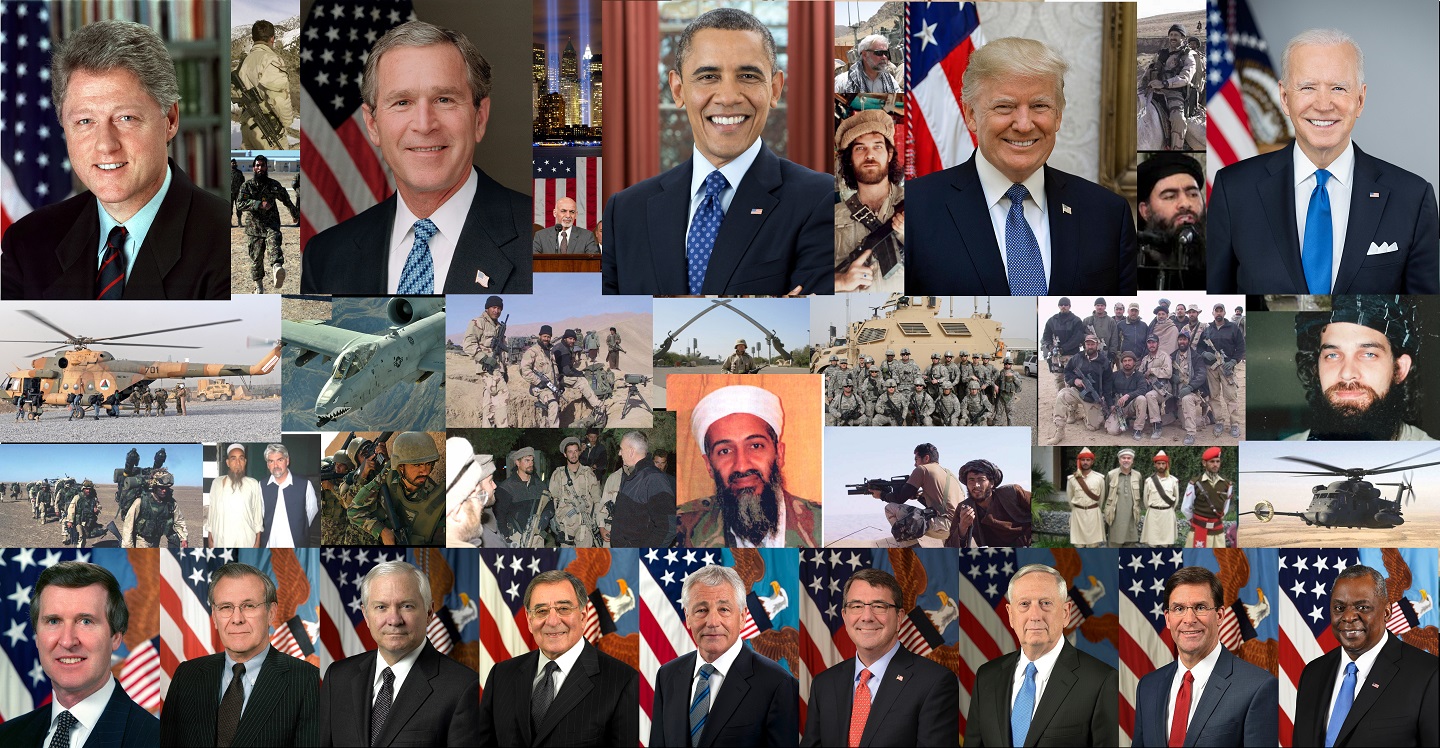
EDITOR’S NOTE: Twenty-five years ago, the September 11 attacks altered the trajectory of the nation and the lives of countless Americans. As we pause this week to remember and honor the victims, their families, and the first responders who sacrificed everything, we must also reflect on the strategic origins and legacy of that day.
This week, WAR ROOM is re-releasing three selections from our archives that examine what we have learned since about Al-Qaeda’s capabilities, how the experience of 9/11 marked a profound shift in presidential decision-making and the systemic missteps in Afghanistan. We offer this retrospective not just to understand the last quarter-century of conflict, but to honor those we lost by rigorously examining the national security apparatus built in their memory.
America’s youngest soldiers today were not even born when this war began but their generation will suffer its consequences most.
In 2001, the United States invaded and occupied Afghanistan, and eventually spent over a trillion dollars, as it and its allies killed some 170,000 Afghan citizens. Twenty years later, the United States withdrew from Afghanistan in defeat.
Why was America there? Thucydides reminded us in The Peloponnesian War some 2,500 years ago that, war’s “three…strongest motives [are] fear, honor, and interest.” The United States went to war in Afghanistan in the wake of the 9/11 attacks due to fear and to protect its honor, but inadequate understanding of Afghanistan and its geopolitical neighborhood as well as limited U.S. interests prompted mission creep, such that 20 years marched on. America’s youngest soldiers today were not even born when this war began, but their generation will suffer its consequences most. The U.S. withdrawal from Afghanistan will destroy American honor and undermine American interests. Further, the suicide bombing reportedly carried out by the terrorist group ISIS-Khorasan on August 26, 2021, suggests that even fear, the initial motive for intervention, still exists. Perhaps the United States and other major powers can win only when they are motivated by intense fear. And once Osama bin Laden scurried away to Pakistan, the fear receded—or more probably, humans simply cannot stay in a state of intense fear for very long.
The United States could not even exit before the Taliban (the very group the United States and its allies went there to fight) took over the country again. The question now is — as it was with Vietnam and Iraq and Syria — why couldn’t the world’s so-called greatest power win in Afghanistan? Consider the following 10 reasons.
First, Afghanistan, the arena for the Russo-British “Great Game” of the 19th century, became a 20th century cauldron of competition between the United States and Soviet Union. The 1978 takeover of the Afghan government by Marxists prompted a response by Afghan Islamists. The resulting civil war led the USSR to invade Afghanistan in late 1979, turning the country into an ideological battleground during the 1980s. The United States supported the Islamists, but some of them became adversaries after the Soviet withdrawal from Afghanistan in 1989 and due to America’s Middle Eastern wars of the 1990s and thereafter.
Second, while the Islamist Taliban swept away the Afghan Communists in 1996, the ancient, often reinforcing ethnolinguistic, tribal, and religious cleavage lines that divide Afghan society grew more significant. Pashtuns from Afghanistan’s south and east, who overlapped into Pakistan; the largely Shia’ Hazara and Dari/Farsi speakers from western Afghanistan, who turned toward Iran; and Tajik, Uzbek, and Turkmen Afghans from the north, who sought succor from the post-Soviet neighboring countries—they were all just the tip of the iceberg in a complex identity mélange, which constantly roils Afghanistan.
Third, after al-Qa’ida attacked the World Trade Center and Pentagon, the United States turned immediately to Afghanistan to kill or capture Osama bin Laden and his chief lieutenants, but they fled to Pakistan. Bin Laden was eventually found and killed by U.S. Special Forces in Abbottabad, Pakistan in 2011. Taliban, Al-Qa’ida, and other Islamist leaders were also killed in Pakistan—often by drone strike—between 2004 and 2018. Yet, the United States stayed on the ground in Afghanistan for 20 years. Why, when the United States could have used remote technology and airpower to kill opponents from afar? The ground mission began as a way to prevent Afghanistan from being a terrorist breeding ground. Thus, the United States slid into regime-change, development, and nation-building in one of the poorest countries in the world in 2001. It had no functioning government, and its economy centered on narcotics production.
Fourth, the United States had no idea how to address any of these problems. Indeed, President George W. Bush had campaigned against nation-building just the year before. The Bonn Accords of November 2001, Emergency Loya Jirga of June-July 2002, and the Constitutional Loya Jirga of December 2003-January 2004 were supposed to create a government that could replace the Communist regime of the 1980s and the Taliban of the 1990s. Instead, they eliminated political legitimacy for the new Afghan government. The new “democratic” system in a deeply fragmented country encouraged tremendously fraudulent elections, most significantly Ashraf Ghani’s “victories” in 2019 and 2014, and Hamid Karzai’s in 2009. The United States turned instead to the United Nations to run elections, to the international community for money (often promised but not paid) and military forces (which were scattered to different provinces and controlled by the home country, rather than the commanding general). With many commanders, no one was in charge.
Fifth, the United States had no overarching strategy, instead dividing its military strategy into counterterrorism (CT), largely the province of the Central Intelligence Agency’s Special Activities Division and the Defense Department’s Special Operations Command, and counterinsurgency (COIN), which fell to the rest of the Department of Defense. Under the CT campaign, the United States invaded compounds all over the country, upsetting family honor, and arresting and transporting hundreds of Afghans to Guantanamo Bay and other foreign detention centers, keeping many of them imprisoned for years, with no charges or the possibility of release. The COIN effort lacked enough soldiers and was constantly changing ideas about how to defeat the Afghan insurgents. It tried Provincial Reconstruction Teams, a “Clear-Hold-Build” strategy, and fighting from forward operating bases (FOBs), before taking an “Advise-Train-Assist” approach (which ultimately transformed into a mission to build the Afghan Defense and Security Forces). Poor strategy was compounded with poor tactics and poor planning. Too few soldiers were sent to control a large, rural country, even though defeating a group like the Taliban demands a near-continuous presence in rural areas which were ultimately the military “center of gravity” of this conflict. The support, or at least help, of the rural population was critical, but the military generally struggled with local languages and culture, which meant that the Taliban could completely dominate. While the United States struggled to find its footing tactically and strategically, the Taliban had a coherent strategy to hang around and wait for the United States to leave, and it was also able to execute successfully its immediate tactical goal to encourage the United States into terrible miscues, overreach, and insensitivity to local conditions.
When Ashraf Ghani and other government leaders fled ahead of the Taliban with millions of dollars in cash, no one was surprised.
Sixth, even though the United States and its allies deployed too few soldiers to do the job, they still poured tons of money into Afghanistan. This influx of money seemed like a good idea at first, as Afghanistan needed everything rebuilt after decades of high-intensity war, and had only an agricultural economy, built on illegal opium. However, Afghanistan has a system where certain elders (khans) use their money in a patronage fashion toward their local supporters. Between that arrangement, the longtime war economy, and Afghanistan’s limited absorptive capacity, everyone wanted to pad their pockets against the threat of future upheaval. Before long, vast corruption of all sorts became the norm. When Ashraf Ghani and other government leaders fled ahead of the Taliban with millions of dollars in cash, no one was surprised. Indeed, it was widely known that many government officials had used ill-gotten gains to purchase villas in Dubai, Doha, and other safer locations long before the country fell.
Seventh, the Taliban fled to and received succor in Pakistan. The Taliban, being predominantly Pashtun, slipped across the border into both Pashtunabad, just outside of Quetta, Baluchistan, and into the Federally Administered Tribal Agencies between Khyber-Pakhtunkwa and the Afghan border. These heavily Pashtun areas were the old digs of the Mujahideen from the 1980s, and once again allowed the Taliban to become pawns of Pakistan’s Inter-Services Intelligence Directorate (ISI). It is nearly impossible to find a defeated insurgency that had such an easy refuge in a contiguous state. Pakistan controlled the major access route into Afghanistan, as well as sheltering the Taliban, thereby making Pakistan into a complicated “frenemy” of the United States.
Eighth, when the United States invaded Iraq in March 2003, Afghanistan became the “forgotten war.” In 2003, over 300,000 American troops invaded Iraq, while less than 10% of that number of Americans were in Afghanistan. For the rest of the 2000s, Iraq dominated Afghanistan in the consciousness of most Americans. In 2010, President Barack Obama felt compelled to surge additional troops into Afghanistan to try to regain control over the Taliban. Iraq overshadowed Afghanistan for much of the last 20 years, often occluding the American march toward doom.
Ninth, American officials throughout the war exaggerated and prevaricated so routinely that it became difficult for average Americans (and even national security experts) to understand the situation there. Eventually, an office of the Special Inspector General for Afghanistan Reconstruction (SIGAR) was created to report on government efforts in Afghanistan, but few read the detailed SIGAR reports and instead believed the positive pronouncements of our policy makers, generals, and ambassadors who talked of “success,” “progress,” and “the light at the end of the tunnel.”
Finally, and perhaps most importantly, the United States lost its willingness to lead. The country went to Afghanistan to avenge 9/11, but its leaders immediately began planning a war against Iraq that had nothing to do with 9/11. The United States asked NATO for help in Afghanistan but refused to run it as a war that had to be won with American leadership. The United States put up with Pakistan supporting the Taliban. By the 2010s, American presidents began talking about “leadership from behind” (President Barack Obama), “making America great again” (President Donald Trump), and “building back better” (President Joseph Biden), all slogans about America rather than about leadership. At almost every turn, the United States failed to lead, and the United States can no longer be a great power if its people do not choose to carry the burdens of leadership that great powers must carry. The United States today is racked with extremism and racial challenges, political disagreement over whether its citizens should be vaccinated or masked against an infectious disease, challenges to its democracy, and unwillingness of its major political parties to cooperate to do anything. And it has now lost every significant war since World War II.
We deeply regret what is coming for Afghanistan, which is most likely a new civil war, waged between Afghan proxies on behalf of regional powers. We also regret what is coming for the world, which will only be able to see the U.S. defeat as the profound failure of a declining power. The American adventure in Afghanistan was a disaster from the beginning to the end. Many good, inspired, brave, and even noble people from all over America and all around the world tried very hard to make Afghanistan a success, as others fought and schemed to thwart that. They won, and the United States – we – failed.
Larry P. Goodson is Professor of Middle East Studies at the U.S. Army War College and author of the best-selling Afghanistan’s Endless War (2001).
Thomas H. Johnson is Research Professor at the Naval Postgraduate School and author of multiple books on Afghanistan including Taliban Narratives: The Uses and Power of Stories in the Afghanistan Conflict (2018).
The views expressed in this article are those of the authors and do not necessarily reflect those of the U.S. Army War College, the U.S. Army, or the Department of War.
Photo Credit: All photos are provided by the authors or are public domain courtesy of the U.S. White House and Department of Defense

From our article above:
“In 2001, the United States invaded and occupied Afghanistan, and eventually spent over a trillion dollars, as it and its allies killed some 170,000 Afghan citizens. Twenty years later, the United States withdrew from Afghanistan in defeat.
Why was America there? Thucydides reminded us in The Peloponnesian War some 2,500 years ago that, war’s “three…strongest motives [are] fear, honor, and interest.” The United States went to war in Afghanistan in the wake of the 9/11 attacks due to fear and to protect its honor, but inadequate understanding of Afghanistan and its geopolitical neighborhood as well as limited U.S. interests prompted mission creep, such that 20 years marched on.”
But what about the fear, honor and interest concerns of our “anti-modernization” adversaries — those both here at home and there abroad? As to those such concerns matters — relating to those such entities — consider the following from AI:
“In Book 1 of his History of the Peloponnesian War, the ancient Greek historian Thucydides famously isolates three primal human motivations that dictate the behavior of political actors and states: fear (deos), honor (timē), and interest (ōpheleia). While originally used to explain Athenian imperialism and Spartan anxiety, this triad provides a profound psychological framework for understanding contemporary anti-modernization efforts—movements that reject Western-style secular globalization, liberal socio-political structures, and technocratic integration. When modernization is viewed not as neutral progress, but as an existential threat or a competing form of empire, entities across Afghanistan, the Middle East, and the West react out of these three core motivations.
1. Afghanistan: The Taliban and Tribal Factions. Modernization in Afghanistan has historically been introduced via external intervention (Soviet or Western) or centralized Kabul elites. Entities like the Taliban utilize Thucydides’ triad to justify their resistance: Fear: The rapid influx of Western education, gender equality norms, and digital interconnectedness is perceived as a form of cultural eradication. The primary driver is a reasoned dread of losing their spiritual fabric, social hierarchy, and autonomy. Honor: In Pashtunwali (the traditional tribal code) and hardline Islamist frameworks, capitulating to a foreign-imposed modern blueprint is the ultimate dishonor. Resistance is framed as a matter of civilizational dignity, reputation, and fidelity to ancestral vows. Modernization threatens the traditional localized power structures, patronage networks, and religious legitimacy that the Taliban relies upon to govern. Their material interest lies in maintaining a rural, agrarian, and highly controlled social order free from global financial oversight.
2. The Middle East: State and Non-State Actors Throughout the broader Middle East. Anti-modernization often manifests as a rejection of “Westernization”—the political, legal, and social frameworks of the liberal international order. Fear: There is a pervasive systemic anxiety that unchecked socio-cultural modernization dismantles traditional religious authority and legal systems (such as Sharia). For actors like Iran’s conservative leadership or regional Islamist movements, modernization is feared as an insidious vector for moral decay and domestic political subversion. Honor: Regional entities often view Western-led modernization as a continuation of colonial arrogance that demands the submission of Islamic or Arab civilization. Anti-modern rhetoric reclaims historical greatness, framing the rejection of globalized norms as a refusal to let Western powers dictate local values. Interest: State and non-state entities see a strategic disadvantage in adopting Western regulatory, financial, and human rights frameworks. For authoritarian regimes or ideological movements, maintaining economic insulation or state-dominated markets protects their immediate survival and elite monopolies on resources.
3. The United States and the West: Populist and Traditionalist Movements. Anti-modernization is not exclusive to the Global South. Within the West, populist, neo-traditionalist, and reactionary political movements display a sharp backlash against the current trajectory of late-stage modernization (e.g., hyper-globalization, rapid demographic shifts, automated technocracy, and secular progressivism). Fear: Displaced working-class populations and cultural conservatives experience a profound fear of being rendered economically obsolete by automated industries, globalized outsourcing, and culturally estranged by rapid shifts in social norms. Honor: Western anti-modernization heavily leverages a politics of grievance and lost status. Populist movements seek to restore the “honor” of the forgotten citizen, national sovereignty, and traditional family or religious structures that they feel have been demeaned or hollowed out by a cosmopolitan, technocratic elite. Interest: The immediate material interest of these factions is the protection of local jobs, borders, and national industries from the demands of globalized markets and international climate or financial treaties.”
Final consideration: As per Clausewitz, “war” is the pursuit of policy (for example, our post-Cold war both here at home and there abroad state and societal modernization/transformative policy) by other means. From that such perspective:
a. Who has the better “honor, interest and fear” argument and
b. Should we consider our 20 + year failed modernization/transformative effort — in Afghanistan and indeed here in the U.S./the West and elsewhere — from that such better “honor, interest and fear” argument perspective?
Note that — from the point of view that I offer above — the answer to “what went wrong in Afghanistan” (and, indeed, elsewhere, to include here at home in the U.S./the West), this is that the U.S./the West — re: our post-Cold War modernization/transformative agenda — failed to give adequate consideration to the — proper — “honor, interest and fear” concerns of those entities who believed that they had lost — and/or would lose and/or would continue to lose — such things as power, influence, control, status, safety, privilege, prestige, etc.; this, via our post-Cold War modernization/transformative agenda, arrangements and related efforts.
(The ultimate result of this such failure: A return to something like the “dark ages” of both human — and state and societal — relationships?)
As to my “honor, interest and fear” thoughts above — relating to “transformative” endeavors of the U.S./the West in Afghanistan, etc. — consider the following:
First, consider the “honor, interest and fear” concerns of certain Afghans; this, re: the “transformative” endeavors of the Soviets/the communists, in Afghanistan, years before us:
“The overt attack on Afghan social values was presented, by the resistance forces, as an attack on Islamic values. This was also seen as an attack on the honor of women. The initiatives introduced by PDPA (the communist Peoples Democratic Party of Afghanistan) — to impose literacy on women and girls — inevitably raised questions as to the potential role of women outside the home. This provoked defensive actions from men, concerned with protecting the honor of women with their families, and to also ensure that traditional roles of women within the domestic sphere continued to be performed. It also generated fears that the important roles of women, as the primary vehicles for passing traditional and Islamic values from one generation to another, would be undermined if they were exposed to external and, particularly, non-Islamic values. This enabled the exiled radical Islamic parties to claim leadership of the resistance and to also declare a jihad.”
(Item in parenthesis above is mine. See the book “Afghanistan: Aid, Armies & Empires” by Peter Marsden, Page 58, in Chapter 4 entitled “The Soviet Military Intervention.”)
Next, consider the “honor, interest and fear” concerns of certain Afghans; this, re: the “transformative” endeavors of the U.S./the West, in Afghanistan, years later.
” … On asking an anti-government tribal leader — whom he first met in the mountains of Afghanistan in 1987 — whether the ICRC (the International Committee of the Red Cross) could travel safely in the area under his control, a senior ICRC delegate received the following reply:
‘Today, like 20 years ago, a government and its international allies are trying to impose a model of society, with all the modernization, reconstruction, development and Western values that go with it. Today, like 20 years ago, I disagree and we all shed blood. Today, like 20 years ago, you come here to try and make sure prisoners are well treated, wounded taken care of, our families not bombed, or starved, or humiliated. We respect that. Now, be warned: Just as we do not expect you to support our religious, social, political views and actions, so we expect you not to support — in any way — our enemies. Know when so-called humanitarian action becomes a sword, or a poison — and stop there. … ’ ”
(Item in parenthesis above is mine. See the “Conclusion” to the “Review of the International Committee of the Red Cross” Volume 93, Number 881, March 2011, in the report therein entitled: “Committee of the Red Cross in Afghanistan: Reasserting the Neutrality of Humanitarian Action,” by Fiona Terry.)
Question: Re: “What went wrong in Afghanistan,” can we glean anything from the “honor, interest and fear” matters that I present above?