Editor’s Note: In celebration of our 500th episode premiering last week, we are revisiting some of our most impactful stories from the archives. Whether you are hearing it for the first time or the fifth, this final episode in the retrospective represents the foundation of what we’ve built together over the years. Thank you for being part of this journey to 500. Enjoy this look back.
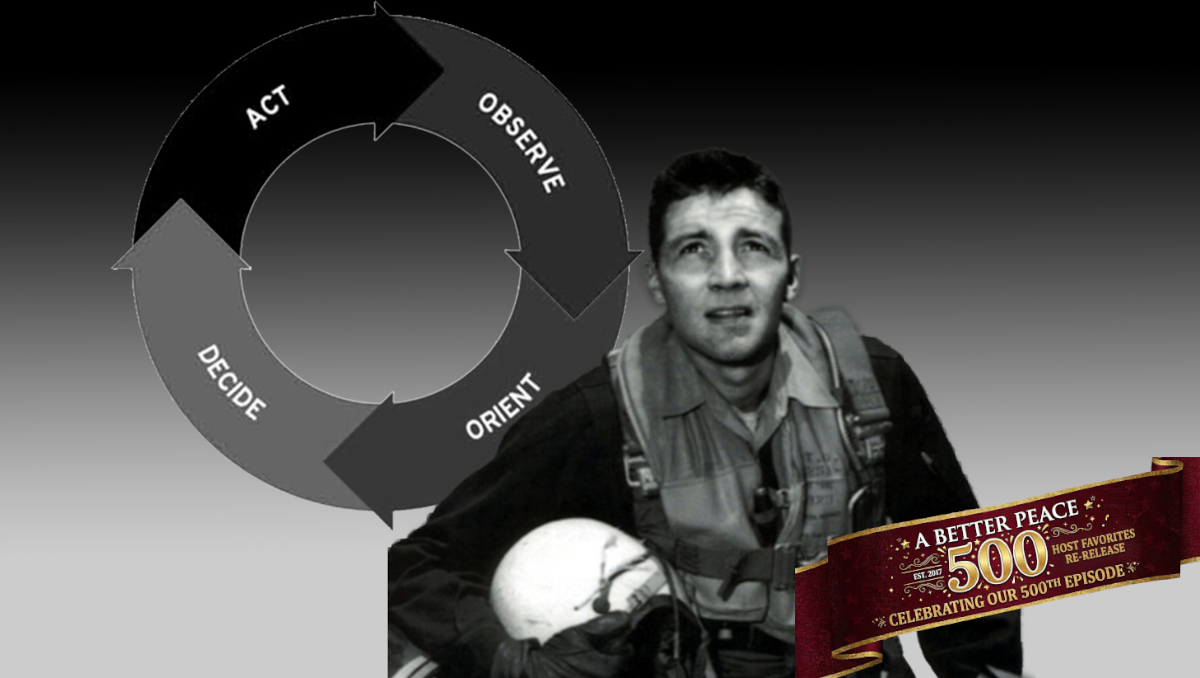
A BETTER PEACE continues its series on Great Strategists with a look at airpower theorist John Boyd, who conceived of the “OODA” (Observe, Orient, Decide, and Act) Loop. Originally expressing an approach to tactical engagement, Boyd later expanded the idea to incorporate broad strategic action. How can individuals, organizations, and entire forces use this action-and-feedback mechanism to shape an uncertain environment and outthink the opponent? Discussing Boyd, his legacy, and contemporary views of his theories are U.S. Army War College professors Clay Chun and Jacqueline E. Whitt.
The OODA loop kinda represents how … humans and organizations learn, grow, and survive
Podcast: Download
Subscribe: Apple Podcasts | Spotify | Amazon Music | Android | Pandora | iHeartRadio | Podchaser | Podcast Index | TuneIn | Deezer | RSS | Subscribe to A Better Peace: The War Room Podcast
Clay Chun was the Chair of the Department of the Distance Education at the U.S. Army War College.
Dr. Jacqueline Whitt is the Director of the Organizational Learning Unit in the Office of Policy, Planning, and Resources for the Under Secretary of Public Diplomacy and Public Affairs at the U.S. Department of State. She was the second Editor-In-Chief of WAR ROOM and remains an associate editor on the team. Follow her on Twitter @notabattlechick.
The views expressed in this presentation are those of the speakers and do not necessarily reflect those of the U.S. Army War College, U.S. Army, or Department of War.
Image: Portrait of John Boyd as a Captain or Major flying as a wingman (U.S. Government photo via Wikimedia Commons, public domain); OODA Loop graphic from Air University (public domain)
Image Composed by Tom Galvin