
Editor’s Note: In celebration of our 500th episode premiering last week, we are revisiting some of our most impactful stories from the archives. Whether you are hearing it for the first time or the fifth, this episode represents the foundation of what we’ve built together over the years. Thank you for being part of this journey to 500. Enjoy this look back.
A BETTER PEACE welcomes Brian Linn and Conrad Crane to discuss the inter-war periods throughout U.S. history and what they’ve meant to the further development of the U.S. Army. WAR ROOM Editor-in-Chief JP Clark joins them to look at how post-war versus pre-war mindsets have guided leadership over time.
The Army prides itself on being able to learn, but it also has shown throughout history it also forgets pretty quick too.
Podcast: Download
Brian Linn is a Professor of History and the Ralph R. Thomas Professor in Liberal Arts, at Texas A&M University. He specializes in military history and war and society in the 20th century.
Con Crane is a military historian with the Army Heritage and Education Center.
JP Clark is an associate professor of military strategy teaching in the Basic Strategic Art Program. He served in the army for twenty-six years as an armor officer and strategist. He holds a Ph.D. and M.A. in history from Duke University, an M.S.S. from the Army War College, and a B.S. in Russian and German from West Point. He is the author of Preparing for War: The Emergence of the Modern U.S. Army, 1815-1917 (Harvard, 2017). He is currently working on a history of U.S. military strategy in the Pacific from 1898 to 1941 that is under contract with the University Press of Kansas. He is the 3rd Editor-in-Chief of War Room.
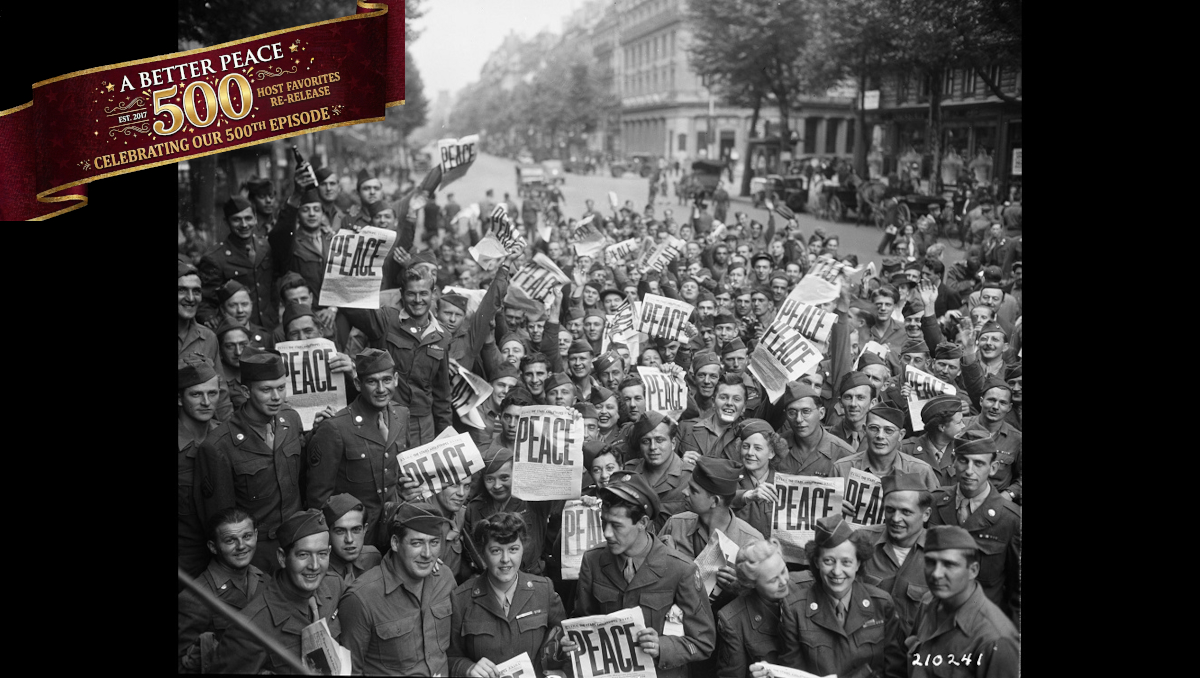
Photo Description: American servicemen and women gather in front of “Rainbow Corner” Red Cross club in Paris to celebrate the conditional surrender of the Japanese on August 15, 1945.
Photo Credit: U.S. Army Photo

Let us consider such things as pre and/or post war periods — and what might be considered as “real soldiering” within these such periods — these, from the “policy” (and, thus from the “war is an attempt to achieve policy via other means?”) perspective that I provide below:
a. During the period 1945-1990, both the U.S and the Soviet Union, and for a significant period of time, seriously try to transform both their own states and societies — and those of the rest of the world — these, more along what might be called “more modern” (albeit different) political, economic, social and/or value lines:
“The United States and the Soviet Union face each other not only as two great powers which in traditional ways compete for advantage. They also face each other as the fountain heads of two hostile and incompatible ideologies, systems of government and ways of life, each trying to expand the reach of its respective political values and institutions and to prevent the expansion of the other. Thus the Cold War has not only been a conflict between two world powers but also a contest between two secular religions. And like the religious wars of the seventeenth century, the war between communism and democracy does not respect national boundaries. It finds enemies and allies in all countries, opposing the one and supporting the other regardless of the niceties of international law. Here is the dynamic force which had led the two superpowers to intervene all over the globe, sometimes surreptitiously, sometimes openly, sometimes with the accepted methods of diplomatic pressure and propaganda, and sometimes the the frowned-upon instruments of covert subversion and open force.” (From Hans Morgenthau’s “To Intervene or Not to Intervene.”)
b. With the Soviet Union defeated, during the period 1990-2015, only the U.S., and for a significant period of time, seriously tries to transform both our own states and societies, and those of the rest of the world; these, more along what might be called “more modern” political, economic, social and/or value lines:
“Since the end of World War II, the United States has pursued a strategy aimed at overturning the status quo by spreading liberalism, free markets, and U.S. influence around the globe. … the United States’ posture stokes fear in Beijing and beyond. … But at its heart, U.S. grand strategy seeks to spread liberalism and U.S. influence. The goal, in other words, is not preservation but transformation. … The United States has pursued this transformational grand strategy all over the world. … In each of these regions, U.S. diplomatic, economic, and military policies are aimed not at preserving but at transforming the status quo. …” (From Dr. Jennifer Lind’s “Foreign Affairs” (Mar/Apr 2017 edition) article “Asia’s Other Revisionist Power: Why U.S. Grand Strategy Unnerves China.”)
c. Since about 2015, no great power (ex: Russia, China or the U.S.) has seriously tried to transform either their own states and societies — or those of the rest of the world — these, more along what might be called “more modern” political, economic, social and/or value lines In fact, ALL these such great powers, of late, seem to be moved, instead, in the exact opposite direction?
“We are also realistic and understand that the American way of life cannot be imposed upon others, nor is it the inevitable culmination of progress.” (See Page 4 of the Trump 2017 National Security Strategy — midway down the second column.)
“We do not expect diverse countries to share the same cultures, traditions, or even systems of government. But we do expect all nations to uphold these two core sovereign duties: to respect the interests of their own people and the rights of every other sovereign nation. This is the beautiful vision of this institution, and this is foundation for cooperation and success.” (See about the 15th paragraph of the White House transcript of the Trump 2017 speech to the United Nations General Assembly.)
“Strong, sovereign nations let diverse countries with different values, different cultures, and different dreams not just coexist, but work side by side on the basis of mutual respect.” (See about the 16th paragraph of the White House transcript of the Trump 2017 speech to the United Nations General Assembly.)
Question — Based on the Above:
If my observations above are even somewhat valid and correct, then — given Clausewitz’s suggestion that war is the attempt to achieve policy/political objectives via other means — might we be able to consider such things as pre and/or post-war periods — and “real soldiering” within these such periods — these, exactly from “policy” perspective that I have attempted to provide above?
Question — posed by JP Clark I believe — beginning at about the 19:00 point in this podcast: “What about a conflict makes an Army want to forget?”
Potential answer (me speaking now): Acknowledging failure in a conflict — or, more correctly, acknowledging the basis for failure in a conflict — this may be what makes an Army want to forget.
As to such “failures,” consider the following three examples. Likewise, in these three such examples, consider the potential “common” basis for failure:
a. The Napoleonic conflict — re: Napoleon’s “transformative” efforts in Spain in the Peninsular War — specifically, his (failed?) such state and societal “transformative” efforts there:
As Hegel pointed out, although the constitution that Napoleon imposed on “the Spaniards was more rational than what they had before, … they recoiled from it as from something alien.” (G.W.F. Hegel, Philosophy of Right 287 — T.M. Knox trans., 1962).
b. The Cold War — re: the communist Sandinistas’ “transformative” efforts in Nicaragua — specifically, their (failed?) such state and societal “transformative” efforts:
” ‘Blood of Brothers’ is a graphic account of a country torn in half over the Sandinistas’ efforts to build a new political and economic order. Early on, Mr. Kinzer saw that Sandinista policies were alienating ordinary Nicaraguans. ‘In 1983 most Nicaraguans had still not fallen to the depths of deprivation and despair which they would reach in later years, but many were already unhappy and restive. . . . When the Sandinistas decreed that foreign trade was to be a state monopoly, they effectively declared war on these small-scale entrepreneurs. . . . [ And ] by trying to transform [ the existing system of food production ] so completely and so suddenly, they were underestimating the deeply ingrained conservatism of Nicaraguan peasants. … ’ Yet Mr. Kinzer’s own critique of what he calls the regime’s ‘colossal misjudgments’ suggests that the Sandinistas’ policies were not just tactical responses to outside aggression but reflections of their deep political convictions. His catalogue of their ‘errors’ is long: their rejection of free-market economics, their militarism and arrogance, their antagonism toward the Roman Catholic Church hierarchy, the ‘suffocating social and political controls’ they imposed, their embrace of an obsolete Communist political model and of ‘Fidel Castro’s outlandish dream’ of spreading revolution throughout the hemisphere.” (See the 1991 Washington Post article “The Sandinista Decade” by Linda Robinson.)
c. The Post-Cold War — re: the market-democracy U.S./Western “transformative” efforts in Iraq and Afghanistan — specifically, our (failed?) such state and societal “transformative” efforts:
“Similarly, in classical theory, the insurgent initiates. Thus, Galula asserts that ‘whereas in conventional war, either side can initiate the conflict, only one – the insurgent – can initiate a revolutionary war, for counter-insurgency is only an effect of insurgency’. … But, in several modern campaigns – Iraq, Afghanistan, Pakistan and Chechnya, for example – the government or invading coalition forces initiated the campaign, whereas insurgents are strategically reactive (as in ‘resistance warfare’). Such patterns are readily recognisable in historical examples of resistance warfare, but less so in classical counter-insurgency theory.” (See David Kilcullen’s “Counterinsurgency Redux.”)
Question: Reflecting on the above, what then might be the — common — basis for “transformative” failure (a) found in the conflicts above which (b) might want to make armies want to forget?
Answer: That, at times, one’s force of arms — and even one’s “deep political convictions” — at achieving state and societal transformations — at times, neither nor both of these may not be enough to cause certain states and societies to (a) abandon their time-honored political, economic, social, value, etc., ways of life, ways of governance, etc., and, in the place of same, to (b) embrace one’s own political, economic, social, value, etc., ways of life, ways of governance, etc. This being especially true in instances where — (a) even if one’s constitution, etc., is much better than theirs, (b) the matters contained and required therein are so alien as to cause the targeted states and their societies (or critical portions thereof) to (1) “recoil as to something alien” and to (2) embrace (often successful — see my examples above?) “resistance warfare” accordingly.
Here may be an interesting question, which might be considered with regard to the matters that I present in my first comment above — but may best be considered with regard to my second comment above (see “resistance warfare”) — and which might be entertained as to the assertion that “It’s Only a Pre-War Period in Hindsight.” Here goes:
a. If Russia and China — in the Cold War but even more so in the post-Cold War — saw/see themselves as being threatened by the market-democracy “transformative” efforts of the U.S./the West,
b. And if, accordingly, Russia and China’s “countering” efforts — both in the Cold War but also in the post-Cold War — can be seen from the perspective of them being engaged in “resistance warfare” against the U.S./the West (see my second comment above),
c. Then, from that such “resistance warfare” perspective, does “It’s Only a Pre-War Period in Hindsight” apply? (If not, then in these such circumstances, how should we see China and Russia’s “resistance warfare” against the U.S./the West today — as pre-war, post-war, continuing war or something else?)
As to my final, item “c,” questions immediately above, consider the following two items:
“Yet, as noted by scholars across different theoretical traditions, the liberal international order is not simply a normatively thin order that regulates in mutually beneficial ways relations among states through value-free rules, institutions, and markets. It is rather an ideologically thick order (Allan, Vucetic, and Hopf 2018; Jahn 2019; Cooley and Nexon 2020), infused with a complex set of ideas, norms and principles, whose main institutions, actors, and practices seek to transform states and their societies both beyond and within the West.” (See the article “Civilizationism and the Ideological Contestation of the Liberal International Order” by Gregorio Bettiza, Derek Bolton and David Lewis in International Studies Review, Volume 25, Issue 2, June 2023.)
“This may, in fact, be the missing explanatory element. Ideologies regularly define themselves against a perceived ‘other,’ and in this case there was quite plausibly a common and powerful ‘other’ that both (Chinese) cultural conservatism (Confucianism) and (Chinese) political leftism (Chinese socialism) defined themselves against. This also explains why leftists have, since the 1990s, become considerably more tolerant, even accepting, of cultural conservatism than they were for virtually the entire 20th century. The need to accumulate additional ideological resources to combat a perceived Western liberal ‘other’ is a powerful one, and it seems perfectly possible that this could have overridden whatever historical antagonism, or even substantive disagreement, existed between the two positions.” (Items in parenthesis above are mine. See the Foreign Policy article “What it Means to Be ‘Liberal’ or ‘Conservative’ in China: Putting the Country’s Most Significant Political Divide in Context,” by Taisu Zhang.)
Thought — Based on the Above:
If “the main institutions (one example: militaries?), actors (one example: soldiers?) and practices” (one example: open force?) — of the liberal international order — led by the U.S./the West? — have — before, during and after the Cold War — “sought to transform states and societies both beyond and within the West.” (See my first quoted item immediately above.)
And if entities within places such as China (or even within the U.S./the West itself?) — thus threatened by the main institutions, actors and practices of the liberal international order — before, during and after the Cold War — have resorted (and still resort?) to “resistance warfare” against same. (See my second quoted item immediately above.)
Then, from that such perspective, might we say that neither a pre-war characterization — nor a post-war characterization — neither of these would seem to help us very much? This suggesting that a continuing war context, this might be what we need to consider and adopt?