
Editor’s Note: In celebration of our 500th episode premiering this week, we are revisiting some of our most impactful stories from the archives. Whether you are hearing it for the first time or the fifth, this episode represents the foundation of what we’ve built together over the years. Thank you for being part of this journey to 500. Enjoy this look back.
For many, Afghanistan and the lessons that should have been learned have been overshadowed recently by the invasion of Ukraine by Russia. And as much as Ukraine deserves the attention of the world, national security professionals have a duty to learn as much as possible from the successes and failures of Afghanistan. To that end, A BETTER PEACE is extremely pleased to welcome Maj Gen Brian Mennes, the Deputy Commanding General, XVIII Airborne Corps, Fort Bragg, North Carolina. He joins Tom Spahr in the virtual studio to discuss his experiences in Afghanistan during his multiple tours in the theater. Tom and the general served together on three separate tours in Afghanistan and their conversation focuses on the wins that they achieved along the way along with the losses and the eventual fall of the Afghan government in August 2021.
Clausewitz would say “General before you start this war be sure to understand the peace you hope to create.”
Podcast: Download
Subscribe: Apple Podcasts | Spotify | Amazon Music | Android | Pandora | iHeartRadio | Podchaser | Podcast Index | TuneIn | Deezer | RSS | Subscribe to A Better Peace: The War Room Podcast
MG Brian Mennes is the Deputy Commanding General, XVIII Airborne Corps, Fort Bragg, North Carolina. He is the former Commanding General, 10th Mountain Division (Light Infantry) and Fort Drum, New York and Deputy Chief of Staff for Operations OPERATION FREEDOM’S SENTINEL, Afghanistan. He has served multiple tours in both Afghanistan and Iraq.
Thomas W. Spahr is the DeSerio Chair of Strategic and Theater Intelligence at the U.S. Army War College. He is a retired colonel in the U.S. Army and holds a Ph.D. in History from The Ohio State University. He teaches courses at the Army War College on Military Campaigning and Intelligence.
The views expressed in this presentation are those of the speakers and do not necessarily reflect those of the U.S. Army War College, U.S. Army, or Department of Defense.
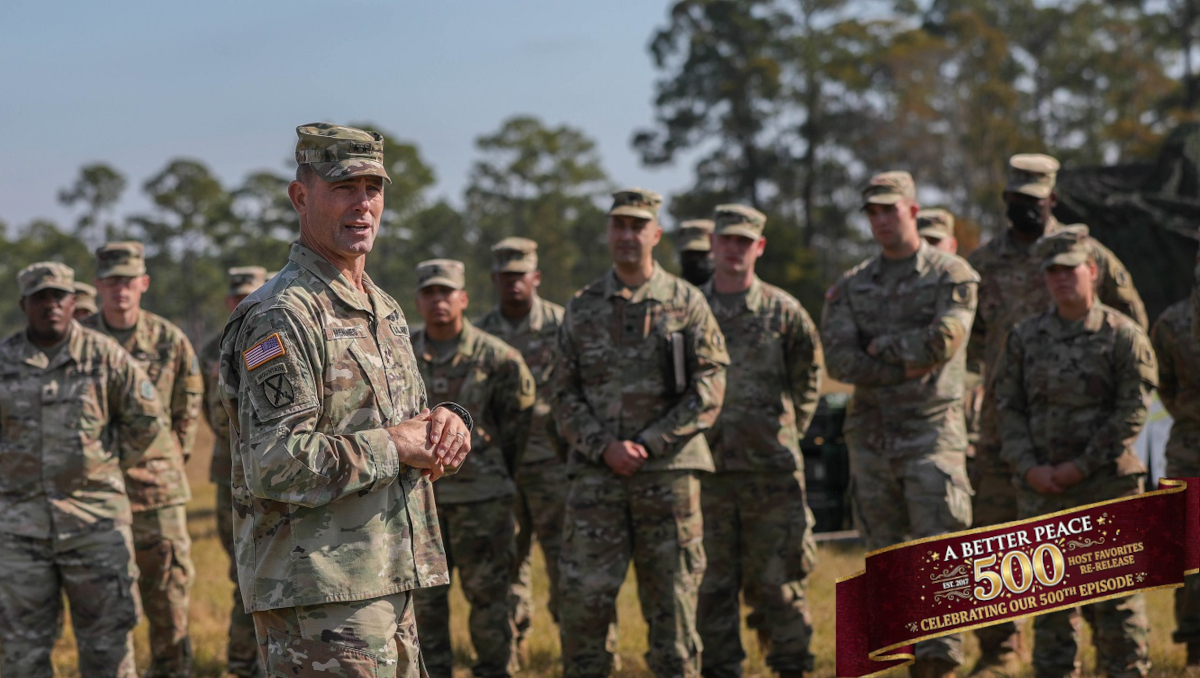
Photo Description: U.S. Army Maj. Gen. Brian Mennes, the Deputy Commanding General of the XVIII Airborne Corps, pays a visit to the 35th Signal Brigade on Nov. 3, 2021, at Ft. Stewart, Ga.
Photo Credit: Spc. Maxine Baen


At about the 05:25 point in this podcast, and reflecting there on the question as to whether he, MG Mennes, was surprised when the Afghan Army fell, MG Mennes stated that he was not surprised; this, “because of how much energy it took, from an external force, to even help determine what security was in the rural towns and villages across Afghanistan.” Thereafter, interviewer Dr. Spahr — at about the 07:55 point in the podcast — and reflecting on the cir. 2012 period — stated that he (Dr. Spahr) believed that at least some progress had been made, during this time, in doing “counterinsurgency” in Afghanistan.
But here, I suggest, is the problem; this being that (a) what we were doing in Afghanistan would not seem to be “counterinsurgency”/”defensive” war and, therefore and accordingly, (b) one would not seem to be able attribute, view or discuss one’s successes, and/or one’s failures (for example, as to being able to achieve security in rural towns and villages); this, from an (erroneous?) “counterinsurgency”/”defensive” war perspective.
Rather these such matters (ex: success or failure in achieving security in the rural environs), these, in the Afghanistan War case (etc.?), would need to be viewed, considered, discussed and reported on more from a “revolutionary war”/”offensive” war point of view. As to these such contention, consider the following quoted matters:
David Kilcullen:
“Politically, in many cases today, the counter-insurgent represents revolutionary change, while the insurgent fights to preserve the status quo of ungoverned spaces, or to repel an occupier – a political relationship opposite to that envisaged in classical counter-insurgency. Pakistan’s campaign in Waziristan since 2003 exemplifies this. The enemy includes al-Qaeda-linked extremists and Taliban, but also local tribesmen fighting to preserve their traditional culture against twenty-first-century encroachment. The problem of weaning these fighters away from extremist sponsors, while simultaneously supporting modernisation, does somewhat resemble pacification in traditional counter-insurgency. But it also echoes colonial campaigns, and includes entirely new elements arising from the effects of globalisation.” (See David Kilcullen’s “Counterinsurgency Redux.”)
Robert Egnell:
“Dhofar, El Savador and the Philippines are all campaigns driven by fundamentally conservative concerns. When we are looking to Syria right now, it is not just about maintaining order or even the regime, but about larger political change. In Afghanistan and Iraq too, we represented revolutionary change. So, perhaps we should read Mao and Che Guevara instead of Thompson in order to find the appropriate lessons of how to achieve large-scale societal change through limited means? That is what we are after, in the end. And in this coming era, where we are pivoting away from large-scale interventions and state-building projects, but not from our fairly grand political ambitions, it may be worth exploring how insurgents do more with little; how they approach irregular warfare, and reach their objectives indirectly.” (See the Small Wars Journal article “Learning From Today’s Crisis of Counterinsurgency” — an interview by Octavian Manea of Dr. David H. Ucko and Dr. Robert Egnell.)
“First, an (U.S. plus) insurgency strategy provides a more accurate description of the nature of the problem in Afghanistan, as well as the means needed to address it. Given that the international coalition’s aim is not merely counterterrorism but also broader societal transformation, the main hurdle is not the existence of Taliban fighters, the Haqqani Network, or other groups currently categorized as insurgents; they are simply actors that cause friction in the struggle to transform Afghan society. The challenge is to transform not only the political system that, in part, is an unfortunate post-invasion creation of the West, but also societal ideas at large. Rather than assuming that the West is the protector of the existing Afghan political order, as the counterinsurgency approach does, an insurgency approach would acknowledge that Afghan society is in fact far from permeated by Western notions of governance, justice, and economic management, and that the international coalition is instead the agent of change. The aims of operations in Afghanistan thereby take a much more ambitious turn, and the tactics that must be used to achieve the more ambitious aims change from defense to offense — not least along the civilian lines of operations, including governance and development. (See the National Defense University Press Joint Force Quarterly 70 (3rd Quarter, July 2013) article “A Western Insurgency in Afghanistan” by Robert Egnell. Therein, see Page 12 and, there, the bottom of column “a” and the top of column “b.”)
“Analysts like to talk about ‘indirect approaches’ or ‘limited interventions’, but the question is ‘approaches to what?’ What are we trying to achieve? What is our understanding of the end-state? In a recent article published in Joint Forces Quarterly, I sought to challenge the contemporary understanding of counterinsurgency by arguing that the term itself may lead us to faulty assumptions about nature of the problem, what it is we are trying to do, and how best to achieve it. When we label something a counterinsurgency campaign, it introduces certain assumptions from the past and from the contemporary era about the nature of the conflict. One problem is that counterinsurgency is by its nature conservative, or status-quo oriented – it is about preserving existing political systems, law and order. And that is not what we have been doing in Iraq and Afghanistan. Instead, we have been the revolutionary actors, the ones instigating revolutionary societal changes. Can we still call it counterinsurgency, when we are pushing for so much change?” (From the 2013 Small Wars Journal article “Learning From Today’s Crisis of Counterinsurgency” by Octavian Manea: An interview with Dr. David H. Ucko and Dr. Robert Egnell.”)
Question — Based on the Above:
If we were to make a careful study and announce our results re: the Afghanistan War — NOT from a “counterinsurgency”/”defensive” war perspective BUT RATHER from a “revolutionary”/”offensive” war perspective (someone MUST get around to doing this?) — then, from that such “revolutionary”/”offensive” war perspective, what might be (a) The Lessons of the Afghanistan War” and (b) MG Mennes’ — and Dr./COL Spahr’s, etc. — observations relating to same???
(Dr. Spahr and MG Mennes: Given your vast experience in the Afghanistan War, would either or both of you like to “get the ball rolling” here — and/or sponsor, contribute and/or manage this such effort? Just a thought.)
Addendum:
Consider the matters that I present above; these, from the following perspective:
“Since the end of World War II, the United States has pursued a strategy aimed at overturning the status quo by spreading liberalism, free markets, and U.S. influence around the globe. … the United States’ posture stokes fear in Beijing and beyond. … But at its heart, U.S. grand strategy seeks to spread liberalism and U.S. influence. The goal, in other words, is not preservation but transformation. … The United States has pursued this transformational grand strategy all over the world. … In each of these regions, U.S. diplomatic, economic, and military policies are aimed not at preserving but at transforming the status quo. …” (See Dr. Jennifer Lind’s “Foreign Affairs” (Mar/Apr 2017 edition) article “Asia’s Other Revisionist Power: Why U.S. Grand Strategy Unnerves China.)