
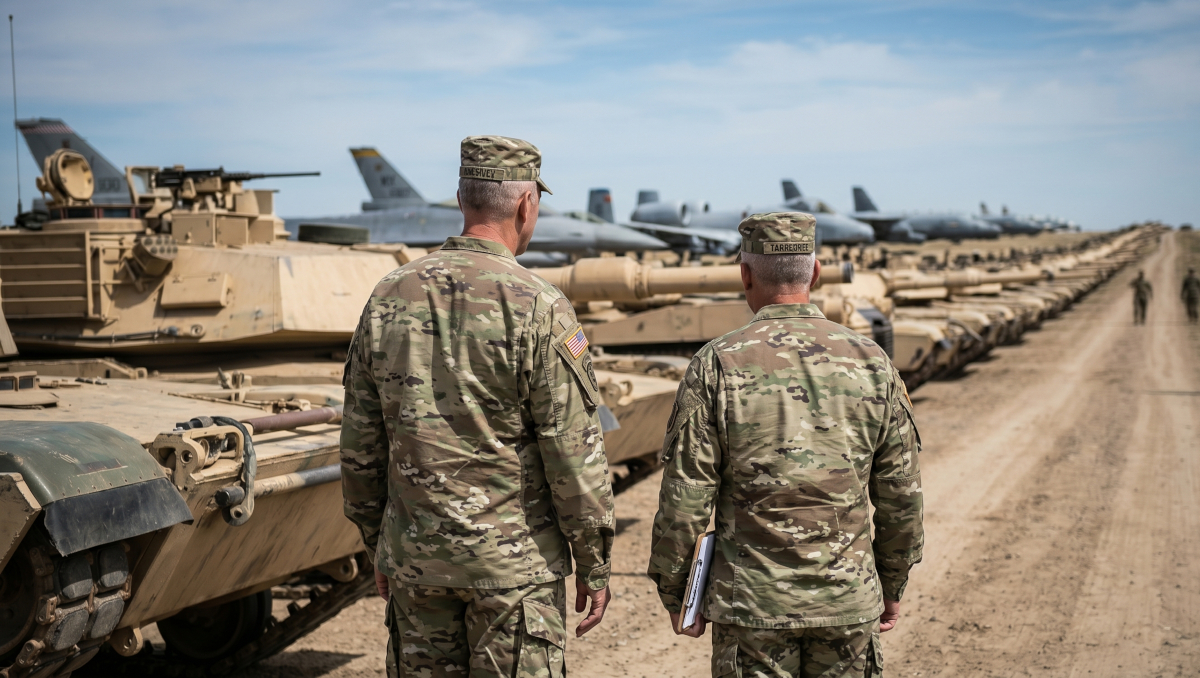
Traditional measurements often fail to capture how modern, advanced militaries compete.
Are the United States and China amidst an intensifying militarily competition? Traditional ways of measuring such competition—comparing military budgets or the building of similar platforms—indicate that the answer is a resounding no. While China is rapidly expanding its navy, the United States is not keeping pace. Similarly, whereas Chinese military budgets have increased dramatically in absolute terms (albeit not in relative terms), U.S. military budgets have not. Put simply, China is racing, while the United States does not appear to be responding. Yet few observers of international affairs would say that the United States and China are not in competition. So, should we believe the metrics or our lying eyes?
Traditional measurements often fail to capture how modern, advanced militaries compete. As we argue in a new article in Comparative Strategy, both the academic and policy communities need to update their methodologies. By examining the operational concepts of militaries, one can discern how and against whom they are preparing for war. Indeed, both U.S. and Chinese operational concepts demonstrate that the two are competing intensively with each other.
The Analytical Challenge
In the modern era, the nature of warfare has changed. Traditional bean-counting methods of measuring competition—budgets or numbers of individual military platforms—fail to capture this shift. There are several reasons for this.
First, modern militaries no longer aim to employ force from a single service or domain. Advanced military force development rests on the assumption of either jointness or the ability to create effects from multiple sources. For this reason, different militaries may acquire different platforms and come up with different solutions to similar operational or tactical problems. This complicates comparative methodologies, and points to why traditional bean counting may produce misleading results.
Second, and relatedly, advances in military technology further complicate assessments. Capabilities in the space, cyber and electro-magnetic spaces are undoubtedly crucial, but also almost impossible to measure due both to high levels of classification and the pace of technological development. Similarly, unmanned systems are not only difficult to count but also challenging to assess: Rapid development cycles and the difference between peacetime and wartime industrial capacities make it difficult to judge whether a state has a meaningful edge at any given time or even in what ways and spheres they are competing.
Third, both the theater of operations and strategic objectives influence how competition unfolds. Traditional measurements often implicitly assume competition in a single domain such as on land or at sea and that the contestants have similar objectives. In East Asia these assumptions do not hold. U.S. and Chinese forces are not deployed in a symmetric fashion in pursuit of similar objectives. PLA force development is largely centred around Taiwan-related scenarios including denying the U.S. forces freedom of maneuver within the First Island Chain. While the U.S. military is developing a broad set of capabilities and concepts aimed at deterring and if needed defeating any Chinese offensive action. These two forces therefore face off in a large, complex maritime/air/littoral environment encompassing multiple unique operational and tactical contexts determined by the interaction of military geography, military technology and operational goals.
Further complicating matters is the ability of China to concentrate forces in the Indo-Pacific and within the First Island Chain, while U.S. forces are spread around the world in line with strategic priorities and operational necessities set by Washington. Moreover, aggregate defense budgets do not tell us how particularly the United States is prioritizing.
Operational concepts as an analytical tool
To solve this analytical problem, we propose that both academics and analysts focus on the operational concepts that militaries use to inform their force development. Operational concepts are expressions of how a military seeks to fight future wars. For example, Admiral Christopher Grady, who served as Vice Chairman of the Joint Chiefs of Staff, described the U.S. Joint Warfighting Concept as a “roadmap to the future,” which should inform how the joint force thinks about think about “competition, deterrence, and conflict.”
Examining operational concepts to analyze military competition has many advantages. Coherent operational concepts tend to focus on the bigger picture, setting out how force design should evolve over a designated period to achieve a set of desired outcomes. Often, they implicitly or even explicitly focus on a specific potential adversary or a scenario. In addition, operational concepts tend to outline how a military can achieve certain effects against that adversary, often by integrating capabilities from different domains. In short, they provide insight into who the competitor is, what problem that competitor poses, how a military intends to compete, and how it plans to fight if open conflict erupts. Operational concepts tend to focus on effects, such as fires or intelligence, rather than on specific capabilities. Therefore, it makes sense to have a typology of these different ideal-typical effects. We argue that the joint functions provide such a typology. Indeed, according to U.S. doctrine, the joint functions provide “a sound framework of related capabilities and activities grouped together to assist commanders to integrate, synchronise, and direct various capabilities and activities in joint operations.” When examining operational concepts, analysts can also rely on these analytical categories to see what a military is aiming to achieve.
| Command and Control | Protection |
| Intelligence | Sustainment |
| Fires | Information |
| Movement and Maneuver |
Although U.S. operational concepts aim to achieve superiority across the joint functions, they place particular emphasis on fires, intelligence, and command and control.
The U.S.-China competition
Our analysis of U.S. and Chinese operational concepts demonstrate that intensifying competition and an action-reaction dynamic is unfolding. Both sides have for more than a decade developed concepts that seek to exploit the potential weaknesses of the other. Moreover, their operational concepts demonstrate what their strategic goals are. Whereas China’s main objective is to fight a war over Taiwan while deterring, delaying or denying U.S. intervention, the United States aims to deter Chinese aggression and defend Taiwan. To do so, the U.S. military needs to penetrate, disrupt and operate within China’s anti-access/area denial (A2/AD) bubble. These objectives are reflected in the operational concepts and now doctrine of the U.S. services and the Joint Staff.
Although U.S. operational concepts aim to achieve superiority across the joint functions, they place particular emphasis on fires, intelligence, and command and control. Vitally, the U.S. military is seeking to integrate these functions to enhance the speed of planning, decision making and execution and create distributed resiliency in terms of the creations of effects. Further, U.S. efforts to operationalize these ideas is reflected in capability development, including the testing of the Joint Fires Network in the Indo-Pacific and development of missiles with longer ranges for attacking in all domains.
Chinese operational concepts similarly demonstrate how the United States is the main challenge facing the PLA. A key approach informing them is so-called “System Destruction Warfare.” Through this approach, PLA officers highlight how war is not a competition between individual platforms or even services, but rather a confrontation between opposing operational systems. The key to victory therefore lies in defeating or disrupting the operational system of the adversary, including through strikes against key nodes.
PLA concepts represent the operationalization of this approach. As the U.S. Department of War (DOW) stated, China in 2021 started developing a new core concept called “Multi-Domain Precision Warfare.” According to the report, the PLA aims to “rapidly identify key vulnerabilities in the U.S. operational system and then combine joint forces across domains to launch precision strikes against those vulnerabilities.” Unsurprisingly, China is investing heavily in some of the same key functions as the United States, such as intelligence, C2, and fires. For example, the PLA has developed a massive arsenal of long-range precision-guided missiles that can be delivered from multiple sources.
Both U.S. and Chinese operational concepts therefore reveal that they see the other as a major military competitor. Moreover, these concepts reveal that they are intensifying their efforts to gain an edge, including through significant investments in particularly intelligence, C2, and fires. In essence, operational concepts analysed using the framework of the joint functions more precisely indicate the nature of military between the world’s two most advanced militaries.
Conclusion
As military competition intensifies across key geostrategic theatres, it is important to find proper analytical tools. Analysis of operational concepts provide a window for assessing how militaries compete. They reflect how military operations are now planned and conceived and allow us to move beyond single service or single platform assessments.
To be sure, analysis of operational concepts is not a perfect tool. For example, operational concepts will likely not reflect how the war will be fought or who will be successful. Further, they do not include the wider areas of strategic competition that directly or indirectly impact military competition such as technological capability, industrial capacity and the ability to innovate rapidly and effectively. Moreover, they should therefore be coupled with quantitative assessments that capture those other elements; the old measures still matter. For example, in East Asia, missile depth provides an important additional data point about the nature of military competition, even if it has to be placed in the context of wider operational considerations.
With the increasing importance states attach to joint and multi-domain operations, as well as the growing salience of the cyber and space domains, simple platform counting exercises will increasingly fall short. As the U.S.-China case illustrates, such traditional bean-counting can produce misleading results. It is therefore vital that academics, practitioners and analysts continue to develop new methodologies for measuring this kind of competition to be better placed to grapple with questions of arming, strategy and stability in East Asia and beyond.
Ian Bowers is Professor at The Norwegian Institute for Defence Studies, Norwegian Defence University College
Henrik Stålhane Hiim is Professor at The Norwegian Institute for Defence Studies, Norwegian Defence University College
Photo Credit: Created by Gemini


If it can be said that military competition is a subset of strategic competition (Clausewitz?), then can it be said that military operational concepts; these, in fact, may be/are a subset of strategic operational concepts?
If so (military operational concepts are a subset of strategic operational concepts), then what are the strategic operational concepts that (a) guide/direct our military operational concepts (and those of our opponent) today and that (b) empower (and/or constrain) us, and them, accordingly?
Herein, I am thinking of the current U.S./China scenario; this, as being somewhat similar to the Old Cold War U.S./USSR scenario: Wherein, (a) while military operational concepts — on both sides — were developed and deployed within each of these entities’ individual strategic operational concepts, (b) “victory” was ultimately achieved (by the U.S. in this case) via other ways and other means? (For example, via ideological and/or economic ways and means?)
Thus:
a. If China, today versus the U.S., is using its military, and its military operational concepts, etc.,; these, along the generally same “holding pattern awaiting the demise of the opponent via other ways and other means” strategic operational concept that the U.S. used v. the USSR during the Old Cold War,
b. Then are U.S. military operational concepts — within the scenario that I present above — proper, effective, sufficient, adequate, etc.?
(Thus, before we get too far along the line of adopting “military operational concepts” — these, rather than “bean counting” — instead might it be important to first question everything: jointness, multi-domain operations, our current military operational concepts and even our current strategic operational concept; these, in consideration of the Reverse Cold War scenario that I present above?)
Note — from the Reverse Cold War (actually, the end thereof) scenario that I present above:
If we consider that the U.S., today, is moving (apparently with/due to significant popular support?) somewhat more toward a more authoritarian way of governance (?) and somewhat more toward a more authoritarian way of life (?); this, without China having to apply any (or only a few?) of its military assets,
This, much as the Soviets/the communists, cir. 1990, moved (apparently with/due to significant popular support?) more toward a more market-democracy way of governance and/or a more market-democracy way of life; this, without the U.S. having to apply any (or only a few?) of its military assets,
Then:
a. From this such “China (and Russia?) is(are) already winning/China (and Russia?) has (have) already won” perspective,
b. How do our current military operational concepts — and even our current strategic operational concepts — apply?
Possible Answer: So as to provide that we do not lose certain important parts of our near home and abroad “empire” at the end of the Reverse Cold War — much as the USSR lost certain important parts of their near home and abroad “empire” at the end of the Old Cold War?
If this is correct, then might we say that our current strategic operational concepts, and indeed our current military operational concepts, these are best seen — exactly — from the “critical empire protecting at the end of losing the Reverse Cold War” perspective that I provide above? (Herein, we simply do not want to make the same mistake that the USSR did — we want to learn from their mistake and not repeat same?)
Note that, from the perspective that I provide above, an argument can be made that — today at the end of the post-Cold War/at the end of the Reverse Cold War — the U.S. is not “competing” with China. (This, much as — at the end of the Old Cold War itself — the Soviets/the communists were no longer “competing” against the U.S?),
Rather, in this current “semi-capitulation” case, the U.S., today re: China, is simply trying to hold on to certain important parts of its “empire”/certain parts of its “spheres of influence.” (An effort which the Soviets did not do, or could not do, at the end of the Old Cold War, and which they came to regret?)
Thus, from this such “non-competitive”/”less-competitive”/”we wish to join with you not compete against you”/”we only want to (in some cases only temporarily) keep certain parts of our empire/certain parts of our spheres of influence” point of view, (a) what strategic method, approach, etc., and (b) what “platforms” or “military operational concepts,” etc., (designed, built, deployed and used to achieve this such much more limited objective?) do we need to “count” today?