
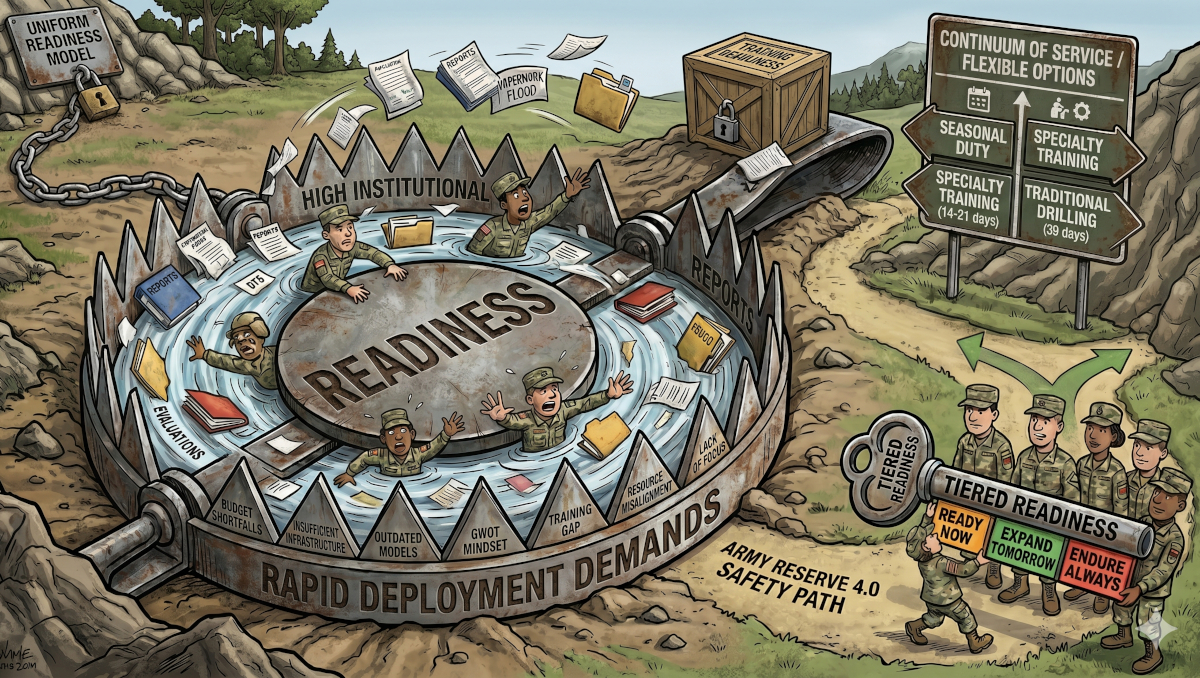
To meet the demands of modern, high-intensity warfare, the U.S. Army Reserve must remake itself –“Army Reserve 4.0”– is the finding of an Army War College integrated research project. Steve Trynosky discussed this study with authors Kiona Pritchard, Brandon Collins, and Colleen Vermeulen. They found the Army Reserve is in a “readiness trap” caused by spreading insufficient infrastructure and budget across too many formations. To address this, the team proposes a tiered readiness model: “Ready Now” for immediate response, “Expand Tomorrow” for operational depth, and “Endure Always” for a long-term strategic reserve. Beyond structural changes, the authors advocate for a “unified culture” through increased cross-pollination, such as embedding Reserve officers in active-duty units and vice versa. By offering flexible service options tailored to diverse civilian lifestyles, the Army Reserve can better retain top talent and remain an indispensable partner to the joint force in future peer conflicts.
One of the things that we see here at the Army War College and out across the broader force—it’s considered okay as an active duty officer to not be familiar with the reserve component. And that’s a problem because the reserve components, plural, make up roughly 50% of the force.
Podcast: Download
Brandon Collins is an Army lieutenant colonel and was commissioned as a Military Intelligence Officer in 2006 from Officer Candidate School and has held an array of assignments in both the Regular Army and Army Reserve, to include, most recently, CJ2X Director for Combined Joint Task Force-OIR in Baghdad, Iraq. LTC Collins holds a Juris Doctor from South Texas College of Law – Houston; a Master’s Degree in Global and International Studies from the University of Kansas, and a Bachelor’s Degree in Communications from Stephen F. Austin State University. He is a member of the AY26 Resident Course at the U.S. Army War College.
Kiona Pritchard is a colonel and an Army Nurse Corps Officer commissioned in 2005 through the Army ROTC Green to Gold Program following several years of active duty enlisted service. She began her career in the Regular Army and later transferred to the Army Reserve becoming a Nurse Practitioner. COL Pritchard has held a variety of command, clinical, and staff assignments, most recently as Commander of the 10th Battalion, 108th Regiment, an Army Reserve instructor unit for medical non-commissioned officer professional military education and enlisted medical MOS qualification courses. Kiona holds a Master of Science in Nursing from the University of Cincinnati and Bachelor of Science in Nursing from the University of Portland. She is a member of the AY26 Resident Course at the U.S. Army War College.
Colleen Vermeulen is a colonel who earned her commission as an Army Engineer Officer from ROTC in 2004. She has held a diverse range of command and staff assignments in both the Regular Army and Army Reserve, to include, Reserve Command Engineer for Special Operations Command South and Commander, 3rd Battalion, 330th Infantry Regiment, a unique Army Reserve unit missioned to deliver Infantry One Station Unit Training. COL Vermeulen holds both a Master of Divinity and Master of Nonprofit Administration from the University of Notre Dame as well as a Bachelor of Arts in Government from Cornell University. She is a member of the AY26 Resident Course at the U.S. Army War College.
Stephen Trynosky is the John Parker Chair of Reserve Component Studies at the U.S. Army War College and earned his commission as a Medical Service Corps Officer from ROTC in 1998. He has held a diverse range of command and staff assignments in both the Regular Army and Army Reserve, to include, most recently, Senior Advisor, Professional Military Education, Office of the Secretary of War; and Commander, 993rd Medical Detachment (Veterinary Service Support). COL Trynosky holds both Juris Doctor and Master of Public Health degrees from the State University of New York at Buffalo, as well as a Master of Military Art and Science from the U.S. Army School of Advanced Military Studies and a BA in history from Saint Peter’s College. He is a graduate of the AY23 Resident Course at the U.S. Army War College.
The views expressed in this presentation are those of the speakers and do not necessarily reflect those of the U.S. Army War College, U.S. Army, or Department of War.
Photo Credit: Created by Gemini
As to the matters discussed here, are we talking about “integration” here (the word used throughout this podcast)? Or, given this such discussion, could the word “assimilation,” in certain instances, be considered/be substituted instead?
(Example, from the introduction to our podcast above: “Beyond structural changes, the authors advocate for a “unified culture” through increased cross-pollination, such as embedding Reserve officers in active-duty units and vice versa.”)
Thank you for this exceptionally important discussion and conversation. Knowing well one of the conversation partners (COL Colleen Reiss Vermeulen), I cannot but help to believe I have had undo influence on her perspectives here. I constructed a much more agressive argument in 2019 (just after retirement) based on the context at that time:. Sadly the journal I submitted to wasw reluctant to publish. That said, it is a perennial point of challenge and I am glad to see that it is now gotten deeper research and attention. We need “one Army” to truely be “one Army” in order to be a full joint partner for the good of our national defense. Bravo for the War College to push this into the limelight. Thanks for all of yor efforts.
I dont think the USAR needs to integrate AC and AGR, we need to simply get rid of the AGR program and all its overhead and staffing issues and make all those positions a rotation for an AC Soldier. We would get better trained full time staff and not have the manning issues at the Supply Sergeant and similar level positions and would also get cadre in who already have all of their schooling vs having to lose that Soldier for months and months to schooling. Plus, it would get rid of the systemic problem (the USAR’s dirty little secret) that we have of getting AGR Soldiers to actually come to work. Yes, we have a lot of great AGRs, but it would shock the world to know how many issues we have in outlying units of AGRs basically working part-time and some times not showing up at all.