By the standard army scorecard, I had just presided over a failure.
In the summer of 2023, I ordered the soldiers of the 528th Field Hospital at Fort Liberty, North Carolina to take apart the thing we existed to provide. I commanded the 528th Field Hospital, the largest field hospital in the army, a facility that can scale to 148 beds, six operating tables, a surgical menu running from orthopedics to oral surgery, pharmacy, radiology, and significant intensive and intermediate care convalescence. My guidance was deliberately sparse: “Shrink it to fit in four containers…design the rest yourselves.”
What came back was twelve beds, forty soldiers, and four tents, less than a tenth of the beds the field hospital had available, all packaged to move. Then we tested what they built three times, with three different teams, while supporting 2nd Brigade, 82nd Airborne, during a two-week training exercise. We timed ourselves setting up, sustaining patients, tearing down, and moving.
The results were humbling. Only one of three teams hit the six-hour setup standard the soldiers had established. Our operating room could not meet sterility requirements. We had no reliable blood supply, our security depended on a combat brigade that could be pulled away at any moment, and at one point we were so short of providers that nurses stepped into multiple roles.
By the standard army scorecard, I had just presided over a failure. However, I would argue I presided over exactly the opposite, and the reason why says more about how the army should innovate than about how it should build hospitals.
The Hospital Is Fine. The Battlefield Moved.
For the last two decades, American battlefield medicine operated from a position of luxury. Air superiority, mature evacuation networks, and secure rear areas meant a wounded soldier could usually reach a surgeon within the “golden hour,” and that standard measurably cut combat mortality. The field hospital I commanded was built for that world: comprehensive, self-sufficient and superb, provided it can sit still, be resupplied, and stay protected.
A war against a peer adversary revokes every one of those assumptions. Contested airspace grounds medical evacuation, and long-range fires turn a large, fixed medical infrastructure into a target rather than a sanctuary. Casualty volumes could exceed anything in living memory, while the helicopters that would move those casualties rearward may not fly. The lesson emerging from Ukraine is blunt: prolonged casualty care far forward, under fire, without assured evacuation, is becoming the norm rather than the exception.
So, the question that kept me up at night as a commander was not whether the hospital was good. It demonstrably was. The question was whether it was positioned to be relevant in the fight soldiers would actually face, and how I, sitting inside a large organization with no acquisition authority and no crystal ball, could do anything about it.
The answer was a mobile, light, flexible package: a deliberately stripped-down hospital meant to push credible surgical and critical care close to the point of injury and keep it moving…constantly. The concept remains unproven. The way it was tested is the part worth stealing.
Innovating Like an Entrepreneur, Not a Program Office
The military’s default approach to new capability is what entrepreneurship scholars call causal logic: define the desired end state, write the requirement, and resource backward toward it over years of analysis and acquisition. That logic works when the future is predictable. It is brittle when it is not and slow either way. The Government Accountability Office reports that major defense programs take almost 12 years to deliver even an initial capability. Although that figure looks to be decreasing, the future battlefield will not wait that long.
There is an alternative, drawn from research on how expert entrepreneurs actually behave under genuine uncertainty. The approach, called effectuation, inverts the sequence. Start with the means already in hand such as the people, equipment, and knowledge you have today, and ask what can be built now. Commit only what you can afford to lose, which permits bold experimentation precisely because the downside is bounded. Treat every setback not as a verdict but as the specification for the next iteration. And rather than forecasting the future, act to create it.
I didn’t set out to run a textbook effectual experiment, but in hindsight that is what we did. We spent no acquisition dollars and waited for no requirements document. We reconfigured equipment and people we already owned. I bounded the bet at three iterations, an affordable loss even if all three flopped. And critically, I gave intent and constraints rather than a design: four containers, keep it mobile, it must operate like a hospital (Emergency, Surgical, Convalescence, Pharmacy, Radiology). The soldiers did the rest.
The difference between the two logics matters most when the results come in. A requirements process sees a list of deficiencies to adjudicate. An experiment sees its next set of specifications. The second list is the one worth reading. The setup overrun traced not to the design but to badly packed containers, a training and load-plan problem, that rehearsal and a published standard can close. Midway through the experiment, the soldiers concluded that two well-packed containers could do the work of four, trading some barrier protection for faster displacement, an optimization no one at the top would have directed. The operating room’s sterility gap turned out to be a single-component problem with a named fix: swap a general container for a purpose-built surgical container (which the unit owned).
Even the findings that worried me most changed character. Before the experiment, “can we sustain casualties forward when evacuation fails?” was a reasonable argument. Afterward it was a list of requirements someone can be told to meet: a walking blood bank or forward blood storage sized to meet demands; and security and resupply written into orders rather than borrowed from organizations with competing missions. Neither is solved, but a vague doubt cannot be assigned, costed, or tested. A specification can.
The change of command is often where innovation goes to die.
Meanwhile, the central hypothesis held: The package proved genuinely agile, and those twelve beds sustained critically injured patients for up to seven days while the hospital kept moving. That figure needs validation under harsher conditions, but it speaks directly to a battlefield where evacuation cannot be assumed. Twelve beds held forward for a week is a different proposition than 148 beds waiting where a casualty may never reach them, and three exercises with no new procurement bought knowledge faster than a decade of analysis could have.
The Experiment Outlived the Commander
The change of command is often where innovation goes to die. A successor inherits a project with someone else’s name on it, no funding line, and a full training calendar. When a commander leaves, the expectation is that the package leaves as well. This didn’t happen, and the reasons matter more than the concept does. Because the package was built from equipment the unit already owned, continuing it required no one’s permission. Because the iterations were documented rather than merely completed, the successor inherited a baseline instead of a war story. And because shrinking the footprint had forced the unit to work with partners it never needed before, it had relationships to build on. The result: innovation continued unlike anything that could have been imagined.
Two follow-on experiments became a focus. The first envisioned the package afloat. A hospital that fits in four containers can be set up on an Army vessel, which matters in the Pacific, where the acres needed for a doctrinal hospital are scarce or non-existent where casualties are generated. The second moved the hospital indoors, into buildings of opportunity, the approach both sides have adopted in Ukraine, where persistent surveillance and strikes are present.
A first iteration’s job is not to produce the answer. It is to leave behind a unit that keeps asking better questions after the commander who started it is gone. It converts a contested assumption (that real hospital care can be pushed this far forward) into a concrete development path.
The Real Risk Is Grading This Pass/Fail
Having since traded command for a faculty office at the U.S. Army War College, I can see the danger facing this concept more clearly than I could from inside it. It is not from any of the technical shortfalls. It is the institutional reflex to grade an experiment against doctrinal standards and stop there. By that rubric, the mobile, light, flexible package “fails” the standard for theater hospitalization on multiple axes, and a conventional review could end the concept with a memo.
That would be the wrong lesson twice over. First, the demand signal is not going away: the next fight will require forward care whether or not the army fields a concept to provide it. Second, and more broadly, killing a cheap, instrumented, deliberately bounded experiment for failing on its first iteration teaches every commander and soldier in the army exactly one thing: don’t experiment!
The disciplined question is not “what is the experiment missing?” It is “what is the minimum capability that preserves credible damage-control surgery and critical-care sustainment while remaining genuinely mobile?” The data suggests the answer is narrower than doctrine assumes, and the binding constraints are surgical sterility, blood, and committed security and logistics, not bed count or specialty breadth. Restoring every hospital capability we “lacked” would simply rebuild the original field hospital and forfeit the forward reach that justified the effort in the first place.
What should happen next is equally clear. Treat the concept as a development program, not a fielding decision. Saying plainly that it is not ready protects both patients and the concept’s credibility. Fund the next iterations under progressively harder conditions: increased simulated casualty loads, contested communications, displacement under more extreme time pressure. Convert the borrowed dependencies into committed ones, so security and resupply are designed in rather than requested ad hoc, and capture what soldiers learned in a transferable training package, because innovations cross from enthusiasts to the wider force on the strength of evidence and repetition, not enthusiasm.
The deeper point extends well beyond medicine, and it is the one I now teach. Across the army, the capabilities that will matter most in the next war are being debated under conditions of irreducible uncertainty about adversaries, technology, and the character of the fight itself. Institutions facing that kind of uncertainty have two options. They can forecast and resource toward a future they cannot actually see, or they can run cheap, fast, bounded experiments that let the future reveal itself one iteration at a time. Any commander can choose the second path. All it takes is intent, four containers, and the willingness to be wrong in public!
The innovating unit’s real task, once the first experiment works, is to convert evidence into sponsorship. A first iteration runs on means at hand. The iterations beyond need money. The gap between these iterations is where unit level innovation dies. Document the experiment rather than simply completing it, because data survives a change of command more than war stories. Nest the next iteration inside a scheduled exercise that is already funded. Find a sponsor who owns requirements and dollars while the results are still fresh, because the window between a promising experiment and institutional indifference is measured in days and months. It is not fun work, but it is the difference between a concept and an anecdote.
Four containers, twelve beds, forty soldiers, three tries. Judged as a finished product, the experiment falls short. Judged as innovation, it succeeded at the only thing a first iteration can: it turned an argument into a development path, then handed that path to soldiers who created opportunities to test it at sea, took it indoors, and continued to innovate. The next war will reward the medical force…and the army…that creates its future rather than waits to be told what it is.
Clayton Manning is an Assistant Professor in the Department of Command Leadership and Management at the United States Army War College and an operational psychologist with over 20 years of experience advising senior leaders in complex, high-consequence environments. He has designed, led, and evaluated leader assessment and selection programs within some of the military’s most demanding organizations, while also serving in executive leadership roles, including as a hospital commander and chief of operations for a directorate of psychological applications. He commanded the 528th Field Hospital, 16th Hospital Center, 44th Medical Brigade, from 2022 to 2024.
The views expressed in this article are those of the author and do not necessarily reflect those of the U.S. Army War College, the U.S. Army, or the Department of War.
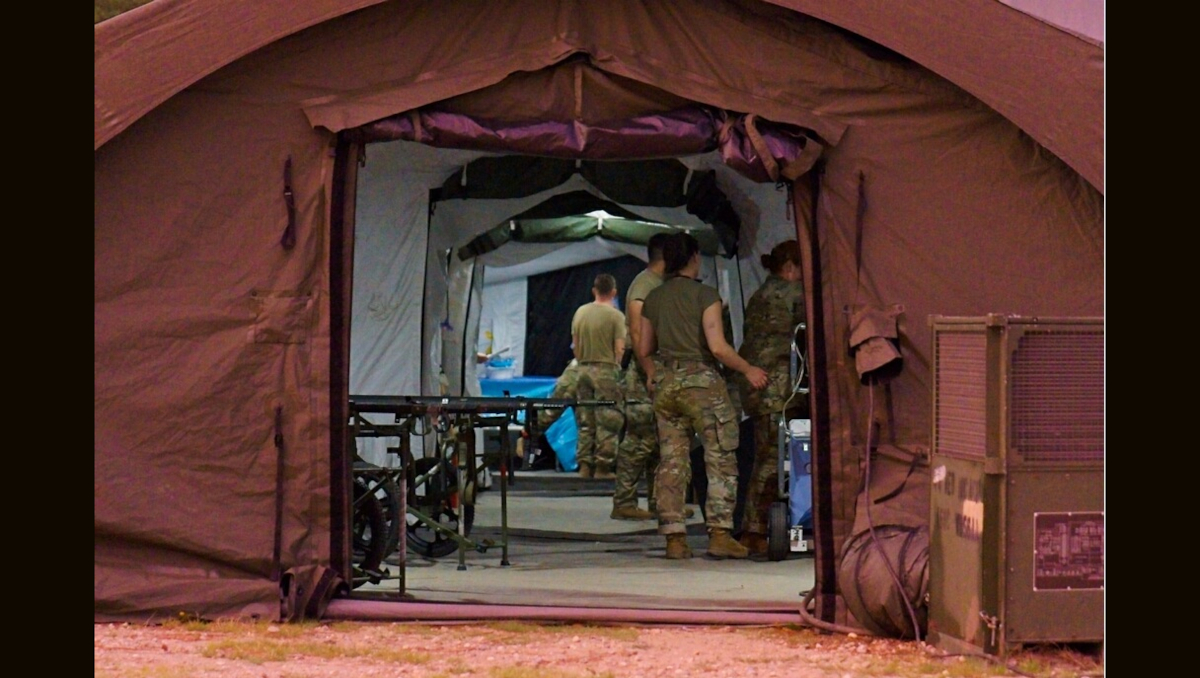
Photo Description: Medical personnel move through the Emergency Medical Treatment (EMT) and Medical Care Unit (ICU/ICW) sections of the 528th Field Hospital’s Mobile, Light, Flexible (MLF) package during an operational experiment at Fort Liberty, North Carolina, in August 2023.
Photo Credit: Photo by Clayton T. Manning.